You could hardly have two more different books on behavioral economics, both by important contributors to the field. Chater and Loewenstein regret their part in what they feel has turned into a scam, while Thaler and Imas celebrate how it has gone from victory to victory.
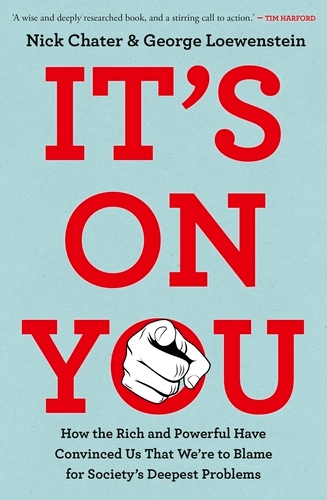
It's On You. How they rig the rules and we get the blame for society's problems
by
Nick Chater and George Loewenstein
"Two decades ago, behavioral economics burst from academia to the halls of power, on both sides of the Atlantic, with the promise that correcting individual biases could help transform society. The hope was that governments could deploy a new approach to addressing society’s deepest challenges, from inadequate retirement planning to climate change—gently, but cleverly, nudging people to make choices for their own good and the good of the planet.
"It was all very convenient, and false. As behavioral scientists Nick Chater and George Loewenstein show in It’s On You, nudges rarely work, and divert us from policies that do. For example, being nudged to switch to green energy doesn’t cut carbon, and it distracts from the real challenge of building a low-carbon economy.
"It’s on You shows how the rich and powerful have repeatedly used a clever sleight of hand: blaming individuals for social problems, with behavioral economics an unwitting accomplice, while lobbying against the systemic changes that could actually help. As two original proponents of the nudge principle, Nick and George now argue that rather than trying to “fix” the victims of bad policies, real progress requires rewriting the social and economic rulebook for the common good."
######
The Winner's Curse: Behavioral Economics Anomalies, Then and Now
by Richard H. Thaler and Alex Imas
"Nobel Prize winner Richard H. Thaler and rising star economist Alex O. Imas explore the past, present, and cutting-edge future in behavioral economics in The Winner’s Curse.
"Why do people cooperate with one another when they have no obvious motivation to do so? Why do we hold on to possessions of little value? And why is the winner of an auction so often disappointed?
"Over thirty years ago, Richard H. Thaler introduced readers to behavioral economics in his seminal Anomalies column, written with collaborators including Daniel Kahneman and Amos Tversky. These provocative articles challenged the fundamental idea at the heart of economics that people are selfish, rational optimizers, and provided the foundation for what became behavioral economics. That was then.
"Now, three decades later, Thaler has teamed up with economist Alex O. Imas to write a new book with an original and creative format. Each chapter starts with an original Anomaly, retaining the spirit of its time stamp. Then, shifting to the present, the authors provide updates to each, asking how the original findings have held up and how the field has evolved since then.
"It turns out that the original findings not only hold up well, but they show up almost everywhere. Anomalies pop up in people’s decisions to save for retirement and how they carry outstanding credit card debt. Even experts fail to optimize. The key concept of loss aversion explains missed putts by PGA pros and the selection of which stocks to sell by portfolio managers. In this era of meme stocks and Dogecoin, it is hard to defend the view that financial markets are highly efficient. The good news, however, is that the anomalies have gotten funnier."


 Posts
Posts


No comments:
Post a Comment