Showing posts with label students. Show all posts

Sunday, October 12, 2025

John Gurdon (1933-2025)

One hope for a future free of the need for human organ transplants is that it might become possible to re-initiate the process by which embryos originally grow their own kidneys from stem cells, i.e. from cells that are "pluripotent,"  in that they retain the possibility  of growing into any of the organs with which we humans come originally equipped.

Great progress is being made in that direction, although  obviating the need for transplants is still only a distant hope.   I had the good fortune to meet two of the pioneers of those efforts, in Stockholm in 2012, when that year's Nobel Prize in Physiology or Medicine was awarded jointly to Sir John B. Gurdon and Shinya Yamanaka "for the discovery that mature cells can be reprogrammed to become pluripotent"  

John has now died, at the age of 92.  I hope he  derived great satisfaction from the fact that his pioneering work is continuing to lead to steady progress.

 Here's his obituary from the Guardian, which contains an anecdote that I recall he shared in Stockholm. His story should give comfort to students unappreciated by teachers who don't realize that students retain a good deal of pluripotency regarding what kind of adults and scholars they will become.

 Sir John Gurdon obituary. Biologist who won the Nobel prize for discovering that adult cells can be reprogrammed.  byGeorgina Ferry

 " His career narrowly missed being driven off course by a report from his biology teacher, placing him last in his year and dismissing his idea of becoming a scientist as a “sheer waste of time, both on his part, and of those who have to teach him.”

Sunday, October 5, 2025

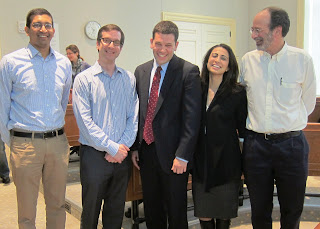
Grace Guan defends her dissertation at Stanford

 Grace Guan defended her Ph.D. dissertation this past Friday.

Welcome to the club, Grace. 


 Here's my earlier post about one of the papers she spoke about--for extra credit, see if you can identify four of her coauthors in the above post-defense photo:

Friday, May 23, 2025  Deceased organ allocation: deciding early when to move fast


Wednesday, April 30, 2025

New/old paper, finally published, sadly still relevant: Kessler & Roth in AEJ:Policy

 Here's a paper, just published this week, which reports (now among other things) a field-in-the-lab experiment begun in August 2010 (when my coauthor Judd was just a kid--see photo below:-)  It was motivated by the shortage in organ transplants that has only grown since that time, because the growth in transplants hasn't kept pace with the growth in kidney disease.

Increasing Organ Donor Registration as a Means to Increase Transplantation: An Experiment with Actual Organ Donor Registrations  by Judd B. Kessler and Alvin E. Roth, American Economic Journal: Economic Policy vol. 17, no. 2, May 2025 (pp. 60–83) 

Abstract: The United States has a severe shortage of organs for transplant. Recently—inspired by research based on hypothetical choices—jurisdictions have tried to increase organ donor registrations by changing how the registration question is asked. We evaluate these changes with a novel "field-in-the-lab" experiment, in which subjects change their real organ donor status, and with new donor registration data collected from US states. A "yes/no" frame is not more effective than an "opt-in" frame, contradicting conclusions based on hypothetical choices, but other question wording can matter, and asking individuals to reconsider their donor status increases registrations.

#######

Earlier:

Monday, July 22, 2024 Don't take "No" for an answer in deceased organ donor registration (a paper forthcoming after ten+ years)


Tuesday, September 2, 2014 Don't take "No" for an answer: a reconsideration of how to do deceased donor registration


Wednesday, May 11, 2011 Pro-social behavior of all kinds: Judd Kessler


Tuesday, April 29, 2025

Mitch Watt defends his thesis

 Mitch Watt defends his thesis: Welcome to the club, Mitch.


Thursday, January 23, 2025

Inputs to academic productivity, Part 2: Dissertation advisors (by Angrist and Diederichs)

  A new NBER working paper by Josh Angrist and Marc Diederichs looks at Ph.D. graduates of top Economics departments since 1994. The goal of the paper is to understand the advisor-student relationship, as part of the production function of producing top economists.  In an appendix (i.e. not the main point of the paper) they produce a long table ranking effective advisors, as measured by the success of their students.  I'm charmed to find that, through the magic of econometrics, they ranked me first.

A big part of my delight is that there are teachers up and down my family tree.  My parents, who were both high school teachers, would have been glad to see the table (and my mom would have believed in its accuracy and robustness to alternative specifications:)

 So, before I say more about the paper, here's the first page of their table (Table A2, p48-53, listing the first 180 advisors):


Now that we've gotten the important part out of the way, here's the paper:

DISSERTATION PATHS: ADVISORS AND STUDENTS IN THE ECONOMICS RESEARCH PRODUCTION FUNCTION by Joshua Angrist and Marc Diederichs, NBER Working Paper 33281, http://www.nber.org/papers/w33281 

Abstract: "Elite economics PhD programs aim to train graduate students for a lifetime of academic research. This paper asks how advising affects graduate students’ post-PhD research productivity. Advising is highly concentrated: at the eight highly-selective schools in our study, a minority of advisors do most of the advising work. We quantify advisor attributes such as an advisor’s own research output and aspects of the advising relationship like coauthoring and research field affinity that might contribute to student research success. Students advised by research-active, prolific advisors tend to publish more, while coauthoring has no effect. Student-advisor research affinity also predicts student success. But a school-level aggregate production function provides much weaker evidence of causal effects, suggesting that successful advisors attract students likely to succeed–without necessarily boosting their students’ chances of success. Evidence for causal effects is strongest for a measure of advisors’ own research output. Aggregate student research output appears to scale linearly with graduate student enrollment, with no evidence of negative class-size effects. An analysis of gender differences in research output shows male and female graduate students to be equally productive in the first few years post-PhD, but female productivity peaks sooner than male productivity. "

" Why do so few highly-selected elite program graduates follow the path to research success taken by their extraordinarily successful advisors? What aspects of economics advisee training might be
changed or enhanced so as to boost graduate student success and total research output?
These questions motivate our study of the economics PhD education production function at elite universities. The principal production inputs in this function are the faculty who teach and advise graduate students, along with aspects of the advising relationship that faculty and students develop together."

#######

Yesterday's post: Wednesday, January 22, 2025  Inputs to academic productivity, Part 1: Socioeconomic background (by Abramitzky et al.)

Another thought about Ph.D.s (and deciding whether to get one): Thursday, September 12, 2024 Should you get a Ph.D.?

and here are all my blog posts on students.