Showing posts with label market design. Show all posts

Saturday, November 15, 2025

Judd Kessler: the most helpful advice I ever got (YouTube short video)

 I was charmed by this very short video featuring Judd Kessler (and I'm very grateful to whoever gave him that advice):


https://youtube.com/shorts/zBTlYwvYE2M?si=q6_vRIflWvAmMDYb 


You can see his new book, Lucky By Design in the background 

“Lucky by Design is that rarest of things: an economics PAGE-TURNER.” —Lin-Manuel Miranda 

Friday, October 31, 2025

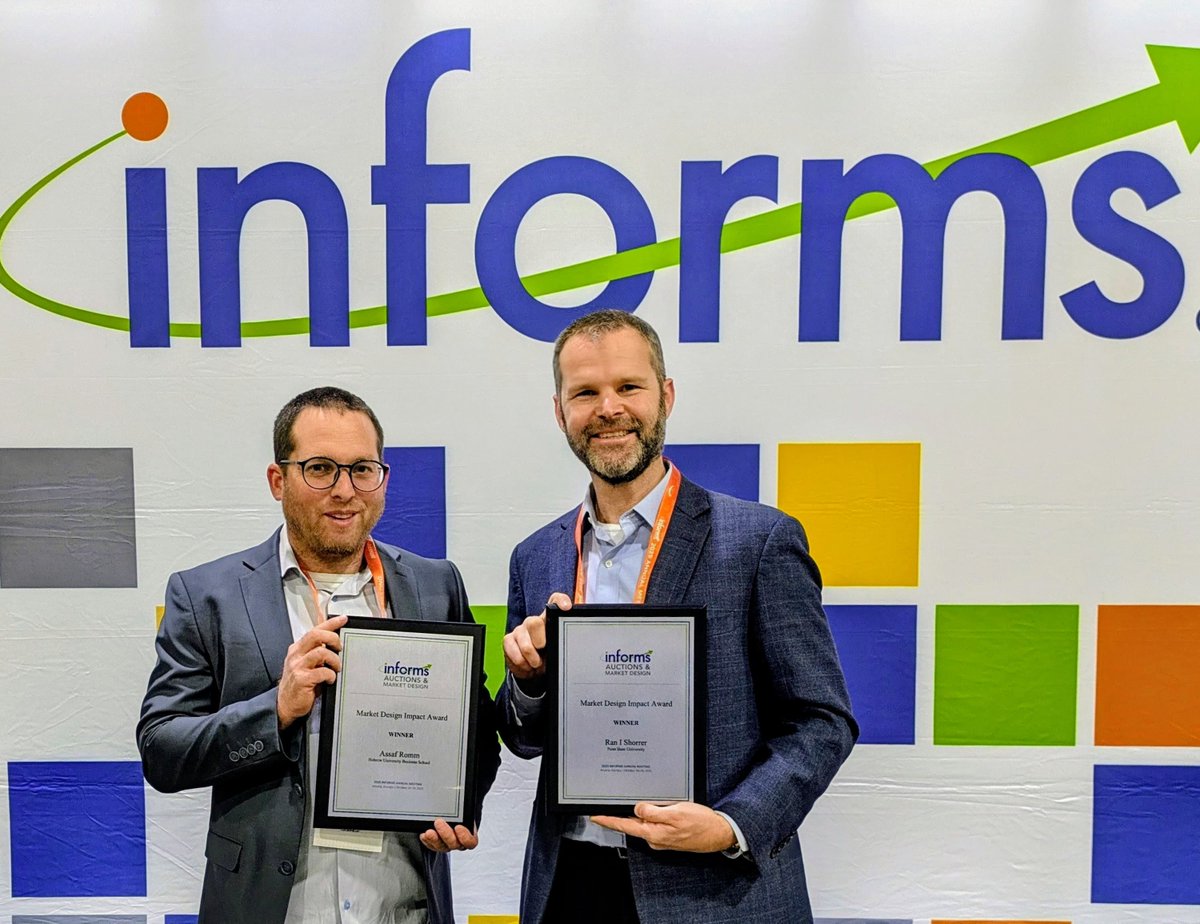
Market Design Impact Award to Hassidim, Romm, and Shorrer

 The Hebrew University breaks the news with this congratulatory message:

"Congratulations to our very own Assaf Romm  and coauthors! 🎉Assaf, along with Avinatan Hassidim and Ran Shorrer , has been awarded the inaugural INFORMS Auctions and Market Design (AMD) Market Design Impact Award- recognizing major contributions in market design over the past 15 years.
Their groundbreaking work has transformed both theory and practice, from redesigning Israel’s Psychology Master’s admissions and Pre-Military Academy programs to improving the medical internship match, impacting thousands of lives. Beyond implementation, their research revealed how real-world behavior can differ from theoretical predictions, helping to pioneer the field of behavioral market design.
Through innovative design, rigorous theory, and a deep understanding of human behavior, Assaf and his coauthors have shown how market design can address pressing social needs while advancing the field.
👏 Remarkable achievement! "


Two men in suits stand side by side holding framed award plaques with text reading INFORMS AMD Market Design Impact Award for Ran Shorrer and Assaf Romm in front of a large blue and green INFORMS logo on a gray background with colorful geometric squares 


I expect that a full(er) account will soon be given on the INFORMS  Market Design Impact Award  page 

Thursday, October 16, 2025

Experiments and behavioral market design at Pitt (tomorrow)

 I'm flying  back to my old haunts in Pittsburgh today, for (among other things) two events at the University of Pittsburgh tomorrow:

 October 17, 2025 PEEL Reopening Ceremony with Professor Vesterlund & Professor Roth

"The History of PEEL: The Pittsburgh Experimental Economics Laboratory (PEEL) was founded by John Kagel and Alvin Roth, a Nobel Laureate in Economics. Since its inception, PEEL has served as a hub for pioneering research in experimental economics. Notably, the lab contributed to foundational work on market design, which played a significant role in Roth’s Nobel Prize-winning contributions. Over the decades, PEEL has maintained its reputation as a center of excellence, attracting top scholars and fostering innovation in economic research. +


October 17, 2025 BEDI Workshop (Behavioral Economics and Design Initiative)

BEDI Workshop - Friday, October 17th, 2025

Breakfast | 8:15 am – 8:45 am
Wesley W. Posvar Hall, 4130, 230 S Bouquet St, Pittsburgh, PA 15213 


Conference Welcome | 8:45 am – 9:00 am
Lise Vesterlund, BEDI Director, Andrew W. Mellon Professor, University of Pittsburgh


Session 1 | 9:00 am – 10:40 am
Erina Ytsma– Assistant Professor, Carnegie Mellon University, “Gender Differences in the
Response to Incentives: Evidence from Academia”
Stephanie Wang – Professor, University of Pittsburgh
Claire Duquennois – Assistant Professor, University of Pittsburgh, “Minority athletic performance,
racial attitudes, and racial hate”
Jonathan Woon – Professor & Associate Dean, University of Pittsburgh, “The Epistemology of
Justice: Awareness and Institutional Choice”

Refreshment Break | 10:40 am – 11:10 am

Session 2 | 11:10 am – 12:00 pm
Jenny Chang – Graduate Student, Carnegie Mellon University, “When Women Self-Promote:
Evidence on Beliefs and Downstream Consequences”
Aden Halpern – Graduate Student, University of Pittsburgh 

Brandon Williams – Graduate Student, University of Pittsburgh
Dhwani Yagnaraman – Graduate Student, Carnegie Mellon University, “Crowd-in and crowd-out of
climate policies”
Aaron Balleisen– Graduate Student, Carnegie Mellon University, “Cheap Talk and Pluralistic
Ignorance”

Lunch | 12:00 am – 1:15 pm

Session 3 | 1:15 pm – 2:30 pm
Osea Giuntella – Associate Professor, University of Pittsburgh, “Beliefs, Resilience, and Leadership: Evaluating Trauma-Informed Training”
John Conlon – Assistant Professor, Carnegie Mellon University, “Memory Rehearsal and Belief Biases”
Alex Chan – Professor, Harvard University, “Preference for Explainable AI”


PEEL Re-Opening + Refreshment Break | 2:30 pm to 3:30 pm

Session 4 | 3:30 pm – 4:45 pm
Alistair Wilson – Professor, University of Pittsburgh, “Veto Delegation: A Mechanism that works! (Kinda)”
Yucheng Liang – Assistant Professor, Carnegie Mellon University, “Asking the Right Questions: Information Acquisition for Choices under Risk”
Muriel Niederle - Professor, Stanford University


Friday, September 19, 2025

Stanford celebrates 100 years of GSB

 GSB at 100: A Century of Impact, by Michael McDowell  interviews leading faculty members including

"Susan Athey: The GSB has had so many impacts, but let me just pick one particular issue that’s close to my heart, which is that it’s been several times in its history, it’s really been on the frontier of important ideas. One of the big ideas in the group that I’m in was market design and the use of formal strategic thinking and game theory and information economics to understand real phenomena. And Bob Wilson, who’s one of the grandfathers of the group that I sit in, Economics, he worked with oil companies in 1960s and looked at their bidding data and then developed formal theories that helped understand what was going wrong in those markets and how to fix it. And then later, he advised one of my advisors, Paul Milgrom, and they shared the Nobel Prize for some of their work on market design.

"And so, there’s many different takes on that, but one of my takes was that there was the connection to the world and the fact that the problem they were solving was coming out of a real problem leading to cutting edge theory that then created a field that didn’t exist. More recently, we were on the cutting edge of using machine learning for decision problems and what’s called causal inference, formally, and now Stanford is the best place in the world to do this kind of research. To go from zero in 2012 to best in the world with multiple amazing young scholars doing cutting edge research in 12 years is really stunning. And the GSB really supported us in that endeavor.

"So I think the GSB has been a really fabulous place for helping us stay grounded and really connected to real problems, but also allowing us to hire the kind of talent and giving us the space to do the pure research that doesn’t just solve today’s practical problems, but that actually builds the foundation for many people to solve applied problems."

Saturday, September 13, 2025

Kidney exchange in Operations Research (and elsewhere)

 Kidney exchange is an important medical innovation that has given rise to literatures not only in medicine but in economics, computer science and operations research. (That diversity of literatures is related to the interdisciplinary growth of market design.)

Here's a new survey of the OR literature on kidney exchange.

Mathijs Barkel, Rachael Colley, Maxence Delorme, David Manlove, William Pettersson, Operational research approaches and mathematical models for kidney exchange: A literature survey and empirical evaluation,  European Journal of Operational Research, 2025, ISSN 0377-2217, https://doi.org/10.1016/j.ejor.2025.08.059.


Abstract: Kidney exchange is a transplant modality that has provided new opportunities for living kidney donation in many countries around the world since 1991. It has been extensively studied from an Operational Research (OR) perspective since 2004. This article provides a comprehensive literature survey on OR approaches to fundamental computational problems associated with kidney exchange over the last two decades. We also summarise the key integer linear programming (ILP) models for kidney exchange, showing how to model optimisation problems involving only cycles and chains separately. This allows new combined ILP models, not previously presented, to be obtained by amalgamating cycle and chain models. We present a comprehensive empirical evaluation involving all combined models from this paper in addition to bespoke software packages from the literature involving advanced techniques. This focuses primarily on computation times for 49 methods applied to 4320 problem instances of varying sizes that reflect the characteristics of real kidney exchange datasets, corresponding to over 200,000 algorithm executions. We have made our implementations of all cycle and chain models described in this paper, together with all instances used for the experiments, and a web application to visualise our experimental results, publicly available.
Keywords: Combinatorial Optimisation; OR in health services; Kidney paired donation; Cycle packing; Computational experiments


Wednesday, August 20, 2025

Market design podcast on NPR's Planet Money (with Alex Teytelboym)

 Alex Teytelboym comments throughout a program about market design on NPR's Planet Money:


 The episode focuses on the design of markets regulated by governments, and  touch on the regulation of fisheries, and on the spectrum incentive auction (about which they interviewed Glen Weyl instead of Paul Milgrom).

##########

Earlier related posts:

Monday, February 16, 2009  Sustainable fisheries

Sunday, January 30, 2011  Fishing as an endangered but protected transaction

Tuesday, July 24, 2018  Design of fisheries--EURO Excellence in Practice Award to Bichler, Ferrell, Fux, and Goeree

Friday, July 9, 2021 Fishery regulation involves onboard observers at sea--a very dangerous job

 ##########

 Monday, March 9, 2020 Paul Milgrom et al. on the incentive auction--two recent papers, and two pictures

 Monday, June 15, 2020  Paul Milgrom corrects the record on spectrum auctions and market design


Monday, August 11, 2025

Lucky by Design: The Hidden Economics You Need to Get More of What You Want, by Judd Kessler

 Here's a great new book about how to navigate markets, by Judd Kessler, who knows his way around.


Lucky by Design: The Hidden Economics You Need to Get More of What You Want
– forthcoming,  October 14, 2025  by Judd Kessler 

"What’s the secret to scoring a reservation at a hot new restaurant? When should you enter a lottery to increase your odds of winning? Why did your neighbor’s kid get into a nearby preschool while yours didn’t? Who gets priority for a life-saving organ donation?

These outcomes are not a matter of luck. Instead, they depend on how we navigate hidden markets that arise to decide who gets what when many of us want something and there isn’t enough to go around. Every day we play in these markets, yet few of us fully understand how they work.

In familiar markets, what we get depends on how much we’re willing to pay. Hidden markets do not rely on prices: you can’t buy your way in to a better position. Instead, what you receive hinges on the rules by which the market operates, and the choices you make in them.

Judd Kessler has spent a career studying and designing these very markets. Now, he reveals the secrets of how they work, and how to maneuver in them. Whether you want to snag a coveted ticket, secure a spot in an oversubscribed college course, get better matches in the dating and job markets, do your fair share of the household chores (but no more), or more efficiently allocate your time and attention, this must-read guide will show you how to get Lucky by Design."

#####

Market design advice: pre-order now to be the first on your block, and to help the book.

Thursday, July 24, 2025

INFORMS celebrates Yash Kanoria

Last month, INFORMS' Division of Manufacturing and Service Operations Management awarded Yash Kanoria  the 2025  MSOM Young Scholar Prize.

Here's a slide from the prize announcement (shared with me by Omar Besbes).


Here are two papers of his that I admire:

Ashlagi, Itai, Yashodhan Kanoria, and Jacob D. Leshno, (2017). “Unbalanced Random Matching Markets: The Stark Effect of Competition”,  Journal of Political Economy 125, 1: 69-98. https://www.journals.uchicago.edu/doi/full/10.1086/689869 

  Ashlagi, Itai, Mark Braverman, Yash Kanoria, and Peng Shi, (2020). Clearing matching markets efficiently: informative signals and match recommendations. Management Science66(5), 2163-2193 https://pubsonline.informs.org/doi/abs/10.1287/mnsc.2018.3265


Friday, July 11, 2025

Market design search at WU Vienna's new Department of Business Analytics and Decision Science

 Ben Greiner writes to remind me that "Vienna is a beautiful place to live and work" and that there is a 27 July deadline for the first wave of recruiting for a new department, including two full professor slots for market designers.

" WU Vienna is establishing a new Department of Business Analytics and Decision Sciences, with a research focus on predictive and prescriptive analytics in support of data-informed strategic decision-making. This initiative reflects WU’s commitment to strengthening its academic profile at the intersection of analytics, artificial intelligence, and decision sciences.

As part of the department’s launch, approximately 24 new academic positions will be opened. These include 6 professorships, up to 6 tenure-track positions, 6 postdoctoral positions, and 6 pre-doctoral positions.

First call for professorships in June 2025

The first call launches on June 4, 2025 featuring 4 professorships.

These positions are distinguished by two different methodological orientations, with two different professorships per orientation:

  • The first group focuses on candidates with a methodological focus on machine learning, symbolic or sub-symbolic AI (including deep learning, reinforcement learning, generative AI, and automated decision-making), or modern statistics and economicetrics.

  • The second group focuses on candidates with a methodological focus in simulation, optimization, experimentation, algorithmic game theory, and/or market design.

To learn more about the call and application process, please visit the website for our job offerings.


Thursday, July 10, 2025

Job search for Professor of Market Design: U. Mannheim and ZEW--Leibniz Centre for European Economic Research

Professor Achim Wambach writes with news of a job opening in market design:

Professor of Economics, Market Design (W3)
Department of Economics, University of Mannheim
 

"In a joint appointment process, the Department of Economics at the School of Law and Economics at the University of Mannheim and the ZEW – Leibniz Centre for European Economic Research in Mannheim are looking to fill the position of

Professor of Economics, Market Design (W3).

The job holder will be assigned to the Centre for European Economic Research immediately upon her/his appointment. She/he will remain a member of the department with a reduced teaching obligation of two credit hours per term (so called Jülicher Modell). The position is permanent.

We are looking for an individual who, thanks to her/his outstanding scientific qualifications, will strengthen both institutions' competencies in the analysis of markets and market design. She/he has proven her/his expertise in the game-theoretical analysis of market rules with a particular focus on auction or matching markets. The successful candidate has an affinity to field experiments and applied research.

The job holder will lead the Research Department 'Market Design' at ZEW, conduct research in market design and publish this research in internationally leading academic journals. She/he will also be responsible for third-party fundraising. The successful candidate should have experience in policy-advising, particularly in the practical application of market design. The position requires a distinguished academic record, demonstrated by high-level publications in international economic journals, and ideally experience by leading policy advisory projects. The candidate should also possess the ability to lead larger research teams and to effectively communicate research findings to a broader audience, including policymakers and the general public."

Friday, July 4, 2025

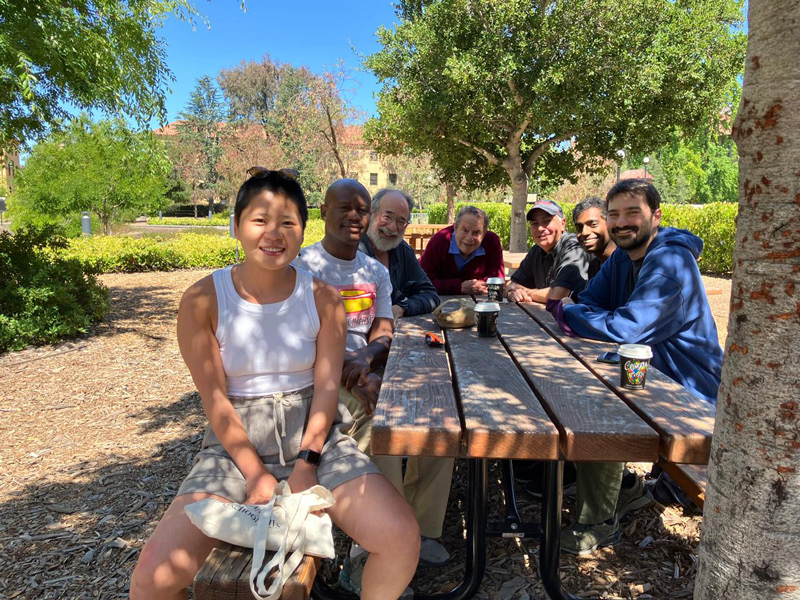
Coffee and science at Stanford

 Julio Elias is welcomed home by the Universidad del CEMA after a great visit to Stanford.

Julio Elías, Director del MAE, fue Tinker Visiting Professor en Stanford University [Julio Elías, Director of the MAE, was Tinker Visiting Professor at Stanford University]

Featured in the story is this photo of Stanford's weekly market design coffee.

Café/Reunión de Market Design junto a Alvin Roth


Wednesday, June 4, 2025

INFORMS Market Design Impact Award: call for nominations

 Here's the call for nominations for a new prize to recognize practical market design.

 Call for Submissions: Market Design Impact Award

The INFORMS Auctions and Market Design (AMD) is happy to announce the Market Design Impact Award. The prize is awarded annually and is intended to recognize major contributions in market design. It may be awarded to one individual or a small team when the research is joint. The award may be given for original research from the last 15 years that has made a lasting impact (directly or indirectly) on the field and/or the practice of market design.

Nomination Procedure

Anyone in the market design community may nominate a candidate. The committee is seeking nominations, which include a nomination letter and two letters of recommendation, highlighting the nominee's accomplishments with emphasis on the criteria for the award. Please send nominations to amdimpactaward@gmail.com by July 30 with the subject "Market Design Submission"

A nomination letter of no more than 1000 words describing the content of the contributions.
Bibliographic data (and links or the papers) as needed.
One-two sentences that describe the contribution.
At least two (and most three)  endorsement letters that describe in at most 500 words the lasting contribution, significance, and impact of the paper(s) and work. The letters should specify the relationship of the endorser to the nominees. The nominator should solicit these letters.
The Award Committee welcomes questions from anyone considering or intending to submit a nomination. The committee may be contacted by email at amdimpactaward@gmail.com.

Committee 2025

Jose Correa, University of Chile

Alvin Roth, Stanford University

David Shmoys, Cornell University

The winner(s) will be recognized at the AMD business meeting of the 2025 INFORMS Annual Meeting. Information on this prize can also be found at the AMD webpage.


Wednesday, May 14, 2025

Matching Theory and Market Design: conference in Sicily.

 Here's the preliminary program for the

20th Matching in Practice Workshop  University of Messina, Department of Economics, Aula Magna 2, 15-16 May 2025

Thursday 15 May

9:00-9:15 Opening

9:15-11:00 Presentation session “Matching with externalities and equity concerns I” 

 Alexander Nesterov, Higher School of Economics  “Reserves in Targeted Admissions: A Mechanism Design Approach” 

 Guillaume Haeringer, Baruch College  “School Choice under Uncertainty: an Experiment” 

Antonio Romero Medina, Universidad Carlos III de Madrid  “Optimizing Daycare Enrollment: How To Avoid Early Applications”

11:00-11:15 Coffee break

11:15-13:00 Presentation session “Dynamic matching and incentives to participation I”

 Duygu Sili, Università degli Studi di Messina  “Costly Multi-Hospital Dynamic Kidney Exchange”

 Subhajit Pramanik, Università degli Studi di Padova  “A Dynamic Bargaining Framework for International Kidney Paired Exchange Program”

 Özgür Yilmaz, Koç University “Dynamically Optimal Kidney Exchange” 

13:00-14:00 Lunch

14:00-15:15 Seminar presented by the 2012 Nobel Prize in Economics Prof. Alvin Roth (Stanford University)  “The Economics of Kidney Exchange: Kidneys and Controversies”  (open to the public)

16:00-22:00 Departure to and walk across Taormina, with gala dinner to follow at Ristorante La Botte.

Friday 16 May

9:00-10:45 Presentation session “Matching with externalities and equity concerns II” 

Flip Klijn, Institute for Economic Analysis (CSIC) and Barcelona School of Economics  “Characterizing No-Trade-Bundled Top-Trading Cycles Mechanisms for Multiple-Type Housing Markets”

 Péter Biró, Institute of Economics, HUN-REN KRTK “Ex-post Stability under Two-Sided Matching: Complexity and Characterization”

 Emre Dogan, HSE University “Incentivizing Public Lawyers and Enhancing Fairness via Sorting in Adversarial Systems”

10:45-11:00 Coffee break

11:00-12:45 Presentation session “Dynamic matching and incentives to participation II”

 Pietro Salmaso, Università degli Studi di Napoli Federico II  “Rationalizable Conjectures in Dynamic Matching”

Johanna Raith, IHW – Leibniz Institute for Economic Research “College Application Choices in a Repeated DA Setting: Evidence from Croatia”

 Sonal Yadav, University of Liverpool “Teacher Redistribution in Public Schools”

12:45-13:40 Roundtable  “Organ-donor exchange programs, international comparison” Moderator Prof. Antonio Nicolò (Università degli Studi di Padova), with the participation of Prof. Alvin Roth (Stanford University) and Dr. Giuseppe Feltrin (National Transplant Center)

13:40-14:30 Farewell lunch.

 The MiP Workshop is an annual meeting organized by the Matching in Practice network of European researchers working in the research field of Matching Theory and Market Design.

This year’s MiP workshop is funded by the following projects: Prin2022 “Externalities and fairness in allocations and contracts” (CUP J53D23004650006 – ID 2022HLPMKN) and PrinPNRR2022 “Incentivizing participation of compatible pairs in Kidney Paired Exchange Programs” (CUP J53D23015460001- ID P2022P5CHH), both funded by the European Union – Next Generation EU.

The Organizing Committee includes the Messina Unit Manager of the aforementioned projects, Prof. Antonio Miralles Asensio, and the Principal Investigators of both funding projects, respectively Prof. Maria Gabriella Graziano (University of Naples Federico II) and Prof. Antonio Nicolò (University of Padua). External members of the Scientific Committee are Prof. Caterina Calsamiglia (IPEG and ICREA, Spain), Prof. Rustam Hakimov (Université de Lausanne, Switzerland) and Prof. Péter Biró (Hungarian Academy of Sciences, Hungary).


Friday, March 21, 2025

Market design comes to the "new new economic sociology" (and vice versa)

 In the Journal of Cultural Economy, sociologists reflect on their involvement with engineers in a project to integrate wind-generated electricity in Denmark.

Ossandón, J., & Pallesen, T. (2025). The new new economic sociology – the market intervention test. Journal of Cultural Economy, 1–21. https://doi.org/10.1080/17530350.2025.2451252 


ABSTRACT: "This paper explores what happens when the ‘new new economic sociology’ – the figure created with Callon’s importation of ANT to the study of markets – intervenes in market interventions. Empirically, the paper examines a situation in which a researcher moves out of her habitual position of studying economists and engineers doing markets, to instead take part in an effort of engineering a market. The paper has two contributions. One is analytical. We propose a framework to inspect that special constrained situation in which the new new economic sociology coexists with market design. The second contribution is more practical. We hope what we propose in this paper, will help others in a similar situation to understand the particular direction of their intervention. "


Saturday, March 8, 2025

Is market design insidious?

 Is market design not just performative, but insidious?  Here's a paper arguing that might be the case.

Nik-Khah, E. (2025). Platforming economics: tech economics, market design, and the transformation of markets. Journal of Economic Methodology, 1–21. https://doi.org/10.1080/1350178X.2025.2470267 

ABSTRACT: Economic methodologists join economists in crediting market designers for taking a pragmatic approach toward improving markets for the common good. Accordingly, the new wave of market design, designated ‘tech economics,’ now accepts responsibility for pursuing efficiency, as well as a myriad of other policy goals. Yet, ambiguity surrounds the targets they hold out for intervention and therefore the justifications they have offered for the continued deployment of their designs. By scrutinizing the theoretical and practical features of these designers’ ‘markets,’ this paper finds that market designers have offered to assist platforms in extending their domains of governance. While this stance has opened up multitudes of design opportunities, the attendant conceptual shift raises questions not only about the activities undertaken by specific tech economists, but more generally about the plausibility of the economist’s professed stance to improve markets for the benefit of all.

Maybe this discussion could benefit from a Bond-style villain?

"The designer’s chief exponent was, of course, Alvin Roth"

###########

This strikes me as a conversation worth having (and I'll be happy to play myself when it is turned into a movie...)


Tuesday, February 25, 2025

Donald Shoup (1938-2025) led the war on (too much) free parking

 Here's his WSJ obit:

Donald Shoup, a Parking Guru Who Reshaped the Urban Landscape, Dies at 86
An economist at UCLA, Shoup said free parking carries a high cost, which is borne by everybod
y, By Jon Mooallem 

“Nothing is more pedestrian than parking,” he often joked. Everyone else is focused on traffic, Shoup told the website Streetsblog. “I thought I could find something useful if I studied what cars do for 95 percent of the time, which is park.”

...

"In the mid-1960s, he was working in Midtown Manhattan while completing a Ph.D. at Yale and suddenly noticed a paradox he couldn’t make sense of as an economist, but which everyone took for granted as human beings. Up and down West 44th Street, “almost all cars were parking for free on some of the most valuable land on earth,” Shoup recalled on the “Curb Enthusiasm” podcast. 

...

“We have expensive housing for people, and free parking for cars! We have our priorities the wrong way around,” Shoup cried out...

 ...

“A surprising amount of traffic isn’t caused by people who are on their way somewhere,” Shoup concluded in a 2007 New York Times opinion column. “Rather, it is caused by those who have already arrived.” 

...

"Shoup’s policy prescriptions were straightforward: Get rid of minimum parking requirements; bring the price of on-street parking in line with demand, enough to maintain one or two empty spots on every block; and funnel the resulting revenue into upkeep and other public services for the immediate area, creating what Shoup called a “parking benefit district,” to bring residents and local businesses on board.

"There were already some successful test cases of these reforms when “The High Cost of Free Parking” was published, most notably in Pasadena, Calif., where reinstalling parking meters was key to revitalizing a historic shopping district. And Shoup considered the proposals in his book so sensible and self-evident that, he later recalled, he naively assumed his vision would immediately become a reality. “I thought the world would change next month,” he told the podcast, “The War on Cars.”

#######

HT: Atila Abduldakiroglu 

Friday, January 31, 2025

The NBER celebrates market design

 From the NBER Reporter:

Working Group Report: Market Design  By Michael Ostrovsky and Parag A. Pathak

Here are the introductory paragraphs (after which the report goes on to survey various areas of market design research).


"The Market Design Working Group, established in 2009 under the leadership of Susan Athey and Parag Pathak, is a preeminent research forum in the field of market design. The working group meets annually, alternating between Cambridge, Massachusetts, and Palo Alto, California, to present research that bridges theoretical economics and practical applications, all focused on what The Economist aptly characterized as “an intelligently designed invisible hand.”1 Research in market design has been celebrated in academic circles, as evidenced by recognitions like the 2012 Nobel Prize for work on matching markets and the 2020 Nobel Prize for auction theory, and has also been instrumental in catalyzing tangible reforms in real-world institutions and markets.

"One feature that sets market design apart from much of traditional economic theory is its unwavering commitment to practical applications. Market designers have developed a unique professional profile, equally at home in university lecture halls, hospital surgery wards, school committee meetings, and the boardrooms of technology companies. This versatility allows them to translate complex economic models and analyses into solutions for real-world problems. The field’s research has informed an impressive range of applications across various sectors of society. "

Friday, January 3, 2025

Sessions that caught my eye in the ASSA program

Economics of Higher Education

Lightning Round Session

 Saturday, Jan. 4, 2025   8:00 AM - 10:00 AM (PST)

 Hilton San Francisco Union Square, Golden Gate 3
Hosted By: American Economic Association
  • Chair: Caroline Hoxby, Stanford University

Cap-and-Apply: Unintended Consequences of College Application Policy in South Korea

Taekyu Eom
, 
SUNY-Buffalo


Do Double Majors Face Less Risk? An Analysis of Human Capital Diversification

Andrew S. Hanks
, 
Ohio State University
Shengjun Jiang
, 
Wuhan University
Xuechao Qian
, 
Stanford University
 
Bo Wang
, 
Nankai University
Bruce A. Weinberg
, 
Ohio State University


Inequality-Aware Market Design

Paper Session

 Sunday, Jan. 5, 2025   10:15 AM - 12:15 PM (PST)

 Hilton San Francisco Union Square, Union Square 1 and 2
Hosted By: Econometric Society
  • Chair: Piotr Dworczak, Northwestern University

Waiting or Paying for Healthcare: Evidence from the Veterans Health Administration

Anna Russo
, 
Massachusetts Institute of Technology
 

Optimal Redistribution via Income Taxation and Market Design

Mohammad Akbarpour
, 
Stanford University
Pawel Doligalski
, 
University of Bristol
Piotr Dworczak
, 
Northwestern University
 
Scott Duke Kominers
, 
Harvard University

Should the Government Sell You Goods? Evidence from the Milk Market in Mexico

Diego Javier Jimenez Hernandez
, 
Chicago Federal Reserve
 
Enrique Seira
, 
Michigan State University

Taxing Externalities without Hurting the Poor

Mallesh M. Pai
, 
Rice University
Philipp Strack
, 
Yale University
 

Discussant(s)
Vasiliki Skreta
, 
University of Texas-Austin and University College London
Dmitry Taubinsky
, 
University of California-Berkeley
Mohammad Akbarpour
, 
Stanford University
Dan Waldinger
, 
New York University


Market Design in College Admissions

Paper Session

 Sunday, Jan. 5, 2025   10:15 AM - 12:15 PM (PST)

 Hilton San Francisco Union Square, Union Square 11
Hosted By: Econometric Society
  • Chair: Evan Riehl, Cornell University

College Application Mistakes and the Design of Information Policies at Scale

Anaïs Fabre
, 
Toulouse School of Economics
Tomas Larroucau
, 
Arizona State University
Christopher Andrew Neilson
, 
Princeton University
Ignacio Rios
, 
University of Texas-Dallas
 

Inequity in Centralized College Admissions with Public and Private Universities: Evidence from Albania

Iris Vrioni
, 
University of Michigan
 

Stakes and Signals: An Empirical Investigation of Muddled Information in Standardized Testing

Germán Reyes
, 
Middlebury College
Evan Riehl
, 
Cornell University
 
Ruqing Xu
, 
Cornell University


Finance and Development

Paper Session

 Sunday, Jan. 5, 2025   1:00 PM - 3:00 PM (PST)

 Hilton San Francisco Union Square, Continental Ballroom 9
Hosted By: American Economic Association
  • Chair: Martin Kanz, World Bank

Default Contagion in Microfinance

Natalia Rigol
, 
Harvard Business School
Ben Roth
, 
Harvard Business School
 

Abstract

Joint liability is one of the hallmarks of microfinance. Though it is intended to reduce non-payment, it has also been hypothesized to lead to default contagion, whereby non-payment by one borrower may reduce the likelihood of repayment by groupmates. Utilizing unexpected deaths, we document significant default contagion in one of Chile's largest microfinance institutions. We estimate that a single default causes an additional 0.8 borrowers to default, indicating that nearly half of observed default is due to contagion. 

Credit Contracts, Business Development, and Gender: Evidence from Uganda

Selim Gulesci
, 
Trinity College Dublin
 
Francesco Loiacono
, 
European Bank for Reconstruction and Development
Miri Stryjan
, 
Aalto University
Andreas Madestam
, 
Stockholm University

Discrimination Expectations in the Credit Market: Survey Evidence from India

Stefano Fiorin
, 
Bocconi University
Joseph Hall
, 
Stanford University
Martin Kanz
, 
World Bank
 

Discussant(s)
Simone Gabrielle Schaner
, 
University of Southern California
Anna Vitali
, 
New York University
Janis Skrastins
, 
Washington University-St. Louis