Showing posts with label behavioral economics. Show all posts

Wednesday, October 22, 2025

Divergent views on behavioral economics: books by Loewenstein and Chater, and Thaler and Imas

 You could hardly have two more different books on behavioral economics, both by important contributors to the field. Chater and Loewenstein regret their part in what they feel has turned into a scam, while Thaler and Imas celebrate how it has gone from victory to victory.

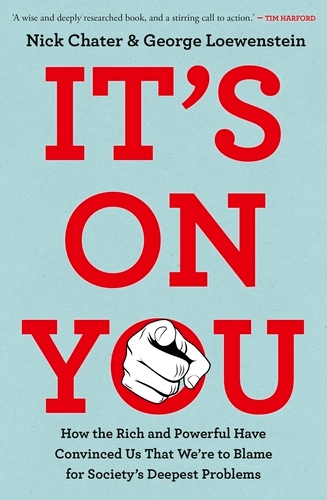
It's On You.  How they rig the rules and we get the blame for society's problems 
by
Nick Chater and George Loewenstein
 

"Two decades ago, behavioral economics burst from academia to the halls of power, on both sides of the Atlantic, with the promise that correcting individual biases could help transform society. The hope was that governments could deploy a new approach to addressing society’s deepest challenges, from inadequate retirement planning to climate change—gently, but cleverly, nudging people to make choices for their own good and the good of the planet.

"It was all very convenient, and false. As behavioral scientists Nick Chater and George Loewenstein show in It’s On You, nudges rarely work, and divert us from policies that do. For example, being nudged to switch to green energy doesn’t cut carbon, and it distracts from the real challenge of building a low-carbon economy.

"It’s on You shows how the rich and powerful have repeatedly used a clever sleight of hand: blaming individuals for social problems, with behavioral economics an unwitting accomplice, while lobbying against the systemic changes that could actually help. As two original proponents of the nudge principle, Nick and George now argue that rather than trying to “fix” the victims of bad policies, real progress requires rewriting the social and economic rulebook for the common good."

Book cover of It's On You by Nick Chater, George Loewenstein 

###### 


The Winner's Curse: Behavioral Economics Anomalies, Then and Now
by Richard H. Thaler  and Alex Imas  

"Nobel Prize winner Richard H. Thaler and rising star economist Alex O. Imas explore the past, present, and cutting-edge future in behavioral economics in The Winner’s Curse.

"Why do people cooperate with one another when they have no obvious motivation to do so? Why do we hold on to possessions of little value? And why is the winner of an auction so often disappointed?

"Over thirty years ago, Richard H. Thaler introduced readers to behavioral economics in his seminal Anomalies column, written with collaborators including Daniel Kahneman and Amos Tversky. These provocative articles challenged the fundamental idea at the heart of economics that people are selfish, rational optimizers, and provided the foundation for what became behavioral economics. That was then.

"Now, three decades later, Thaler has teamed up with economist Alex O. Imas to write a new book with an original and creative format. Each chapter starts with an original Anomaly, retaining the spirit of its time stamp. Then, shifting to the present, the authors provide updates to each, asking how the original findings have held up and how the field has evolved since then.

"It turns out that the original findings not only hold up well, but they show up almost everywhere. Anomalies pop up in people’s decisions to save for retirement and how they carry outstanding credit card debt. Even experts fail to optimize. The key concept of loss aversion explains missed putts by PGA pros and the selection of which stocks to sell by portfolio managers. In this era of meme stocks and Dogecoin, it is hard to defend the view that financial markets are highly efficient. The good news, however, is that the anomalies have gotten funnier." 


Wednesday, June 25, 2025

Experimental and behavioral econ at Stanford in August (registration open)

 Here is the program and links to register for the Stanford Experimental Economics session at SITE this summer: 

Session 13: Experimental Economics  Wed, Aug 20 2025, 8:00am - Thu, Aug 21 2025, 5:00pm PDT

Organized by
Christine Exley, University of Michigan
Muriel Niederle, Stanford University
Kirby Nielsen, California Institute of Technology
Al Roth, Stanford University
Lise Vesterlund, University of Pittsburgh

###########

And here's an announcement of a workshop that will immediately follow that session:


On August 21-23 Stanford will host the third instance of the Graduate Student Boot Camp in Behavioral Public Economics. The camp is organized by Doug Bernheim, Ben Lockwood, and Dmitry Taubinsky. It will feature instructional sessions from each of them, as well as sessions from four external speakers: Matthew Gentzkow, Botond Kőszegi, Olivia Mitchell, and Matthew Notowidigdo.

We would also like to invite other young scholars—graduate students, postdocs and assistant professors—to audit the boot camp. We will not be able to provide accommodations or cover travel expenses, but we welcome participation in our lectures/discussions and meals.  If you are a young scholar interested in attending some or all of the camp, please indicate your interest (and which sessions you would be able to attend, so that we can gauge attendance and our capacity constraints) via this form: https://forms.gle/dNBWgkrUXtYXgnMT9. We are aiming for 10-15 young scholars.

If you are interested in the content covered in previous instances of the boot camp, you can find additional information here and here.

All best,
Doug, Dmitry, and Ben

Sunday, April 20, 2025

The Mystery of the Ultimatum Game, by Kayoko Kobayashi,

 I get very little snail mail these days, but every now and then an interesting book arrives.  The latest is the English translation of the prizewinning book (originally in Japanese) by Kayoko Kobayashi, an economist at Nanzan University. (The link is to her English language webpage, but Google translate is still helpful...)

 The Mystery of the Ultimatum Game. Why We Are Predictably Irrational by Kayoko Kobayashi, Springer, 2025.

"The original Japanese edition won the Nikkei Prize for Economics Books (the 64th Nikkei-Keizai Tosho Bunka award) in 2021, an accolade bestowed upon an outstanding economics book published in a given year. Furthermore, this edition also received the Takashima Kunio Jiyu Prize Encouragement Award in 2024."

While the book invites one to think about "irrationality," the introductory chapter ends with a brief encomium towards the traditional notion of economic rationality, as exhibited by those mythical creatures, homo economicus, also known as the Econ.

"I will close with a modest defense of the Econ.  I said earlier that the Econ might not be much fun to be around. Yet the Econ is also a good person, and in some sense an amazing one.  The Econ does not get jealous. The Econ does not deprecate himself in comparison with others. He does not abandon hope for the future nor sink into despair. He is the kind of person who, no matter how hopeless the situation may seem, doe not dwell on the past but calmly assess the present, focuses solely on the future, and pursues what needs to be done with unwavering determination, choosing the best course of action from the options available."


Sunday, January 5, 2025

Dan Ariely has replaced Milton Friedman as the inspiration for a fictional Sherlock Holmes-type crime solver

Remember Henry Spearman?  He's the hero of the Henry Spearman mystery novels by Marshall Jevons. He's a crime-solving Sherlock whose secret is neoclassical economics, and his physical description makes it seem that he's modeled on Milton Friedman.

He's been replaced by a  crime solver using behavioral economics…not in a novel but in a television series, and it seems that he's modeled on Dan Ariely.

The Irrational season 2  By Sarabeth Pollock
Jesse L. Martin returns as a brilliant professor with a knack for getting inside peoples' heads.
 

"Following the success of The Irrational season 1, NBC quickly ordered up another season of the crime drama that centers on Professor Alec Mercer (Jesse L. Martin), behavioral scientist and leading expert on human behavior based on the book Predictably Irrational by Dan Ariely. 

...

"through behavioral analysis, Mercer and his team are always able to provide key insight into the toughest of cases."

Tuesday, July 30, 2024

Danny Kahneman, remembered by Stanford's Center for Advanced Study in the Behavioral Sciences

 Daniel Kahneman, 1934-2024: Nobel Prize Winner & CASBS Legend

"Daniel Kahneman, the Nobel laureate, professor emeritus of psychology and public affairs at Princeton University, and among the most distinguished and consequential cognitive and behavioral scientists of the past half-century, passed away on March 27, 2024. He was 90.

"Daniel Kahneman was a CASBS fellow during the 1977-78 academic year, occupying office (called “studies” at CASBS) #6. (Notably, this remarkable class included two other future Nobel Prize winners – Oliver Williamson (2009) and Robert B. Wilson (2020) – as well as future Supreme Court Justice Ruth Bader Ginsburg.)

"Kahneman’s 1977-78 year is legendary for two reasons. First, it is here, at CASBS, where Kahneman and his principal collaborator of nearly a decade, Amos Tversky – who had a visiting appointment at Stanford University’s psychology department that year[1] – completed a paper they painstakingly had been working on for years: “Prospect Theory: An Analysis of Decision under Risk.” The paper, published in March 1979 in the journal Econometrica, is a landmark in the annals of the social sciences. The paper presents a direct challenge to standard expected utility theory through the concept of loss aversion, describing how economic agents assess prospective losses and gains in an asymmetric manner. In other words, people frame transactions or outcomes in their minds subjectively, affecting the value (or utility) they expect to receive.

...

"Though Kahneman himself had expressed it in various ways over the years, he put it crisply in 2016:

"CASBS is where behavioral economics took shape. When Richard Thaler heard that Amos Tversky and I would be in Stanford, he finagled a visiting appointment down the hill to spend time with us. We spent a lot of time walking around the Center and became lifelong friends. Those long conversations that Dick had with Amos and me helped him construct his then heretical (and now well-established) view of economics, by using psychological observations to explain violations of standard economic theory.[5]

***********

Earlier:

Wednesday, March 27, 2024

Wednesday, March 27, 2024

Danny Kahneman (1934-2024)

 Danny Kahneman passed away today.

Here's the Washington Post obituary:

Daniel Kahneman, Nobel-winning economist, dies at 90. He found that people rely on shortcuts that often lead them to make wrongheaded decisions that go against their own best interest  By Chris Powe

"Daniel Kahneman, an Israeli-American psychologist and best-selling author whose Nobel Prize-winning research upended economics — as well as fields ranging from sports to public health — by demonstrating the extent to which people abandon logic and leap to conclusions, died March 27. He was 90.

"His death was confirmed by his stepdaughter Deborah Treisman, the fiction editor for the New Yorker. She did not say where or how he died.

...

"Dr. Kahneman took a dim view of people’s ability to think their way through a problem. “Many people are overconfident, prone to place too much faith in their intuitions,” he wrote in his popular 2011 book “Thinking, Fast and Slow.” “They apparently find cognitive effort at least mildly unpleasant and avoid it as much as possible.”

"Dr. Kahneman spent much of his career working alongside psychologist Amos Tversky, who he said deserved much of the credit for their prizewinning work. But Tversky died in 1996, and the Nobel is never awarded posthumously.

"Both men were atheist grandsons of Lithuanian rabbis, and both had studied and lectured at the Hebrew University of Jerusalem. Their three-decade friendship and close collaboration, chronicled in Michael Lewis’s 2016 book “The Undoing Project,” was a study in opposites.

"According to Lewis, Tversky was the life of the party; Dr. Kahneman never even went. Tversky had a mechanical pencil on his desk and nothing else; Dr. Kahneman’s office was full of books and articles he never finished. Still, Dr. Kahneman said, at times it was as if “we were sharing a mind.” They worked so closely together that they tossed a coin to decide whose name would go first on an article or a book.

"Their research helped establish the field of behavioral economics, which applies psychological insights to the study of economic decision-making, but also had a far-reaching effect outside the academy. "

Friday, December 22, 2023

Decline and decay of nudges

 Here's the latest paper to suggest that small "nudges" can have much less of a lasting effect than was initially thought.

The Semblance of Success in Nudging Consumers to Pay Down Credit Card Debt  by Benedict Guttman-Kenney, Paul D. Adams, Stefan Hunt, David Laibson, Neil Stewart & Jesse Leary, NBER WORKING PAPER 31926 DOI 10.3386/w31926  December 2023

Abstract: We run a field experiment and a survey experiment to study an active choice nudge. Our nudge is designed to reduce the anchoring of credit card payments to the minimum payment. In our field experiment, the nudge reduces enrollment in Autopaying the minimum from 36.9% to 9.6%. However, the nudge does not reduce credit card debt after seven payment cycles. Nudged cardholders tend to choose Autopay amounts that are only slightly higher than the minimum payment. The nudge lowers Autopay enrollment resulting in increasing missed payments. Finally, the nudge reduces manual payments by cardholders enrolled in Autopay.

Sunday, September 10, 2023

Nudges, shoves, regulations and designs: debate in Behavioral and Brain Sciences

Do "nudges" provide low cost solutions to big economic problems? Are they crowding out more effective, but harder or more expensive approaches?

The latest volume of Behavioral and Brain Sciences, Volume 46 - 2023, (a journal optimized to achieve impact factor, which counts references to previously published articles) contains 34 responses to the (previously published) target article*

The i-frame and the s-frame: How focusing on individual-level solutions has led behavioral public policy astray

#####
Here are two of the responses that might be of most direct interest to regular readers of this blog:

########
The issue includes two separate responses by the authors of Nudge:

And here's a reply to all the commentary by the authors of the target article:

*Earlier post:

Thursday, June 16, 2022