I post market design related news and items about repugnant markets. See my Stanford profile. I have a forthcoming book : Moral Economics The subtitle is "From Prostitution to Organ Sales, What Controversial Transactions Reveal About How Markets Work."
Showing posts with label Moral Economics. Show all posts
Showing posts with label Moral Economics. Show all posts
"To really understand the nuts and bolts of economics, look to the black market. Alvin E. Roth is Craig and Susan McCaw Professor of Economics at Stanford University and the George Gund Professor of Economics and Business Administration Emeritus at Harvard University. He was awarded the Nobel Prize in Economics in 2012. He joins host Krys Boyd to discuss his work on organ donation which led him to study what he called “repugnant transactions” like sex and drugs and why he feels banning them completely doesn’t always have the effect we think it does. His book is “Moral Economics: From Prostitution to Organ Sales, What Controversial Transactions Reveal About How Markets Work.”
Transcript (also at the above link)
Here's a very contemporary Texas question:
"Krys Boyd [00:25:48] I’m really curious, Alvin, about whether making things illegal has much of an effect on things. I live in Texas, where recreational marijuana is against the law. I can tell you just anecdotally that it appears to not stop very many people. You pose this interesting question about why the laws work pretty well to keep people from committing murder for hire, but not so well at all from buying and selling illegal drugs. "
"Kidneys, surrogacy, prostitution, gambling, price gouging, assisted dying: some transactions make people recoil, even when all parties consent. Cato’s Ryan Bourne talks with Nobel Prize-winning economist Alvin Roth about his new book, Moral Economics, what makes markets “repugnant,” what economists can add to moral debates, and why banning exchange rarely makes scarcity, exploitation, or hard trade-offs disappear."
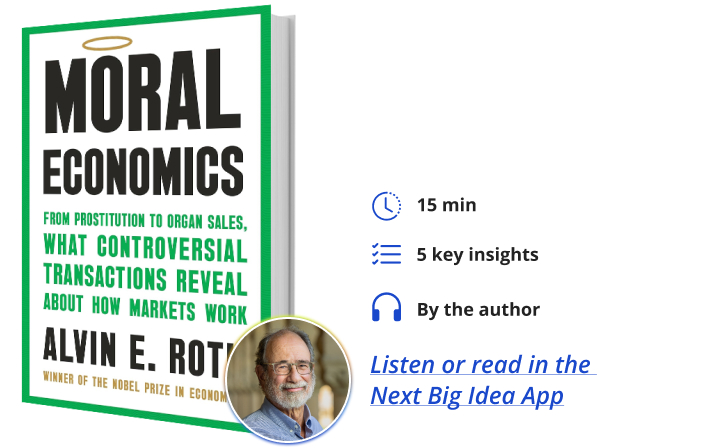
Below, Alvin Roth shares five key insights from his new book, Moral Economics: From Prostitution to Organ Sales, What Controversial Transactions Reveal About How Markets Work.
Alvin is the Craig and Susan McCaw Professor of Economics at Stanford
University and the George Gund Professor of Economics and Business
Administration Emeritus at Harvard University. A pioneering expert in
the field of market design, he was awarded the Nobel Prize in Economics
in 2012. He is also a member of the National Academy of Sciences and
past president of the American Economic Association.
What’s the big idea?
There’s an old joke about economics and sociology that says
economists try to understand the choices people make, and sociologists
try to understand why people don’t really have any choices. Alvin looks at how societies try to decide whether to allow some choices and ban others.
There are lots of morally contested markets and transactions that
some people would like to engage in, but others think shouldn’t be
allowed. Often, the objections are stated in terms of moral or religious
reasons. And the transactions that the opponents seek to ban don’t harm
them personally—they might not even know the transactions had occurred
unless someone tells them.
For example, same-sex marriage is a morally contested transaction:
two people want to marry each other, and some other people don’t think
same-sex marriages should be allowed—even though you can’t tell if
someone is married unless they tell you, for instance, by wearing a
wedding ring. For centuries, marriage was regarded as inherently
heterosexual. But, after considerable controversy, the U.S. and many
other countries have legalized same-sex unions.
This isn’t a unique situation. Lots of controversial markets are
connected to reproduction. There have been bans at different times and
places on contraceptives, in vitro fertilization, abortion, and
surrogacy. That is, there have been laws enshrining opposing views about
whether a woman should be able to prevent becoming pregnant during sex (by buying contraception), should be able to initiate a pregnancy without sexual intercourse (via IVF), or be able to terminate
a pregnancy via abortion, not to mention being a surrogate or having a
surrogate bear a baby. In the U.S., all those things have been through
the courts multiple times and with different results.
Notice that reliable contraception and IVF involve modern disputes
about modern technologies. Before reliable contraception, sex between a
man and a woman often resulted in pregnancy, and before assisted
reproductive technology, like IVF, sex was the only avenue to
pregnancy. Many traditional laws and norms that attempted to keep sex
within the bounds of marriage between a man and a woman were attempts to
ensure that babies would be born into families. But if pregnancy
becomes a choice, and if there are other ways to have a child than
intercourse between a man and a woman, then the door opens to more
expansive views about who can have sex with whom, and who can start a
family. So, while expanding marriage to include same-sex couples doesn’t
depend on modern technology, we can see that the changes in
reproductive technology may have moved the needle on what kinds of
marriages and related transactions receive social support.
Of course, bans on extra-marital sex, prostitution, or abortion never
succeeded in making those things disappear, even though they raised
barriers.
2. Bans on markets need social support to work well.
Some bans work well while others give rise to active black markets.
For example, why is it so easy to buy drugs, but so hard to hire a
hitman? U.S. laws aren’t so different for drug dealers and hitmen: if we
catch them, we send them to prison for a long time. Yet our prisons are
filled with drug dealers, and there have been years in which more than
100,000 people died from opioid overdoses. But murder for hire is so
rare that it doesn’t even make it into the national crime statistics,
and homicides from any cause are vastly fewer than drug overdose deaths.
At least some of the difference has to do with how people think about
drugs and murder. If I told you I was looking to buy some heroin, you
would be surprised, but you wouldn’t call the police (and if you did,
they would tell you that they were busy with more pressing calls). But
if I told you I was looking to hire a killer, you might very well call
the police, and when you did, they would encourage you to tell me that I
might find an available hitman at a certain bar, where I would find
myself trying to hire an undercover detective. To put it another way,
there are neighborhoods where drugs are readily available, and the
neighbors look away, but not so many neighborhoods where killers are the
norm, in part reflecting that the social norm against drugs is much
more porous than against murder.
“At least some of the difference has to do with how people think about drugs and murder.”
I don’t know how we should best make progress in dealing with the
markets for addictive, lethal drugs. Not only are we losing the “War on
Drugs,” but it won’t even accept our surrender: experiments with
decriminalizing drug use have shown the potential to make cities less
livable. We’re going to need to experiment, to find better ways to
proceed.
It’s worth noticing that we’ve learned to live with legal markets for
tobacco and alcohol, even though each of those causes more deaths than
are due to drug overdoses. And we’re wrestling with some other kinds of
addiction, such as gambling (particularly on your phone, during a game).
The drug epidemic teaches us that well-intentioned policies can fail.
By and large no one approves of heroin, but we haven’t succeeded in
vanquishing it any more than we succeeded in making alcohol disappear
during Prohibition.
3. Moral intuitions aren’t enough by themselves.
We need to gather and pay attention to evidence about the
consequences of particular policies. This is hard when moral intuitions
collide, partly because much moral argumentation rests on weak or no
evidence. But we can’t afford to judge our policies just by their
intentions. We have to at least look at their consequences, too.
Nevertheless, moral intuitions are important and consequential, so we
need to understand them better. There are some things that many moral
intuitions have in common. For example, concern about the possible
exploitation of vulnerable people is often an issue.
4. Sometimes adding money to a transaction arouses repugnance.
For example, paying in cash is what turns sex into prostitution.
Often, the objection to introducing money into transactions is that it
might be an undue influence that could coerce the poor into
transactions that they (or we) would prefer not to take part in. But
that’s over-broad: many people work for financial pay at jobs they
wouldn’t otherwise do. And many goods and services that we need wouldn’t
be available if they couldn’t be paid for.
“Many people work for financial pay at jobs they wouldn’t otherwise do.”
Pharmaceuticals made from blood plasma are a good example. Many
countries ban payments to plasma donors and try (almost always
unsuccessfully) to generate as much as they need of the large amounts of
plasma required to treat many diseases from unpaid donors. How do they
make up for the shortfall? Fortunately, you can buy plasma and
plasma-derived medicines from the U.S. We’re the Saudi Arabia of blood
plasma, exporting tens of billions of dollars of plasma products each
year, collected largely from plasma donors who are paid.
5. Religion remains important in many controversies.
It plays a large role in the growth of legal medical aid in dying, in the U.S. and elsewhere.
Overall, in pursuing moral economics, we have to keep in mind the maxim that ought implies can, and the things we feel morally obligated to do, whether by supporting them or banning them, have to be things that we can
do. To understand those limits, we need evidence, including
experimentation, to figure out how to proceed when we’re worried by all
our options.
"A Nobel Prize-winning economist makes the case that our moral objections to controversial markets are getting people killed.
Alvin Roth won the Nobel Prize in Economics for figuring out how to build markets that work. Now he's turned his attention to the markets we refuse to build, and why that refusal has consequences nobody wants to talk about.
In this episode, Mary and Al dig into what he calls "repugnant transactions" — the deals that some people want to make and others think shouldn't be allowed. They get into why banning organ sales creates black markets where donors get operated on in apartments, why the same logic that ended Prohibition applies to the war on drugs, how surrogacy bans in Europe are turning babies into stateless people, and why it's easy to buy heroin but nearly impossible to hire a hit man.
Al's argument isn't that everything should be for sale. It's that if you care about outcomes more than intentions, you have to confront what your bans are actually doing.
Subscribe for new episodes every week.
Chapters:
00:00 Friendship Isn't A Market
00:32 Meet Nobel Economist Al Roth
01:02 What Makes a Market "Repugnant"?
02:58 Should We Pay People for Kidneys?
08:31 Why Drugs Thrive But Hit Men Don't
15:58 Surrogacy, Politics, and Unintended Consequences
21:45 Why Prohibition Keeps Failing
25:19 Markets, Morality, and Reality
28:19 The Rise of Prediction Markets
34:30 What Money Can't Buy"
"Nobel Prize-winning economist Alvin E. Roth discusses the moral limits of markets, how bans create black markets, and why harm reduction often works better than prohibition."
He talks with Nick Gillespie about why some voluntary transactions
provoke moral outrage even when no one is being directly harmed. Roth
explains why black markets often emerge when governments try to ban
activities with persistent demand, why both markets and prohibitions
require social support to function, and how unintended consequences can
make moralistic policies backfire. They discuss the war on drugs,
prostitution, surrogacy, same-sex marriage, price gouging, and why Iran
remains the only country in the world with a legal market for kidney
donors.
They also explore Roth's work designing kidney exchange
networks and school choice systems, how digital technology and private
transactions make certain bans harder to enforce, and why harm reduction
may work better than prohibition in areas ranging from drug policy to
sex work."
Speaking with the great sociologist Mark Granovetter gave me the opportunity to tell the joke "“Economists study how people make choices; sociologists study why people don’t have choices," since Moral Economics is about the controversial markets over which society struggles with which choices should be allowed and which should be banned.
Stanford's Center for the History of Capitalism sponsored the conversation, and here it is on YouTube, but it's just a podcast, there's audio of our conversation, but no video.
"A kidney transplant does not work like buying a gallon of milk. Neither does hiring or getting into a medical residency. In these markets, both sides care deeply about who they end up with, and a good outcome depends on more than money.
Alvin Roth has spent his career studying what makes those systems succeed or fail. His work designing kidney exchange programs showed that even when people desperately want to help each other, the market can still break down unless the rules create the right kind of match. In this episode, Dart and Al discuss matching markets, moral economics, and the hidden rules that shape opportunity, fairness, and work itself.
Alvin Roth is an economist and professor at Stanford University best known for his work on market design and matching theory. He received the 2012 Nobel Prize in Economic Sciences for his work on stable matching and the design of markets used in medical residencies, school choice, and kidney exchange.
In this episode, Dart and Al discuss: - Why some markets depend on matching - Why fit matters more than money - What makes a market stable - Why real markets are messy - The difference between theory and engineering - What “repugnant transactions” are - Why societies ban some exchanges - How social norms shape markets - Why work is also a matching problem - And other topics…
Alvin Roth is the Craig and Susan McCaw Professor of Economics at Stanford University and recipient of the 2012 Nobel Memorial Prize in Economic Sciences, awarded with Lloyd Shapley for the theory of stable allocations and the practice of market design. His work has helped design matching systems for medical residencies, public school admissions, and kidney exchange programs. He is the author of Who Gets What — and Why and Moral Economics: Why Good and Bad Markets Exist.
"It was so fun talking to Alvin Roth, winner of the 2012 Nobel Prize in Economics.
"One of my favorite books of all time is Who Gets What and Why, which has shaped the way I view labor markets. His second book, Moral Economics, came out last week and it’s so so good - endlessly thought provoking, funny, and sharp. In the podcast, we talk about controversial markets and what makes something repugnant, how to think about exploitation and coercion, and what that means for labor markets.
"Check out the latest episode of The Economics of Work and Al's new book Moral Economics!
"Moral Economics from Basic Books:
Amazon: https://a.co/d/0cu6ZCLm
Podcast Episode:
Apple: https://lnkd.in/esVGQQx5
Spotify: https://lnkd.in/e4sr844Q
Youtube: https://lnkd.in/eif7DHMS"
Here's the short version, from the issue's overview in World in Brief.
"Alvin Roth investigates repugnant markets
"Would you like to buy a kidney? How about heroin? Or sex? Don’t worry: you haven’t wandered down the wrong alley—these and other morally questionable transactions are the subject of a new book by Alvin Roth, a Nobel-prize winning economist. Published in Britain on Thursday, “Moral Economics” looks at the murky world of “repugnant transactions”: deals in which buyers and sellers happily transact, but which onlookers would rather ban on moral grounds.
"For Mr Roth, moral economics is about trade-offs. Are the harms of allowing an activity greater than those of disallowing it? Policy, he argues, should weigh both. Two principles emerge. First, bans never fully work: motivated buyers and sellers find workarounds. Second, prohibition generally reduces the size of the market; it would be cheaper and easier to buy heroin if it was legal. It might also be safer. That leaves Mr Roth asking whether the restrictions or the market cause more harm. Here, too, the answer is that it depends."
###########
And here's a link to the longer review, from the Free Exchange column. That column is unsigned, but others on the web have attributed it to Gavin Jackson, who did interview me about the book. Here is the resulting review:
My review of the review is that it missed some of the nuances in my book, but many aspects of the big picture came through clearly:
"The picture that emerges from the book is of a deeply moral person, who believes in bodily autonomy, in not subordinating individual lives to a collective and in not accepting unnecessary deaths to spare some people from feeling squeamish."
Kepler's Books 1010 El Camino Real Menlo Park, CA, 94025
"Nobel Prize–winning economist Alvin E. Roth reframes some of our fiercest moral debates as markets, offering a solution that protects the vulnerable while preserving people’s rights to pursue their own interests.
"About Moral Economics Some of the most intractable controversies in our society are, essentially, about which actions and transactions should be banned. Should women and couples be able to purchase contraception, access in vitro fertilization, and end pregnancy by obtaining an abortion? Should people be able to buy marijuana? What about fentanyl? Can someone be paid to donate blood plasma, or a kidney?
"Disagreements are fierce because arguments on both sides are often made in uncompromising moral or religious terms. But in Moral Economics, Nobel Prize–winning economist Alvin E. Roth asserts that we can make progress on these and other difficult topics if we view them as markets—tools to help decide who gets what—and understand how those markets can be finetuned to be more functional. Markets don’t have to allow everything or ban everything. Prudent market design can find a balance between preserving people’s rights to pursue their own interests and protecting the most vulnerable from harm.
"Combining Roth’s unparalleled expertise as market design pioneer with his incisive, witty accounts of complicated issues, Moral Economics offers a powerful and innovative new framework for resolving today’s hardest controversies.
"About the Speakers
Alvin E. Roth is the Craig and Susan McCaw Professor of Economics at Stanford University and the George Gund Professor of Economics and Business Administration Emeritus at Harvard University. A pioneering expert in the field of market design, he was awarded the Nobel Prize in Economics in 2012. A member of the National Academy of Sciences and past president of the American Economic Association, he lives in Stanford, California.
Paul Milgrom is the Shirley R. and Leonard W. Ely, Jr. Professor of Humanities and Sciences in the Department of Economics at Stanford University. He was awarded the 2020 Nobel Memorial Prize in Economic Sciences. His books include Putting Auction Theory to Work (2004) and Economics, Organization, and Management (1992). He has also written dozens of articles on auction design, game theory, and macro- and microeconomics."
"Nobel Prize-winning economist Alvin E. Roth is not exactly light entertainment, but this does sound like the rare bookstore talk built to pull in people beyond the usual policy crowd. The book is Moral Economics, his new argument that some of our ugliest public fights make more sense when you stop treating them as pure morality plays and start looking at them as markets with consequences. With fellow Nobel winner Paul Milgrom joining him, this should be smart without getting bloodless, and probably sharper, funnier, and more contentious than the phrase market design first suggests."
Neale Mahoney interviews me on Econ to go (with a transcript of our half hour conversation).
"Neale Mahoney: Markets are often treated like natural objects, things that simply exist. But economist Al Roth sees them differently. To him, markets are human inventions, systems we design, shape, and sometimes struggle to agree on. Because when money and morality collide, things can get complicated. Who should be allowed to buy and sell? What should they be allowed to transact? and what happens when people want to trade things that others find morally unacceptable.
Alvin Roth: I think that one of the things we need to do is experiment on what we're morally obliged to do and reflect on it in connection with what we're actually able to do.
Neale Mahoney: I'm Neale Mahoney, Economist and Director of the Stanford Institute for Economic Policy Research. On this episode of "Econ To Go," I catch up with Stanford Economist and Nobel Laureate Al Roth over coffee on campus. We talk about what he calls moral economics, the study of markets where society struggles to agree on what should be bought and sold. From kidney exchange to commercial surrogacy, from prostitution laws to the surprising economics of matchmaking, Al shows us that markets don't just allocate goods. They also reflect our values. You've said that markets and marketplaces are human artifacts. They are not just features of the natural environment. Why is that a good starting place when we think about the study of economics?
Alvin Roth: Well, for a long time, economists sort of thought that markets were things that we just had to take as given. You know, we speak of economists thinking of people as price takers, but in fact, they also thought of us as market takers. There are these markets. But of course, markets are human artifacts. To a great extent they're collective human artifacts, but marketplaces are often artifacts of individual companies or designers, or small groups of participants who modify the marketplace to fit their needs over time, just in the way that Uber is a marketplace designed by the company Uber. But I think there's a good analogy, which is that languages are also human artifacts, and they're collective human artifacts. You and I can speak to each other in English because we both learned English in a conventional way, but there are lots of words in our English that weren't in the language 100 years ago, words like computer and internet and AI. So, we're constantly modifying the language to better suit our needs."
I spoke about economics with Keynes (Soumaya) in the FT:
Nobel laureate Al Roth and the economics of organ sales "The economist Alvin Roth been talking about kidneys since at least 2003, noting time and again that kidneys are in short supply, waiting lists are growing longer, and people are dying as a result.
" Soumaya Keynes So we always start this show with a silly question. So, on a scale of one to 10, how relaxed are you about marketisation? So 10, you’re extremely relaxed about having transactions in literally anything, and maybe five is the average person.
You can watch the AEI book event (and hear me read the first paragraph of the book, and chat about it for about 20 minutes) followed by discussion by Alex Tabarrok, Judd Kessler and Nick Gillespie, and Q&A, all introduced an moderated by Sally Satel.
Here’s a picture taken by Peter Jaworski
And here we are on Youtube (this was originally a live stream):




 Posts
Posts

