Showing posts with label deceased donors. Show all posts

Saturday, November 29, 2025

Gift to deceased donor family (generous ex-post, but illegal ex-ante)

 What is generous ex-post but illegal ex-ante?

Cleveland.com has the story: 

Bernie Kosar gives large check to donor’s family days after life-saving liver transplant   By  Molly Walsh

"CLEVELAND, Ohio — Former Browns quarterback Bernie Kosar marked Thanksgiving by donating $25,000 to the family of the organ donor who saved his life, just days after he was discharged from University Hospitals following a successful liver transplant." 

Thursday, November 20, 2025

Organ procurement centers (OPOs) are responding to changes in their performance evaluations (by Bae, Sweat, Melcher and Ashlagi in JAMA Surgery)

 Here

Bae H, Sweat KR, Melcher ML, Ashlagi I. Organ Procurement Following the Centers for Medicare and Medicaid Services Performance Evaluations. JAMA Surg. Published online November 19, 2025. doi:10.1001/jamasurg.2025.5074 

"In 2024, 4639 patients died in the United States while waiting for a transplant from deceased donors.1 Organ procurement organizations (OPOs) are government contractors responsible for identifying potential donors in a geographical region, recovering their organs, and implementing the offering processes to patients on the waiting list. In 2020, 10% of potential donors—individuals younger than 76 years with inpatient death and organs suitable for transplant—became organ donors, suggesting an opportunity to increase donation and transplant rates.2

"Toward this goal, the Centers for Medicare and Medicaid Services issued a final rule in December 2020 to increase transparency of OPO performances by monitoring several metrics. OPOs are placed into 3 tiers based on donation rate and donor age–adjusted transplant rates, although acceptance of organ offers is up to patients and transplant centers. OPOs that perform poorly on both metrics are placed into tier 3 and are at risk of decertification in 2026.3 This longitudinal study examines changes in OPOs’ organ recovery practices following the initial report released in September 2021, focusing on the number and quality of organs recovered and the resulting transplant rates. 


 "The findings suggest that the 2021 release of the report on OPO performance was associated with increased organ recovery among low-performing OPOs, narrowing the gap in organ donation with high-performing OPOs. Even though the gap in the transplant rate has narrowed, much of it is linked to increased organ recovery from older donors, which may limit improvements in transplant rates. This is despite an increase in organs placed out of sequence by low-performing OPOs."

Saturday, August 9, 2025

Withdrawals from deceased donor registries

The NYT is standing by its recent stories on deceased organ donation. In the meantime  Newsweek has this story about people who have had second thoughts about deceased donation. (For the record, while it's very important to scrutinize current practices, none of the reported concerns even made me think about withdrawing from the donor registry.)

Mass Exodus From Organ Donor Registries Following Media Coverage  by Joshua Rhett Miller

"Thousands of Americans have removed themselves from organ donor registries following "irresponsible reporting" led by the New York Times, officials said.

The Association of Organ Procurement Organizations, a trade group that represents 46 of the nation's 55 federally designated nonprofit entities that help facilitate donations, accused the newspaper of a "lack of balance and accuracy" in its recent coverage of the problems in the sprawling transplant system.

The letter, sent to three Times editors on Tuesday, cited two articles from July 20, including "A Push for More Organ Transplants Is Putting Donors at Risk," in which reporters Brian M. Rosenthal and Julie Tate detailed rushed or premature attempts to retrieve organs from patients who were, in some cases, still showing signs of life.

A third recent Times item, an op-ed written by three cardiologists in which they argue for a "new definition of death" to help alleviate the backlog of recipients in need of transplants, was not included in the letter. The essay has gone viral on X, with many users commenting it has made them rethink or actively change their status as organ donors. 


...

"AOPO claims both articles contained "serious factual inaccuracies," including the trade group attributing "any errors to hospitals" in the story written by Rosenthal and Tate. That phrase wasn't a part of AOPO's response to the newspaper, which subsequently updated the article, according to Tuesday's letter. 

"The main article from July 20 also omitted or misrepresented key facts in some donation cases," the letter continued. "The absence of critical context in the story has fueled massive mistrust in the donation process."

...

"This is the largest spike in registry removals ever recorded in the history of organ donation in the U.S.," AOPO letter reads. "The New York Times' coverage — coupled with a wave of secondary stories by other outlets and widespread, sensationalistic commentary and online reactions — has initiated a wave of panic and fear across the United States."

#########

Earlier:

Sunday, July 20, 2025Organ donation after circulatory death: the NYT recounts some disturbing cases

Sunday, July 20, 2025

Organ donation after circulatory death: the NYT recounts some disturbing cases

 The NYT has a disturbing story this morning about organ donation after circulatory death. These are cases in which a decision has been made to remove the patient from a ventilator, in anticipation that they are irreversibly dying.  If death (via cessation of heartbeat and breathing) occurs almost immediately after removal, the patient may still be a viable organ donor, and otherwise not.  Organ procurement organizations (OPOs) are not supposed to be involved until after death has been declared, but apparently in some small hospitals they get involved earlier, and have sometimes pressured physicians to proceed prematurely.

A Push for More Organ Transplants Is Putting Donors at Risk
People across the United States have endured rushed or premature attempts to remove their organs. Some were gasping, crying or showing other signs of life.  By Brian M. Rosenthal and Julie Tate, July 20, 2025

"Across the United States, an intricate system of hospitals, doctors and nonprofit donation coordinators carries out tens of thousands of lifesaving transplants each year. At every step, it relies on carefully calibrated protocols to protect both donors and recipients.
 

"But in recent years, as the system has pushed to increase transplants, a growing number of patients have endured premature or bungled attempts to retrieve their organs. ...  a New York Times examination revealed a pattern of rushed decision-making that has prioritized the need for more organs over the safety of potential donors.

...

"Most donated organs in the United States come from people who are brain-dead — an irreversible state — and are kept on machines only to maintain their organs. Most donated organs in the United States come from people who are brain-dead — an irreversible state — and are kept on machines only to maintain their organs. Circulatory death donation is different. These patients are on life support, often in a coma. Their prognoses are more of a medical judgment call.

"They are alive, with some brain activity, but doctors have determined that they are near death and won’t recover. If relatives agree to donation, doctors withdraw life support and wait for the patient’s heart to stop. This has to happen within an hour or two for the organs to be considered viable. After the person is declared dead, surgeons go in.

"The Times found that some organ procurement organizations — the nonprofits in each state that have federal contracts to coordinate transplants — are aggressively pursuing circulatory death donors and pushing families and doctors toward surgery. Hospitals are responsible for patients up to the moment of death, but some are allowing procurement organizations to influence treatment decisions.

"Fifty-five medical workers in 19 states told The Times they had witnessed at least one disturbing case of donation after circulatory death.

"Workers in several states said they had seen coordinators persuading hospital clinicians to administer morphine, propofol and other drugs to hasten the death of potential donors.

...

"Circulatory death donation used to be largely forbidden. That began to change in the 1990s, when a dying patient asked the University of Pittsburgh Medical Center to remove her life support and donate her organs. The hospital honored her wishes, then spent two years creating guidelines for future cases. Use of the practice gradually spread.

"Procurement organizations attributed the procedure’s recent growth to technological advances. Dozens of employees at the organizations said it was largely because of government pressure.

"Citing the number of Americans waiting for organs, H.H.S. said in 2020 that it would begin grading procurement organizations on how many transplants they arranged. The department has threatened to end its contracts with groups performing below average, starting next year. Many have raised their numbers by pursuing more circulatory death donors."

Friday, June 6, 2025

Disturbing NYT report about an Organ Procurement Organization in Kentucky

 Deceased donation of organs mostly occurs after potential donors suffer brain death, which, roughly speaking, means the loss of all organized brain activity, including the automatic activities that control breathing and heartbeat.  If the deceased died while on a ventilator, their organs continue to get oxygen, and may be able to save other lives through organ donation.

But sometimes the patient appears to be dead, but there's still enough brain activity to potentially support breathing and heartbeat.  If the decision is made to remove the patient from the ventilator, breathing and heartbeat may cease very quickly, and the patient dies (including brain death which follows the loss of blood  circulation).  In some cases the patient can be reconnected to the ventilator and become a potential organ donor. This is called Donation after Circulatory Death (DCD).  But sometimes the patient doesn't die right after being removed from the ventilator, and might remain alive, for some time,  and even posssibly recover.

Today's NYT reports cases in Kentucky in which the Organ Procurement Organization (OPO) apparently tried to press physicians to declare death prematurely,.

Doctors Were Preparing to Remove Their Organs. Then They Woke Up.   A federal investigation found a Kentucky nonprofit pushed hospital workers toward surgery despite signs of revival in patients.   By Brian M. Rosenthal  June 6, 2025,

"[A federal] investigation examined about 350 cases in Kentucky over the past four years in which plans to remove organs were ultimately canceled. It found that in 73 instances, officials should have considered stopping sooner because the patients had high or improving levels of consciousness. 

...

"Most of the patients eventually died, hours or days later. But some recovered enough to leave the hospital, according to an investigation by the federal Health Resources and Services Administration, whose findings were shared with The New York Times.

"The investigation centered on an increasingly common practice called “donation after circulatory death.” Unlike most organ donors, who are brain-dead, patients in these cases have some brain function but are on life support and not expected to recover. Often, they are in a coma.

"If family members agree to donation, employees of a nonprofit called an organ procurement organization begin testing the patient’s organs and lining up transplant surgeons and recipients. Every state has at least one procurement organization, and they often station staff in hospitals to help manage donations.

"Typically, the patient is taken to an operating room where hospital workers withdraw life support and wait. The organs are considered viable for donation only if the patient dies within an hour or two. If that happens, the procurement organization’s team waits five more minutes and then begins removing organs. Strict rules are supposed to ensure that no retrieval begins before death or causes it."


Friday, May 23, 2025

Deceased organ allocation: deciding early when to move fast

The deceased donor waiting list for kidneys to transplant is congested: offers, which take time to evaluate, are often rejected, while cold ischemia time accumulates.

 Here's a paper just published in Transplantation, in which we suggest new ways to detect organs that will be hard to match, and which might therefore be expedited through the allocation process (to get more quickly to patients who will accept them).

Insights From Refusal Patterns for Deceased Donor Kidney Offers, by Guan, Grace MS1; Neelam, Sanjit MS2; Studnia, Joachim MS2; Cheng, Xingxing S. MD, MS3; Melcher, Marc L. MD, PhD4; Rees, Michael A. MD, PhD5,6; Roth, Alvin E. PhD7; Somaini, Paulo PhD8; Ashlagi, Itai PhD1
Author Information
Transplantation ():10.1097/TP.0000000000005434, May 21, 2025 

"Background.
The likelihood that a deceased donor kidney will be used evolves during the allocation process. Transplant centers can either decline an organ offer for a single patient or for multiple patients at the same time. We hypothesize that refusals for a single patient indicate issues with individual patients, whereas simultaneous refusals for multiple patients indicate issues with organ quality.

Methods.
We investigate offer refusal patterns between January 1, 2022, and December 31, 2023, using Organ Procurement and Transplantation Network data. We aggregate refusals at the same timestamp by a center and define a multiple patient refusal as >1 or >5 patients simultaneously refused. We report the refusal codes associated with single and multiple patient refusals and the nonutilization rate after receiving single and multiple patient refusals by cross-clamp.

Results.
Patient-related refusal reasons are more commonly single patient refusals, whereas organ-related refusal reasons are more commonly multiple patient refusals. Multiple patient refusals before cross-clamp are associated with nonutilization, but single patient refusals are positively correlated with utilization. The nonutilization rate was 28% for organs without pre-clamp refusals, 35% with a single center sending a multiple patient refusal, but only 12% with a single center sending a single patient refusal.

Conclusions.
The risk of nonutilization can be assessed early in the offering process based on the number of single and multiple patient refusals received by a specific time (e.g., cross-clamp). Understanding refusal patterns can guide the development of transparent protocols for accelerated placement."


Wednesday, April 30, 2025

New/old paper, finally published, sadly still relevant: Kessler & Roth in AEJ:Policy

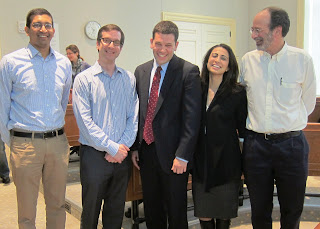
 Here's a paper, just published this week, which reports (now among other things) a field-in-the-lab experiment begun in August 2010 (when my coauthor Judd was just a kid--see photo below:-)  It was motivated by the shortage in organ transplants that has only grown since that time, because the growth in transplants hasn't kept pace with the growth in kidney disease.

Increasing Organ Donor Registration as a Means to Increase Transplantation: An Experiment with Actual Organ Donor Registrations  by Judd B. Kessler and Alvin E. Roth, American Economic Journal: Economic Policy vol. 17, no. 2, May 2025 (pp. 60–83) 

Abstract: The United States has a severe shortage of organs for transplant. Recently—inspired by research based on hypothetical choices—jurisdictions have tried to increase organ donor registrations by changing how the registration question is asked. We evaluate these changes with a novel "field-in-the-lab" experiment, in which subjects change their real organ donor status, and with new donor registration data collected from US states. A "yes/no" frame is not more effective than an "opt-in" frame, contradicting conclusions based on hypothetical choices, but other question wording can matter, and asking individuals to reconsider their donor status increases registrations.

#######

Earlier:

Monday, July 22, 2024 Don't take "No" for an answer in deceased organ donor registration (a paper forthcoming after ten+ years)


Tuesday, September 2, 2014 Don't take "No" for an answer: a reconsideration of how to do deceased donor registration


Wednesday, May 11, 2011 Pro-social behavior of all kinds: Judd Kessler


Thursday, April 10, 2025

Kidneys and Controversies at Mt. Sinai hospital

 I gave a talk yesterday at Mt. Sinai hospital. They had encouraged me to talk about controversies, which I happily did.  They were a sympathetic audience (although the majority of their last five speakers would not have been:)


Sunday, November 17, 2024

Opt-out defaults do not increase organ donation rates, in Public Health

 No one said market design was going to be easy...(well, some people did, but it turns out it isn't.)

Dallacker, M., L. Appelius, A. M. Brandmaier, A. S. Morais, and R. Hertwig. "Opt-out defaults do not increase organ donation rates." Public Health 236 (2024): 436-440. 

"Objectives: To increase organ donation rates, many countries have switched from an opt-in (‘explicit consent’) default for organ donation to an opt-out (‘presumed consent’) default. This study sought to determine the extent to which this change in default has led to an increase in the number of deceased individuals who become organ donors.
 

"Study design: Longitudinal retrospective analysis.
 

"Methods: We conducted a retrospective analysis of within-country longitudinal data to assess the effect of changing the organ donation default policy from opt-in to opt-out. Our analysis focused on the longitudinal deceased donor rates in five countries (Argentina, Chile, Sweden, Uruguay, Wales) that had adopted this change. Using a Bayesian aggregated binomial regression model, we estimated the odds of organ donation within each country over time, as well as the effect of the policy switch.
 

"Results: Switching from an opt-in to an opt-out default did not result in an increase in donation rates when averaged across countries. Moreover, the opt-out default did not lead to even a gradual increase in donations: there was no discernible difference in the linear rate of change of donations after the change in default. Finally, the COVID-19 pandemic was associated with a reduction in the odds of donation across all five countries.
 

Conclusions: Our longitudinal analysis suggests that changing to an opt-out default does not increase organ donation rates. Unless flanked by investments in healthcare, public awareness campaigns, and efforts to address the concerns of the deceased's relatives, a shift to an opt-out default is unlikely to increase organ donations."


...

"Family objections, often a significant barrier to deceased organ donation, should also be addressed. In many countries—including Chile, Sweden, and Wales—the consent of next of kin is necessary for organ donation. The veto power given to families has also been cited as a reason why the opt-out default does not significantly improve donation rates over the opt-in system.27,28 Considering expressed preferences, whether of the deceased or their relatives, overrides the default. Ultimately, the implications for transplantation outcomes between opt-in and opt-out defaults only differ in the rare cases when no explicit statements of preference were made by either the deceased or their relatives. A previous cross-country scenario analysis has shown that, when family preferences are honoured, shifting from an opt-in to an opt-out default alone would only increase organ recovery by 0%–5%.29 

######

 HT: Frank McCormick


Related:

Monday, July 22, 2024 Don't take "No" for an answer in deceased organ donor registration (a paper forthcoming after ten+ years)