Wednesday, March 5, 2025

Demonstrating for science (in Washington and elsewhere)

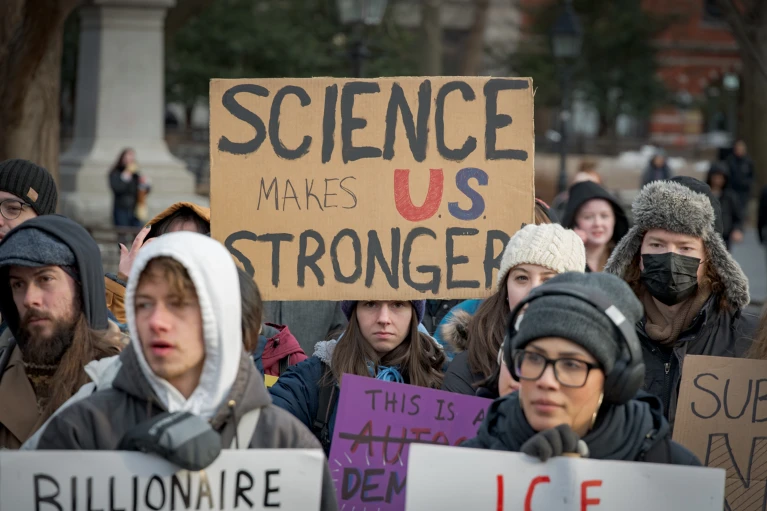
 Scientists are more accustomed to demonstrating science than demonstrating for science, but that may need to change.

Nature has the story:

NEWS, 03 March 2025
US science is under threat ― now scientists are fighting back
Researchers are organizing protests and making their voices heard as Trump officials slash funding and lay off federal scientists.
By Heidi Ledford & Alexandra Witze 


"Across the United States, researchers are navigating uncomfortable territory. Repeated threats to research funding and the mass firings of federal workers have pushed some scientists to take on unfamiliar roles as activists, speaking at rallies, calling legislators and forming new pressure groups. “Historically, scientists have done a really bad job of advocating for their own activities,” says David Meyer, a sociologist at the University of California, Irvine. “So this is a new challenge.”

Unaccustomed role

The events of the past six weeks have compelled many scientists to embrace that challenge. Soon after the second inauguration of US President Donald Trump on 20 January, the new administration attempted to freeze payments on federal grants; announced that it would review and potentially cancel any grant that mentioned terms it deemed indicative of diversity, equity and inclusion (DEI) programmes; and issued dramatic cuts to the overhead, or ‘indirect costs’, paid on projects funded by the US National Institutes of Health.

...

"For many scientists, the big event is coming up on 7 March, at ‘Stand Up for Science’ rallies slated to take place in 32 cities around the country. The main event, in Washington DC, is spearheaded by a group of five researchers, most of them graduate students, who came together to combat their own initial feelings of powerlessness. “It’s been inspiring, as this has grown, to see how many people were feeling the same way and to take action,” says Emma Courtney, a graduate student in biology at Cold Spring Harbor Laboratory in New York."


Tuesday, March 4, 2025

Universities and democracies

 Universities and democracies are neither entirely the same nor entirely different.

Here's the New Yorker story on Harvard:

Will Harvard Bend or Break?  Free-speech battles and pressure from Washington threaten America’s oldest university—and the soul of higher education. By Nathan Heller  March 3, 2025 

“There is a nearly impossible choice being put to university leaders at this point,” Andrew Crespo, a professor at Harvard Law School, told me. “On the one hand, you have outside funders, including the federal government, who have the ability to threaten the university’s ability to operate. On the other, you have the mission of the institution.” Caught in the middle is the influence of universities on fields as disparate as medicine and art. “This is not about any one institution,” Crespo said. “It’s about higher education in the United States, and whether it is going to survive and thrive or fade away.”

...

"Incisive writers about higher education have pointed out that the American university is a bundle of contradictions held in an uneasy balance that miraculously works. And yet, in marvelling at the miracle, it is possible to overlook how fragile even an uneasy balance is. Last year’s struggles over speech—among protesters and counter-protesters, scholars and administrators—seemed to show a system falling out of equilibrium. This year’s ideological pressure, from government officials and donors, has made higher education, one of the greatest achievements of American culture, vulnerable. Universities are the reason that this country has been able to attract talent, chase breakthroughs, and respond to change. If the American university survives the twenty-first century, that resilience will probably have to do not just with rules and standards but with a certain magic flexibility and eclecticism being upheld.

Monday, March 3, 2025

Tesla Owners Beware of Vandalism (email)

 There is some debate in the business literature about what effect taking a public position on controversial social and political issues has on consumer-facing businesses.  Here's a suggestion that there may be reaction not just affecting sales of Teslas and the company's stock price, but to privately owned Teslas. (I used to live in Brookline, MA, and am still on some town email lists there, and this came in a mass email.)

"To all my Brookline neighbors who own Teslas,

"There is a person, or group of people, who have been going around Brookline defacing Teslas.  The sticker in the attached picture was stuck to my car this afternoon.  It’s large and I can’t get it off (if anyone knows how to do this without damaging the car, please let me know.)  The Brookline Police told me that they have received many reports of this.  If you have a Tesla, please turn on Sentry Mode (now!) so if something like this happens to you, there will be video evidence.  I had previously set my car to disable this feature when at home, as it prevents the car from sleeping, and uses a lot of energy. I will now have it enabled 24/7.  If your car has been vandalized, please report it to the police so there is a record of the crime
." 


I'm reminded of reports at one time that animal rights activists/terrorists sometimes attacked people wearing fur coats by spraying the coats with paint. (See e.g. the retrospective story Cutting cruelty out of fashion.)


Sunday, March 2, 2025

Train robbery in the 21st Century

The LA Times has the story about how it's done these days:

Inside the Mojave Desert train heists targeting Nike sneakers  By Alex Wigglesworth

"The thieves stealthily board eastbound freight trains, hiding out until they reach lonely stretches of the Mojave Desert or high plains far from towns. They slash an air brake hose, causing the mile-long line of railcars to screech to an emergency stop.
"
Then, they go shopping.

"That’s the modus operandi described by investigators in a string of at least 10 heists targeting BNSF trains in California and Arizona since last March. All but one resulted in the theft of Nike sneakers, their combined value approaching $2 million, according to investigators.

 ...

"Theft crews typically scout high-value merchandise on rail lines that parallel Interstate 40 by boarding slow-moving trains

...

"Once the desired loot is found, the thieves alert “follow vehicles,” which track the train. The stolen goods are tossed off the train after it comes to a halt — either for a scheduled stop or because an air hose has been cut or control wires inside signal boxes have been sabotaged, said the federal agent, Brynna Cooke.

The cargo is then loaded into box trucks, or hidden in nearby brush until they arrive — provided the surveillance crews that are following the train don’t detect law enforcement, Cooke said. These tactics are often employed by transnational criminal groups that consist primarily of Mexican citizens from Sinaloa, she said.

There were at least 65,000 railroad cargo thefts last year, a 40% increase from 2023

...

"In the Jan. 13 heist, stolen cases of Nikes hurled from the train were later picked up by trucks, the federal complaint states. County and state law enforcement officers were able to catch up with the vehicles with the help of tracking devices that were inside some of the boxes. "

Saturday, March 1, 2025

Kidney transplant black market in Myanmar

 BBC Burma has the story (I guess they haven't updated their country name...no doubt they still refer to the Gulf of Mexico, too:) 

The story is about Burmese people purchasing a kidney from other Burmese people, after which they both travel to India for the surgeries, which involves pretending to be relatives.

Myanmar villagers reveal 'desperate' illegal kidney sales, BBC Burmese 

"Zeya, whose name has been changed to conceal his identity, knew of local people who had sold one of their kidneys. "They looked healthy to me," he says. So he started asking around.

"He is one of eight people in the area who told BBC Burmese they had sold a kidney by travelling to India.

...

"Buying or selling human organs is illegal in both Myanmar and India, but Zeya says he soon found a man he describes as a "broker".

"He says the man arranged medical tests and, a few weeks later, told him a potential recipient - a Burmese woman - had been found, and that both of them could travel to India for the surgery.

"In India, if the donor and recipient are not close relatives, they must demonstrate that the motive is altruistic and explain the relationship between them.

...

"He says the broker made it appear as if he was donating to someone he was related to by marriage: "Someone who is not a blood relative, but a distant relative".

...

Zeya says he was told he would receive 7.5m Myanmar kyats. This has been worth somewhere between $1,700 and $2,700 over the past couple of years

...

" he flew to northern India for the operation and it took place in a large hospital. ... he stayed in hospital for a week afterwards.

...

"The BBC last heard from Zeya several months after his surgery.

"I was able to settle my debts and bought a plot of land," he said.

But he said he couldn't afford to build a house and had not been able to construct one while recovering from the surgery. He said he had been suffering from back pain.

"I have to restart working soon. If the side effects strike again, I have to deal with it. I have no regrets about it," he added.

He said he stayed in touch with the recipient for a while, and she had told him she was in good health with his kidney.

Speaking on condition of anonymity, she told the BBC she paid 100m kyats (between around $22,000 and $35,000 in recent years) in total. She denied that documents were forged, maintaining that Zeya was her relative."


HT: Colin Rowat

###########

Earlier, also on the Myanmar/India black market

Thursday, December 21, 2023

Cash for kidneys report in the Telegraph

Friday, February 28, 2025

Kevin Sontheimer (1938-2025)

 My old friend and colleague Kevin Sontheimer has died.  He was a great leader of Pitt’s economics department when I was there, not just while he was the department chair, but also before and after that too.

Here's his obit at Pitt:

Sontheimer transformed Pitt economics programs here and abroad
 

"Kevin Sontheimer, a 27-year faculty member who, as chairman, transformed the Department of Economics in the Dietrich School of Arts & Sciences and was instrumental in the founding of two pioneering international economics and management programs, died Feb. 3, 2025, at 86.

"His tenure as economics chair lasted through most of the 1980s. One of his early hires was future Nobel Prize-winning economist Alvin Roth as the first Mellon professorship at Pitt. “Kevin played a giant role in my decision to join the department in 1982,” Roth recalled. “He convinced me that, although the department had previously been somewhat under-resourced, it was a healthy department where it would be fun to work, with colleagues who would work together.

“And he was certainly right about that,” Roth continued. “During the time he was chair, we received permission to recruit fairly heavily, and successfully grew the department into a leading research department as well as a fine teaching department. I did some of the best work of my career at Pitt (1982-1998).

“One of the many things that Kevin did as chair was obtain a grant that allowed us to become one of the early economics departments to have an experimental laboratory. He built the department in other ways as well.”

"That included securing a Mellon Foundation grant to found, together with Jan Svenjar and Josef Zieleniec, the Center for Economic Research and Graduate Education (CERGE) at Charles University in Prague in 1991 (which became CERGE-EI in 1992, merging with the Economics Institute of the Czech Academy of Sciences). He was also an instrumental part of the team from his department and the Katz Graduate School of Business to receive USAID grants to work with Academia Istropolitana Nova and other institutions in Bratislava, Slovakia, to set up their economics program as well as the program at Comenius University in Bratislava.

“Kevin was instrumental … a very, very important player in both of these efforts,” said Andrew R. Blair, professor emeritus of business administration and of economics at Katz and the College of Business Administration, and a close colleague of Sontheimer. “Kevin’s role in the Czech Republic and, most especially, the Slovakia relationships was absolutely vital to the success of these Pitt ventures in Central Europe, which were aimed at incorporating free markets in these countries after decades of operating under Soviet domination,” he added.

"While Sontheimer was economics chair, Blair was director of Katz’s International Business Center, and their cooperation was crucial in such efforts. Blair explained that Sontheimer in particular was “the driving force” behind the latter international program, “with Kevin serving both as co-director of the USAID grant implementation and also as resident director in Bratislava of the economics portion of the Comenius relationship. The idea was to train people who were already faculty members at these institutions, to teach with them over there, and to bring them over here” to Pittsburgh: “Without the grant we couldn’t possibly have done that.

“It was a pleasure to work with Kevin.”

"Kevin Charles Sontheimer was born on March 6, 1938, in Pittsburgh, earning his bachelor's degree in physics at Pitt in 1960, a master's degree in economics from Penn State University in 1963 and a Ph.D. in economics from the University of Minnesota in 1969.

"He began his academic career on the faculties of Virginia Tech and SUNY–Buffalo, then joined Pitt in 1978 until his retirement as professor emeritus in 2006. He was economics department chair for eight years.

"His own research focus was on microeconomic theory, which led to publications in Econometrica, Journal of Economic Theory and Journal of Money, Credit and Banking, as well as other leading academic publications in his field. He was also a visiting professor at the Naval Postgraduate School in Monterey, Calif., and at the University of Mannheim in Germany.

"He is survived by his wife of nearly 65 years, Carol Sontheimer; daughter Leigh Ellen Sontheimer; son Erik Sontheimer and daughter-in-law Catherine Brekus; son Steven Sontheimer and daughter-in-law Morgan Triplett; grandchildren Claire, Rachel and Tanner Sontheimer; brother Adrian (“Dink”) Sontheimer and sister Sue Wilmot.

"A gathering to celebrate Sontheimer’s life will be held at a later date. Memorial gifts are suggested to the Alzheimer's Association or the Department of Economics at Pitt. "

Thursday, February 27, 2025

Kidney exchange: the donor stories, and the movie Abundant

 I'm learning a bit about movie production by following the progress of the movie Abundant, which is about to have a pre-release premier.  Here is the trailer (sponsored by the APKD), and the press release.

Here's the trailer:  https://vimeo.com/1048377579


And here's the press release:

LOS ANGELES--()--ABUNDANT, a documentary film that follows the unbelievable events surrounding extreme altruists who donated kidneys to complete strangers, has set its world premiere in Hollywood at The Directors Guild of America Theater Complex on March 1, 2025. The event is presented by OneLegacy Inspires Hollywood and The National Kidney Donation Organization (NKDO) as a kickoff to National Kidney Month. OneLegacy Inspires Hollywood champions authentic and accurate storytelling that highlight the power of organ, eye and tissue donation and transplantation.

“ABUNDANT moves us beyond a mindset of scarcity, reminding us of our shared humanity and connection”

The film’s world premiere is an entertainment industry event to showcase the often-miraculous stories connected to altruistic acts such as living kidney donation. “ABUNDANT moves us beyond a mindset of scarcity, reminding us of our shared humanity and connection,” said Sarah E. Fahey, Chair of OneLegacy Inspires Hollywood. “Through a powerful emotional journey of joy, grief, and hope, the film keeps audiences engaged from start to finish—and lingers long after the credits roll. OneLegacy Inspires Hollywood is thrilled to partner with NKDO and Maitri River Productions to premiere this impactful story during National Kidney Month here in Hollywood. This is the movie Los Angeles, and the world, needs right now,” Fahey added.

The choice of Los Angeles for ABUNDANT’s world premiere was in part inspired by the widespread acts of generosity, kindness and abundance displayed by the Los Angeles community during the recent wildfires. “One thing became obvious to me about abundance and altruism when I was making ABUNDANT,” said Director Donald Griswold. “Acts of abundance or generosity don’t have to be life-saving or dramatic to impact another person’s life meaningfully. We’re all fascinated by the non-directed kidney donors who give a kidney to a stranger, but viewers walk away from the film realizing that small acts and everyday kindnesses make an important impact, too. We saw that in so many ways in LA these last few weeks. We had to show ABUNDANT for the first time here and now.”

National Kidney Donation Organization supports ABUNDANT as part of an effort to gain more attention for kidney donation stories. “We are proud to have a hand in sharing this life-affirming message of hope and goodness with the people of LA, and with all those across the country who might be inspired by it,” said Emily Polet-Monteserro, Executive Director, National Kidney Donation Organization. “This compelling film uses the vehicle of kidney donation to encourage the audience to consider what it means for them to live fully and with love toward everyone, including strangers.”

ABUNDANT includes interviews with 2012 Nobel Prize Laureate Alvin Roth, PhD, Freakonomics Radio host Stephen Dubner, author and researcher Abigail Marsh, PhD, and business leader in the field of system change, Tynesia Boyea-Robinson among other notable personalities. The film features first-hand stories of non-directed kidney donation (where a person donates a kidney to a complete stranger) in a never-before-seen way of telling stories. 

#############

Earlier:

Tuesday, September 24, 2024

Abundant: a moving documentary about living organ donors

Wednesday, February 26, 2025

Abortion bans have increased both births and infant mortality (JAMA)

 Not unexpectedly:

US Abortion Bans and Infant Mortality, by Alison Gemmill, PhD1; Alexander M. Franks, PhD2; Selena Anjur-Dietrich, PhD1; et alAmy Ozinsky, BS1; David Arbou r, PhD3; Elizabeth A. Stuart, PhD4; Eli Ben-Michael, PhD5; Avi Feller, PhD6; Suzanne O. Bell, PhD1  JAMA. Published online February 13, 2025. doi:10.1001/jama.2024.28517


"Findings  This analysis of US national vital statistics data from 2012 through 2023 found higher than expected infant mortality in states after adoption of abortion bans (observed vs expected, 6.26 vs 5.93 per 1000 live births; relative increase, 5.60%). Estimated increases were relatively larger among infants who were Black, had congenital anomalies, or were born in southern states.

Meaning  Abortion bans were associated with increases in infant mortality. These increases were larger for populations that already experienced higher than average rates of infant mortality." 

########

There's also an accompanying editorial:

Abortion May Be Controversial—Supporting Children and Families Need Not Be  by Alyssa Bilinski  JAMA. Published online February 13, 2025. doi:10.1001/jama.2025.0854
 

"In this issue of JAMA, 2 articles characterize the impact of recent state abortion restrictions.1,2 Applying observational causal inference methods, the authors estimate a 1.7% increase in birth rates from abortion restrictions in affected states (corresponding to about 22 000 excess births) and a 6% increase in infant mortality (about 500 excess deaths) from 2021 to 2023.1,2 Excess births occurred disproportionately among racially and ethnically minoritized, low-income, and unmarried individuals.1 Among births linked to abortion bans, infant mortality rates were about 4 times higher than rates in the general population.2 The authors note that this likely resulted both as a consequence of abortion bans requiring pregnant individuals to carry fetuses with lethal abnormalities to term and from excess births occurring disproportionately among individuals at high risk for complications. "

Tuesday, February 25, 2025

Summer School in Experimental and Behavioral Economic, University of Crete, July 2025

 Here's an announcement of a summer school in experimental economics this summer in Crete

We are delighted to announce the 2nd Summer School in Experimental and Behavioral Economics for PhD and MSc students, which will take place at the Department of Economics, University of Crete, Rethymno, Greece, from July 7 to July 11, 2025. The School will feature lectures by leading faculty in Experimental and Behavioral Economics. Further, students can present their work in poster sessions and participate in our novel Bring your Experiment! sessions.

We are privileged that our speakers this year are:

Ariel Rubinstein, Tel Aviv University & New York University

Charles Holt, University of Virginia

Simon Gaechter, University of Nottingham

Roberto A. Weber, University of Zurich

John Duffy, University of California, Irvine

Nikos Georgantzis, Burgundy Business School

The topics of the lectures include Experimental Markets, Individual Decision Making, Experimental Games, Macroeconomic Experiments, Experimental Asset Pricing, Auctions, Organizational Behavior.

Bring your Experiment!

This year we have the novelty of offering special sessions with the title "Bring Your Experiment!" where experienced Lab Managers Jose Vicente Guinot Saporta (University of Nottingham) and Andonis Proestakis (Technical University of Crete), with the support of Lab Technician Dimitris Georgantzis Garcia (University of Sheffield), will answer questions on issues related to the implementation of students' experimental designs, protocols and/or programs. Ρilot sessions with small size groups will be also performed when necessary.

Free accommodation
We offer free accommodation for all students at the Student Dorms of the University of Crete.

Application procedure: see https://ebe.soc.uoc.gr/

Application deadline: March 1

Organizing Committee
Nikos Georgantzis, Burgundy Business School
Panagiotis Skartados, University of Crete
Giorgos Stamatopoulos, University of Crete


Donald Shoup (1938-2025) led the war on (too much) free parking

 Here's his WSJ obit:

Donald Shoup, a Parking Guru Who Reshaped the Urban Landscape, Dies at 86
An economist at UCLA, Shoup said free parking carries a high cost, which is borne by everybod
y, By Jon Mooallem 

“Nothing is more pedestrian than parking,” he often joked. Everyone else is focused on traffic, Shoup told the website Streetsblog. “I thought I could find something useful if I studied what cars do for 95 percent of the time, which is park.”

...

"In the mid-1960s, he was working in Midtown Manhattan while completing a Ph.D. at Yale and suddenly noticed a paradox he couldn’t make sense of as an economist, but which everyone took for granted as human beings. Up and down West 44th Street, “almost all cars were parking for free on some of the most valuable land on earth,” Shoup recalled on the “Curb Enthusiasm” podcast. 

...

“We have expensive housing for people, and free parking for cars! We have our priorities the wrong way around,” Shoup cried out...

 ...

“A surprising amount of traffic isn’t caused by people who are on their way somewhere,” Shoup concluded in a 2007 New York Times opinion column. “Rather, it is caused by those who have already arrived.” 

...

"Shoup’s policy prescriptions were straightforward: Get rid of minimum parking requirements; bring the price of on-street parking in line with demand, enough to maintain one or two empty spots on every block; and funnel the resulting revenue into upkeep and other public services for the immediate area, creating what Shoup called a “parking benefit district,” to bring residents and local businesses on board.

"There were already some successful test cases of these reforms when “The High Cost of Free Parking” was published, most notably in Pasadena, Calif., where reinstalling parking meters was key to revitalizing a historic shopping district. And Shoup considered the proposals in his book so sensible and self-evident that, he later recalled, he naively assumed his vision would immediately become a reality. “I thought the world would change next month,” he told the podcast, “The War on Cars.”

#######

HT: Atila Abduldakiroglu 

Monday, February 24, 2025

Mexico focuses on cross-border gun traffic after U.S. designates drug cartels as terrorists

 Politico has the story (from the Associated Press):

Mexico to reform constitution in wake of US terrorism designations
The move by the Trump administration has stirred worry that it could be a preliminary step toward U.S. military intervention on Mexican territory 

“What we want to make clear in the face of this designation is that we do not negotiate sovereignty,” Sheinbaum said. “This cannot be an opportunity for the United States to invade our sovereignty.”

"Her administration also proposed reforming the constitution to apply the most severe penalties available under law to foreigners involved in the building, smuggling and distribution of guns. Mexico has long demanded that the U.S. do more to prevent the flood of guns into Mexico from U.S. gun shops and manufacturers." 

#######

Earlier:

Wednesday, March 27, 2024 Mexico’s Law Suit Against US Gun Dealers


Sunday, February 23, 2025

Helping potential kidney donors lose weight to qualify: Project Donor at RISC

 Many potential kidney donors fail to qualify for reasons involving their own health status. Most commonly they are asked to lose weight before donating, which may not be at all easy to do.

Here's a post on the Effective Altruism Forum about an effort to help donors qualify:

Introducing Project Donor: A cost-effective approach to increasing the number of kidneys available for transplant   By Daniela Shuman, Ruby Rorty, and Steven Levitt

"We can save lives by helping eager living kidney donor candidates who fall short of eligibility requirements (e.g., BMI thresholds) overcome these barriers and qualify for surgery

  • Project Donor is an initiative incubated at the Center for RISC, a think tank at UChicago founded by Steven Levitt. Project Donor is scaling eligibility support for living donor candidates by offering free weight loss, smoking cessation, and emotional support resources to help candidates safely achieve transplant. 
  • In a 2-year pilot program with 353 previously rejected candidate donors, 14% ultimately donated "

#############

Here's the front page of the Project Donor website:

"Transplant centers and nonprofits refer organ donor candidates to our program if they have been screened out for BMI or smoking.

Interested donor candidates consult with a case manager, who enables free access to top-of-the-line resources like nutritionists, Noom, WW, smoking cessation products, and more! "

 ############

And here's the webpage of Chicago's RISC: Radical Innovation for Social Change

"The Center for RISC is the brainchild of Steven Levitt, professor of economics at the University of Chicago and co-author of Freakonomics."

Saturday, February 22, 2025

Kidney exchange and liver exchange are connected by graph theory

 Practical market design involves logistics, and here's a paper by five doctors at the Liver Transplantation Institute of Inonu University in Malatya, Turkey, explaining how they developed the logistics of their busy single-center liver exchange program.  

They also explain the connection between liver exchange and the graph theory involved in kidney exchange. The relevant graphs are compatibility graphs indicating which donors are compatible with which recipients, which are different for kidneys (involving blood types and antibodies) and for livers (involving blood types and anatomy--chiefly size.) But in either case, when the graph is sparsely connected, two way cycles are likely to be rare, so longer cycles and chains become important.


Multiple Swaps Tested: Rehearsal for Triple and Five Liver Paired Exchanges, by Sezai Yilmaz,  Ahmet Kizilay, Nuru Bayramov, Ahmet Tekin, and Sukru Emre, Transplantation Proceedings
Volume 56, Issue 9, November 2024, Pages 2003-2005

" many potential living liver donors cannot donate their organs to their relatives because of blood group incompatibility, unsuitable anatomy due to small graft to recipient weight ratio, small liver remnant size, and the donor's arterial, venous, or biliary anatomic variants. Liver paired exchange (LPE) can be used to overcome incompatibilities between living donor-recipient pairs and should be considered as a means to expand the donor pool and reduce deaths on the LT waiting list. A small number of liver pair exchanges have been performed [[4], [5], [6]]. In this study, we report the early and late results of three and five LDLTs performed simultaneously to initiate the more complex LPE program

...

"Inonu University Liver Transplantation Institute has 12 operating theatres, 3 intensive care units (each with a capacity of 12 patients), and 116 in-patient beds. In our institute, there are 25 LT surgeons, 8 anesthesiologists, 4 intensive care specialists, 3 radiologists, 3 hepatologists, 3 infectious disease specialists, and 1 pediatric hepatologist, and 3 infectious disease specialists who are specialized in both LT and LDLT in adults and pediatrics. As one of the leading LDLT centers in the world, our challenge has been always to deal with patients do not have matching donors. Therefore, our next challenge was to create the Liver Pair Exchange Program. Our experience, facilities, and need for an LPE program convinced us that we should initiate such a program. This was a major undertaking, and we would like to test what kind of problems we could face if we should start an LPE program. To test possible hurdles, we decided to perform five simultaneous LDLTs. In June 2019, we performed 5 simultaneous LDLTs, including 1 pediatric and 5 adult patients. All operations started at 8 am and ended between 4 and 6:30 pm.

... 

 "Collaborations between medical and mathematical modeling professionals have resulted in widespread adoption of kidney pair exchange programs worldwide over the last 2 decades and resulted in a dramatic increase in the number of living donor kidney transplants obtained in this way using tools from fields of optimization and market design [10,11]. These techniques are recently extended to the LPE program as well [12]. One of the important contributions of mathematical modeling professionals had been showing the importance of larger than two-way donor exchanges for increasing the number of transplants that can be obtained through kidney pair exchange or LPE programs [13,14]. Therefore, by demonstrating that our center is capable of performing up to five LDLTs, we have taken an important step for establishing a complex LPE program that can conduct up to five-way donor exchange

...

"[10] AE Roth, T Sönmez, MU Ünver, Kidney exchange
Quarterly J Econ, 119 (2004), pp. 151-188

[11]AE Roth, T Sönmez, M Utku Ünver, A kidney exchange clearinghouse in New England, Am Econ Rev, 95 (2005), pp. 376-380

[12]H. Ergin, T Sönmez, MU Ünver
Efficient and incentive-compatible liver exchange
Econometrica, 88 (2020), pp. 965-1005

[13] AE Roth, T Sönmez, MU Ünver, Efficient kidney exchange: coincidence of wants in markets with compatibility-based preferences, Am Econ Rev, 97 (2007), pp. 828-851

[14] SL Saidman, AE Roth, T Sönmez, MU Unver, FL Delmonico
Increasing the opportunity of live kidney donation by matching tor two-and three-way exchanges, Transplantation, 81 (2006), pp. 773-782 "
Friday, February 21, 2025

The dark-ship black market for sanctioned oil

 Here's a paper that fills in the holes left in ship transport logs when they turn off their transponders. That happens a lot--more than 40% of global seaborn oil seems to be in the black market avoiding sanctions.

The (Un)Intended Consequences of Oil Sanctions Through the Dark Shipping of Sanctioned Oil
Xiwen Bai, Jesús Fernández-Villaverde, Yiliang Li, Le Xu & Francesco Zanetti, NBER Working Paper 33486  DOI 10.3386/w33486  February 2025

Abstract: We examine the rise of dark shipping—oil tankers disabling AIS transceivers to evade detection—amid Western sanctions on Iran, Syria, North Korea, Venezuela, and Russia. Using a machine learning-based ship clustering model, we track dark-shipped crude oil trade flows worldwide and detect unauthorized ship-to-ship transfers. From 2017 to 2023, dark ships transported an estimated 7.8 million metric tons of crude oil monthly—43% of global seaborne crude exports—with China absorbing 15%. These sanctioned flows offset recorded declines in global oil exports but create distinct economic shifts. The U.S., a net oil exporter, faces lower oil prices but benefits from cheaper Chinese imports, driving deflationary growth. The EU, a net importer, contends with rising energy costs yet gains from Chinese demand, fueling inflationary expansion. China, leveraging discounted oil, boosts industrial output, propagating global economic shocks. Our findings expose dark shipping's central role in reshaping oil markets and macroeconomic dynamics."


"from 2017 to 2023, an average of 7.8 million metric tons of crude oil per month were exported via dark ships from Iran, Syria, Venezuela, and Russia, accounting for approximately 43% of total world seaborne crude oil exports recorded in UN Comtrade data.  

...

"China is the largest importer of crude oil transported by dark ships from sanctioned countries. Between 2017 and 2023, China’s imports exceeded 97 million metric tons, accounting for 15% of total sanctioned oil exports. Other notable importers include South Korea, India, Egypt, Turkey, and Russia itself."


Thursday, February 20, 2025

How the Trump administration is ignoring judicial orders halting blanket payment bans

Federal judges have issued injunctions against President Trump's Federal payment bans, for example for foreign aid.   But payments haven't resumed. It turns out that bureaucracies have big strategy sets (and, nowadays, some contempt for courts).

Each foreign aid contract, for example, typically has a clause that allows payments to be ended if the terms of the contract are violated.  So newly appointed heads of agencies are  claiming that all contracts were uniformly being violated, or must be certified as in compliance before payments (on each particular contract, not as part of any blanket order, no sir) can be resumed.

The NYT has the story:

Trump Team Finds Loophole to Defy Spirit of Court Orders Blocking Spending Freezes. Officials cite other legal authorities — not Mr. Trump’s court-blocked directives — to keep withholding foreign aid and domestic grant money.  By Charlie Savage

"The Trump administration is systematically exploiting loopholes to effectively keep much of the president’s blanket spending freezes in place, accounts by officials and court filings show, despite restraining orders from judges who have told agencies to disregard the directives.

"The administration’s strategy is to have political appointees embedded in various agencies invoke other legal authorities to pause spending, while posturing as if those officials had undertaken the efforts independent of President Trump’s original directives.

"In short, critics say, administration officials are paying lip service to complying with the letter of the court orders while violating their spirit. The tactic shows how aggressively and nimbly the Trump administration is working to keep funds jammed up, and the complexity judges face if they want to compel the administration to unblock the money."