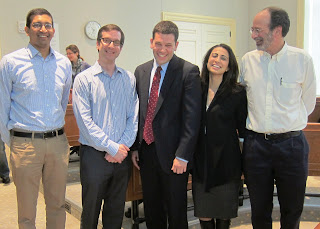
Wednesday, May 14, 2025

Matching Theory and Market Design: conference in Sicily.

 Here's the preliminary program for the

20th Matching in Practice Workshop  University of Messina, Department of Economics, Aula Magna 2, 15-16 May 2025

Thursday 15 May

9:00-9:15 Opening

9:15-11:00 Presentation session “Matching with externalities and equity concerns I” 

 Alexander Nesterov, Higher School of Economics  “Reserves in Targeted Admissions: A Mechanism Design Approach” 

 Guillaume Haeringer, Baruch College  “School Choice under Uncertainty: an Experiment” 

Antonio Romero Medina, Universidad Carlos III de Madrid  “Optimizing Daycare Enrollment: How To Avoid Early Applications”

11:00-11:15 Coffee break

11:15-13:00 Presentation session “Dynamic matching and incentives to participation I”

 Duygu Sili, Università degli Studi di Messina  “Costly Multi-Hospital Dynamic Kidney Exchange”

 Subhajit Pramanik, Università degli Studi di Padova  “A Dynamic Bargaining Framework for International Kidney Paired Exchange Program”

 Özgür Yilmaz, Koç University “Dynamically Optimal Kidney Exchange” 

13:00-14:00 Lunch

14:00-15:15 Seminar presented by the 2012 Nobel Prize in Economics Prof. Alvin Roth (Stanford University)  “The Economics of Kidney Exchange: Kidneys and Controversies”  (open to the public)

16:00-22:00 Departure to and walk across Taormina, with gala dinner to follow at Ristorante La Botte.

Friday 16 May

9:00-10:45 Presentation session “Matching with externalities and equity concerns II” 

Flip Klijn, Institute for Economic Analysis (CSIC) and Barcelona School of Economics  “Characterizing No-Trade-Bundled Top-Trading Cycles Mechanisms for Multiple-Type Housing Markets”

 Péter Biró, Institute of Economics, HUN-REN KRTK “Ex-post Stability under Two-Sided Matching: Complexity and Characterization”

 Emre Dogan, HSE University “Incentivizing Public Lawyers and Enhancing Fairness via Sorting in Adversarial Systems”

10:45-11:00 Coffee break

11:00-12:45 Presentation session “Dynamic matching and incentives to participation II”

 Pietro Salmaso, Università degli Studi di Napoli Federico II  “Rationalizable Conjectures in Dynamic Matching”

Johanna Raith, IHW – Leibniz Institute for Economic Research “College Application Choices in a Repeated DA Setting: Evidence from Croatia”

 Sonal Yadav, University of Liverpool “Teacher Redistribution in Public Schools”

12:45-13:40 Roundtable  “Organ-donor exchange programs, international comparison” Moderator Prof. Antonio Nicolò (Università degli Studi di Padova), with the participation of Prof. Alvin Roth (Stanford University) and Dr. Giuseppe Feltrin (National Transplant Center)

13:40-14:30 Farewell lunch.

 The MiP Workshop is an annual meeting organized by the Matching in Practice network of European researchers working in the research field of Matching Theory and Market Design.

This year’s MiP workshop is funded by the following projects: Prin2022 “Externalities and fairness in allocations and contracts” (CUP J53D23004650006 – ID 2022HLPMKN) and PrinPNRR2022 “Incentivizing participation of compatible pairs in Kidney Paired Exchange Programs” (CUP J53D23015460001- ID P2022P5CHH), both funded by the European Union – Next Generation EU.

The Organizing Committee includes the Messina Unit Manager of the aforementioned projects, Prof. Antonio Miralles Asensio, and the Principal Investigators of both funding projects, respectively Prof. Maria Gabriella Graziano (University of Naples Federico II) and Prof. Antonio Nicolò (University of Padua). External members of the Scientific Committee are Prof. Caterina Calsamiglia (IPEG and ICREA, Spain), Prof. Rustam Hakimov (Université de Lausanne, Switzerland) and Prof. Péter Biró (Hungarian Academy of Sciences, Hungary).


Tuesday, May 13, 2025

Air cargo: fish and electronics (and flowers and armaments)

 Haaretz has the story:

120 Tons of Missiles and Salmon: A Rare Trip on Board an Israeli 747 Cargo Plane by Anshel Pfeffer and Avi Scharf

"Whenever you receive a package ordered online from abroad or eat semi-fresh imported food, there's a good chance it was transported by a 747. Over 300 of these aircraft are still flying cargo across the world despite the fact that most of them are over 20 years old. There's a good reason for this: There is no aircraft in production today that's capable of flying over 120 tons of cargo (jumbos can manage up to about 130 tons), and there's nothing even remotely similar on the drawing board. Thus, 56 years after it first entered commercial service, the 747 is still flying freight – with no retirement in sight.
...

In terms of volume and weight, about 99 percent of international cargo is transported by sea or overland, in trucks and trains. The lone percent of physical goods flown on cargo planes, however, is worth more than one-third of global trade, or around $6 trillion a year. That includes electronic goods, pharmaceuticals and blood plasma, perishables such as fresh seafood, and of course any shipment that needs speedy delivery, like your latest order from Amazon or AliExpress, for which you've agreed to pay an added premium.


"In 2023 the global expenditure involved in shipping all airfreight crossed the $300-billion mark for the first time. It will hit $400 billion before the end of the decade. And that's why the old 747 will still be flying for years to come.

...
“ Pandemics and wars are the best of times for cargo airlines. Normally over half of the volume of airfreight is carried on passenger flights, in the hold next to passengers' luggage. There isn't much room there, for just a few tons at most for the extra cargo, but there are many more passenger flights than cargo flights. When passenger service is canceled as it was around the world during the COVID pandemic, or to and from Israel after October 7 – while at the same time people cooped up at home order a lot more online – the cargo fleets have to supply the missing haulage capacity. In 2023, nearly half the cargo into and out of Israel (151,000 tons out of 334,000) was transported on passenger flights. In 2024, after a full year of war during which non-Israeli airlines barely flew here, that proportion dropped to a little over one-quarter (95,000 tons out of 348,000). That's when the 747, which back in the early 1960s was first envisaged as a freighter, really came into its own.

...
"The 747 freighters that still fly around the world comprise around a quarter of all global cargo fleets. But thanks to their size, they carry half the volume of all goods shipped by air. Which comes in handy especially at time of war when Israel cannot wait for large quantities of munitions and other military equipment to be transported by sea."


Monday, May 12, 2025

Assisted living facilities: U.S. eldercare

As people live longer, we need to think harder about end-of-life and late-in-life care of all sorts.

 The Guardian has the story (much of which focuses on a particular difficult situation):

In the US, not even $11,000 a month can buy you dignity at the end of your life  by Laura Fraser

"how much longer will we accept a future where most of us lose our sense of human worth in old age?"

...

"Currently, about 65% of US elders are cared for by their families at home. For 13% of those who aren’t living with family, the gap is partially filled by assisted living establishments.

...

"Nursing homes, assisted living and memory care (special units for people with dementia) are interchangeable in many people’s minds. But there are big differences. Nursing homes, funded by Medicare and Medicaid, are federally regulated. Assisted living and memory care are state-regulated, and mostly paid for out of pocket; some states have subsidies for certain conditions, so about 20% of all assisted living costs are paid for by Medicaid. The median cost of care in the US is $5,900 a month, but ancillary services provided on top of that base rate, including extra skilled nursing care, and can bring that cost up to $20,000 a month.

...

"Assisted living and memory care communities are covered by a range of 350 licensing regulations that vary widely from state to state – but with little oversight or enforcement of what few regulations exist. Most regulations don’t require minimum staffing ratios, or are worded as “sufficient” to meet residents’ needs. While this standard is vague, some advocates say that being more prescriptive would be problematic given staffing availability, costs and residents’ needs. Caregivers are typically required to have only a few hours’ training; only about half of communities employ a nurse, usually voluntarily. State and regional long-term care ombudsmen have the right to enter and investigate and informally mediate complaints at these residences, but they have no ability to enforce regulations, other than making a complaint to the state licensing agency.

Sunday, May 11, 2025

Dating sites as matching markets: Bumble reimagined

The NYT interviews Whitney Wolfe Herd, who co-founded Twitter in 2012, started Bumble in 2014, stepped down as Bumble CEO and is now resuming that position, amidst some general malaise among dating apps, reflected in stock prices and drop-off in younger participants.  The interview is wide ranging and interesting. I'll excerpt two market design observations, both concerned with congestion--i.e. with the difficulty of curating and finding matches in a large market.

Here's the NYT interview:
Can Whitney Wolfe Herd Make Us Love Dating Apps Again?
  By Lulu Garcia-Navarro

"The next era of Bumble, you had a lot of growth during the pandemic when everyone was stuck on their apps. It was a huge moment. You go public in 2021, ring the bell, baby on your hip, and the very next year user growth starts to slow down. What do you think was happening? My opinion is that I ran this company for the first several years as a quality over quantity approach. A telephone provider came to us early on. They said, “We love your brand, we want to put your app preprogrammed on all of our phones and when people buy our phones, your app will be on the home screen, and you’re going to get millions of free downloads.” I said, “Thank you so much but no thank you.” Nobody could understand what in the world I was doing, and I said it’s the wrong way to grow. This is not a social network, this is a double-sided marketplace. One person gets on and they have to see someone that is relevant to them. If you flood the system just endlessly — you’re not going to walk down the streets of New York City and want to meet every single person you pass. Why would you assume that someone would want to do that on an app? This is not a content platform where you can just scroll and scroll and scroll and scale drives results. What happened was, in the pandemic and throughout other chapters, growth was king. It was hailed as the end all be all.

...

"You’re quite bullish on A.I. I’ve heard you talk about it. How are you imagining A.I. functioning in this next iteration of the app? Let’s say we could train A.I. on thousands of what we perceive as great profiles, and the A.I. can get so sophisticated at understanding: “Wow, this person has a thoughtful bio. This person has photos that are not blurry. They’re not all group photos. They’re not wearing sunglasses. We can see who they are clearly and we understand that they took time.” The A.I. can now select the best people and start showing the best people the best people and start getting you to a match quicker, more efficiently, more thoughtfully. The goal for Bumble over the next few years is to become the world’s smartest matchmaker. This is beyond love. We have a friend product with a very broad member base, and it’s really beautiful."

Saturday, May 10, 2025

NSF slashed again

The "S" in NSF has again attracted the attention of the Trump administration.

 The journal Science reports the story: 

 NSF faces radical shake-up as officials abolish its 37 divisions
Changes seen as a response to presidential directives on what research to fund
By Jeffrey Mervis

"The National Science Foundation (NSF), already battered by White House directives and staff reductions, is plunging into deeper turmoil. According to sources who requested anonymity for fear of retribution, staff were told today that the agency’s 37 divisions—across all eight NSF directorates—are being abolished and the number of programs within those divisions will be drastically reduced. The current directors and deputy directors will lose their titles and might be reassigned to other positions at the agency or elsewhere in the federal government.

The consolidation appears to be driven in part by President Donald Trump’s proposal to cut the agency’s $4 billion budget by 55% for the 2026 fiscal year that begins on 1 October. NSF’s decision to abolish its divisions could also be part of a larger restructuring of the agency’s grantmaking process that involves adding a new layer of review. NSF watchers fear that a smaller, restructured agency could be more vulnerable to pressure from the White House to fund research that suits its ideological bent.

As soon as this evening, NSF is also expected to send layoff notices to an unspecified number of its 1700-member staff. ... The agency is also expected to issue another round of notices tomorrow terminating grants that have already been awarded, sources say. In the past 3 weeks, the agency has pulled the plug on almost 1400 grants worth more than $1 billion."


Friday, May 9, 2025

Cacao, cocoa, and coca (Etymology meets botany, agriculture and health)

Cocoa and cacao and coca?  Which one of these three things is different from the other two? (I'll leave the harder question of milk versus dark chocolate to the end of the post...)

from Microsoft copilot:

"Coca refers to the Erythroxylum coca plant, native to South America. Its leaves have been traditionally used by indigenous cultures for medicinal and stimulant purposes. Coca contains cocaine alkaloids, which can be extracted to produce the drug cocaine. However, when consumed in its natural form—such as in teas or chewed leaves—it has mild stimulant effects similar to caffeine
 

"Cocoa and cacao come from...the Theobroma cacao tree—but they go through different processing methods, leading to distinct characteristics.
Cacao refers to the raw and less processed version of the seed from the cacao tree. It is typically cold-pressed to preserve its natural enzymes, antioxidants, and nutrients. Cacao nibs and powder have a slightly bitter and earthy flavor, making them popular in health-conscious recipes.
Cocoa, on the other hand, is cacao that has been roasted"


What is the etymology of cocoa and cacao?

"The word cacao comes from the Nahuatl (Aztec) word "cacahuatl," which means "cocoa bean". The cacao tree is native to Central and South America, and its cultivation dates back to at least 1500 BCE among the Mayans and Aztecs.
The word cocoa, on the other hand, is actually a corruption of "cacao" that emerged in English around the 18th century. The confusion likely arose due to the similarity between "cacao" and "coco" (which refers to the coconut), and the mistake was reinforced when dictionary printers accidentally merged the entries for "cocoa" and "coco". By the early 1800s, "cocoa" had become the standard spelling.
So, while "cacao" is the original term, "cocoa" became the more commonly used word in English, especially when referring to processed products like cocoa powder.

#########

Now for the important news on chocolate science from Harvard's School of Public Health:

Eating dark chocolate linked with reduced risk of type 2 diabetes By Maya Brownstein 

"Our findings suggest that not all chocolate is created equal,” said lead author Binkai Liu, doctoral student at the Harvard Kenneth C. Griffin Graduate School of Arts and Sciences, studying in the Harvard Chan School Department of Nutrition. “For anyone who loves chocolate, this is a reminder that making small choices, like choosing dark chocolate over milk chocolate, can make a positive difference to their health.”

The study was published online Dec. 4 in The BMJ.


Thursday, May 8, 2025

Politicians and statistics

 Statistics and politics go back along way: the word "statistics" apparently comes from "state" as in data about the state.

 Nature has a book review of

Politicians Manipulating Statistics: How they Do it and How to Oppose Them, by Michael Billig & Cristina Marinho Cambridge Univ. Press (2025)

Why politicians manipulate statistics — and what to do about it
Understanding the playbook that those in power use to twist numbers, and how they make others complicit, is only becoming more important in the post-truth world.

Book review By Ole J. Forsberg 

"Unsurprisingly, perhaps, the name Donald Trump looms large in this book, with a whole chapter devoted to the statistical misdemeanours of the “master manipulator”, from his first term in office to the aftermath of his defeat by Joe Biden in the 2020 US presidential election. 

...

"First, politicians manipulate statisticians, incentivizing them to produce manipulated statistics. Second, statisticians generate those manipulated numbers. Third, leaders use the manipulated statistics to manipulate their audiences."


Wednesday, May 7, 2025

International Workshop on Computational Social Choice (COMSOC 2025): call for papers

 Peter Biro writes:

The submission deadline for the 10th International Workshop on Computational Social Choice (COMSOC 2025) has been extended to May 11, 2025, 23:59 AoE (Anywhere on Earth).

Workshop site: https://urldefense.com/v3/__https://www.ac.tuwien.ac.at/comsoc2025__;!!OToaGQ!qOuZyXX6FOj6yqpijlPhOyx3jQmvUeFMtbBjjElR2UAUGTlYIOiXd59Pove0oPuWY2bOTPrmnM2YBJrh3vKj9dRw$


Submission portal: https://urldefense.com/v3/__https://cmt3.research.microsoft.com/COMSOC2025__;!!OToaGQ!qOuZyXX6FOj6yqpijlPhOyx3jQmvUeFMtbBjjElR2UAUGTlYIOiXd59Pove0oPuWY2bOTPrmnM2YBJrh3hf3ZXwr$

**Non-archival.** In line with COMSOC tradition, the workshop has no formal proceedings; work that is under review or already published elsewhere is therefore welcome, provided it falls within the scope outlined in the original call for papers below.

#########

"COMSOC 2025 is the 10th workshop in the interdisciplinary workshop series on Computational Social Choice. It will take place at the TU Wien, Vienna, Austria, from 17-19 September 2025."


Tuesday, May 6, 2025

Public Lecture on Market Design at Prague Castle, Wednesday, 7 May, 6 p.m

 I'll be speaking at Prague Castle: here's the official announcement:

Science at the Prague Castle: Who Gets What? The New Economics of Matching and Market Design 

Speaker: Alvin Roth

Al Roth is the Craig and Susan McCaw Professor of Economics at Stanford University and the George Gund Professor Emeritus of Economics and Business Administration at Harvard. He shared the 2012 Nobel memorial prize in Economics. He was President of the American Economic Association in 2017, and is a member of the National Academy of Science. He directed the redesign of the National Resident Matching Program, through which most American doctors find their first employment. He helped design the school choice systems used in several large American cities. He is one of the organizers and designers of kidney exchange in the United States, which helps incompatible patient-donor pairs find compatible kidneys for transplantation.   

*
Science-popularizing lecture from the series Science at the Prague Castle

Market design is an ancient human activity but a relatively new part of economics. It seeks to understand how the design of markets and marketplaces influences their performance, and to use this growing understanding to fix markets when they're broken, and to help establish markets where they are missing.  Many markets are matching markets, in which you can't just choose what you want, even if you can afford it: you also have to be chosen. In these markets, prices don’t do all the work. Examples of matching markets are labor markets (workers can't just choose where to work, nor can employers just choose who will work for them), school choice, and kidney exchange. I'll illustrate with examples from these. 

The lecture will be given in English.

Organized by Prague Castle Administration, Institute of Organic Chemistry and Biochemistry  of the CAS, and Charles University. Supported by IOCB Tech Foundation.

Date and place

Wednesday, 7 May, 6 p.m.
Lecture takes place in the lecture room in the Supreme Burgrave´s House
(entrance from the Golden Lane)
map


If you are interested in this lecture, please make reservation here.   Free admission

Monday, May 5, 2025

A tale of two (military) procurements

Procurement of custom made goods is hard. Especially when the need is in the future and the requirements are set by successive committees. Maybe it's possible to learn from experience.

 From Defense One:

The Army made a tank it doesn’t need and can’t use. Now it’s figuring out what to do with it.
The M10 Booker busted its requirements from the beginning. It’s a case study in how Army procurement wants to change. by Meghann Myers

"As the 101st Airborne Division prepared last year to receive their first M10 Bookers—armored combat vehicles designed specifically for infantry forces—staff planners realized something: eight of the 11 bridges on Fort Campbell would crack under the weight of the “light tank.”

It turns out that though the vehicle was initially conceptualized as relatively lightweight—airdroppable by C-130—the twists and turns of the Army requirements process had rendered the tank too heavy to roll across the infrastructure at the infantry-centric Kentucky post, and nobody had thought about that until it was too late.

“This is not a story of acquisition gone awry,” Alex Miller, the Army’s chief technology officer, told Defense One. “This is a story of the requirements process creating so much inertia that the Army couldn't get out of its own way, and it just kept rolling and rolling and rolling.”

###########

How cargo drones could reshape Marine Corps resupply
Medium-sized cargo drones could be key to effective distributed operations. One company is rushing to be the first to deliver them.
  by Patrick Tucker

"The Marine Corps is looking for medium-sized cargo drones to handle supply missions across the far-flung islands of the Pacific. One company hopes its acquisition of a drone from an uncrewed-logistics pioneer will put it in the running.

On Tuesday, Piasecki Aircraft Corporation announced it had acquired Kaman Air Vehicles’ KARGO program, a medium-lift drone that fits in a standard trailer and can lift a 500-pound payload for long distances, or a 1,000-pound payload for short missions of about 100 nautical miles, said President and CEO John Piasecki. But those numbers will likely change as the Marines examine their resupply needs more fully.

The Army and the Marines both need a variety of cargo drone types and payloads, from relatively small ones that only travel short distances to what Piasecki called medium-range drones, capable of carrying 500- to 800-pound payloads, as well as even heavier-duty ones. The Marines are discussing the tradeoffs of extending the payload requirement to 1,400 pounds, he said.

“It’s all [in] flux, and so we'll see how the Marine Corps requirements evolve,” Piasecki said."


Sunday, May 4, 2025

Air traffic control problems follow layoffs of air traffic control staff

 I'll be flying later today, so this news item caught my eye about a United flight from SFO to Newark that turned around over Nebraska and returned to California because of a lack of flight control at Newark. It turns out that Newark is among many airports whose control towers are understaffed.

United flight that was forced to return to SFO cited in Newark airport chaos  By Molly Burke, May 3, 2025 

"United Airlines Flight 1909, which departed San Francisco International Airport at 10:36 a.m. Monday, was in the air for nearly 2½ hours before turning around in Nebraska, according to FlightAware data. The flight was one of more than 100 canceled trips since Monday, with equipment failures at the Federal Aviation Administration creating serious delays and problems at Newark Liberty International Airport, CNN and Airways Magazine reported.

"The Newark-bound flight landed back at SFO around 4:04 p.m., nearly 5½ hours after passengers left the same city, flight tracking showed."

########

That story reminded me of this (surely unrelated) AP news story in February:

Trump begins firings of FAA staff just weeks after fatal DC plane crash  By  TARA COPP February 17, 2025

 " The Trump administration has begun firing several hundred Federal Aviation Administration employees, upending staff on a busy air travel weekend and just weeks after a January fatal midair collision at Ronald Reagan Washington National Airport."

#############

Think of all the money being saved on air traffic control support staff


Saturday, May 3, 2025

Ariel Rubinstein and coffee culture

 Stanford student Chuer Yang appreciates the great economist Ariel Rubinstein in the Stanford Daily:

Cappuccino catalysis  by Chuer Yang

 "I found economist Ariel Rubinstein’s Atlas of Cafes where one can think so long ago that I can’t even recall which rabbit hole I jumped down to get to it. In the vast treasure troves of cartography, this is one of my all-time favorites. The essence of the atlas is in the affix “where one can think.” The quality of coffee is completely irrelevant; the only criteria are the “atmosphere, lighting and noise level,” according to Rubinstein. The atlas is a community of those who like to steep their mornings in the synchronized chaos entailed by a simple cup of Joe. 


Traveler, Your (Digital) Footprints: Cappuccino catalysis

"Rubinstein puts it best in his manifesto:

“In the University of Cafés, no one demands that research must be useful. From the outset, there is an atmosphere of apparent idleness and lack of purpose at the coffee houses, which is the suitable atmosphere for basic research.”

##########

Here's an earlier post that touches on (outdoor) coffee culture at Stanford

Sunday, December 3, 2023 Photos from the daily market design activity at Stanford


Friday, May 2, 2025

How the 1930's looked in 1930, in Haaretz---"Misjudgment of the Nazis"

 The future is the hardest thing to predict.

Here's a recent story in Haaretz, looking back at their reporting from Germany in 1930 (and how it evolved as the 1930's evolved...)

'They'll Never Put Their Madness Into Action': Haaretz's Misjudgment of the Nazis by Ofer Aderet, April 23, 2025

“ Covering the up-and-coming Nazis in early-'30s Germany, Haaretz journalist Gershon Swet reassured his readers that 'it's hard to believe that any government will be able to limit the equal rights of Jews.' His colleague Yeshayahu Klinov was more prescient

“ Swet wrote, "Their platform – a jumble of cheap demagoguery and profound ignorance – is far from being realized. … Hitler, Goebbels … and all the other thugs know very well that their proclamations, demands and howls are likely to have more impact on the street than in actual life."

Thursday, May 1, 2025

Palliative care involves hard conversations

 JAMA has a viewpoint by several palliative care physicians reflecting on why they are sometimes "fired" by their patients, i.e. why patients with (potentially) terminal illnesses may stop talking to them.  The reasons range from not necessarily agreeing that their illness is terminal (their other physicians may be conveying more optimistic messages), to finding that the patient's thoughts  about ending their lives are documented in their medical record.

Why Good Palliative Care Clinicians Get Fired  by Abby R. Rosenberg, MD, MS, MA1,2; Elliot Rabinowitz, MD1,2; Robert M. Arnold, MD  JAMA. Published online April 14, 2025. doi:10.1001/jama.2025.4353

 
"Even the most seasoned palliative care clinician gets fired. In the past year, one of us was fired after asking whether a patient endorsing suicidal ideation had access to a gun; the patient requested not to see the palliative care team because we asked intrusive questions and documented the encounter. One of us was fired after supporting a family’s decision to discontinue life-sustaining therapies for their loved one with multisystem organ failure; the primary intensivist suggested palliative care overstepped in discussing options for which the family (and clinical teams) was not ready. And one of us was fired after sharing the impression that a patient with cancer was dying; the family suggested they preferred the oncologist’s version of a more hopeful future.

Although many health care clinicians have been fired by a patient or family, palliative care clinicians may be at increased risk for dismissal.1,2 We invite difficult conversations, confront people with news they prefer to avoid, and encourage otherwise taboo topics such as human frailty and death. Our focus on what may go wrong differs from other clinicians’ optimism and may be unwelcome to patients and health care teams alike. We acknowledge emotional vulnerability, explore uncertainty, uncover fears, and describe a future in which patients make difficult choices about how they live and how they die."

Wednesday, April 30, 2025

New/old paper, finally published, sadly still relevant: Kessler & Roth in AEJ:Policy

 Here's a paper, just published this week, which reports (now among other things) a field-in-the-lab experiment begun in August 2010 (when my coauthor Judd was just a kid--see photo below:-)  It was motivated by the shortage in organ transplants that has only grown since that time, because the growth in transplants hasn't kept pace with the growth in kidney disease.

Increasing Organ Donor Registration as a Means to Increase Transplantation: An Experiment with Actual Organ Donor Registrations  by Judd B. Kessler and Alvin E. Roth, American Economic Journal: Economic Policy vol. 17, no. 2, May 2025 (pp. 60–83) 

Abstract: The United States has a severe shortage of organs for transplant. Recently—inspired by research based on hypothetical choices—jurisdictions have tried to increase organ donor registrations by changing how the registration question is asked. We evaluate these changes with a novel "field-in-the-lab" experiment, in which subjects change their real organ donor status, and with new donor registration data collected from US states. A "yes/no" frame is not more effective than an "opt-in" frame, contradicting conclusions based on hypothetical choices, but other question wording can matter, and asking individuals to reconsider their donor status increases registrations.

#######

Earlier:

Monday, July 22, 2024 Don't take "No" for an answer in deceased organ donor registration (a paper forthcoming after ten+ years)


Tuesday, September 2, 2014 Don't take "No" for an answer: a reconsideration of how to do deceased donor registration


Wednesday, May 11, 2011 Pro-social behavior of all kinds: Judd Kessler


Tuesday, April 29, 2025

National Academy of Sciences Elects Members and International Members (4 economists: Steve Berry, Parag Pathak, Ed Leamer, and Sergiu Hart)

 Congratulations to all the new members, and to the four newly elected economists.

Of note: One of the economists is unusually young for this distinction, and one, who was not, passed away between the beginning and end of this year's election process.

National Academy of Sciences Elects Members and International Members

"The National Academy of Sciences announced today the election of 120 members and 30 international members in recognition of their distinguished and continuing achievements in original research.

 ...

Berry, Steven T.; David Swensen Professor, Department of Economics, Yale University, New Haven, Conn.

...

Pathak, Parag A.; Class of 1922 Professor of Economics, Department of Economics, Massachusetts Institute of Technology, Cambridge

...

Elected posthumously to the Academy:

Leamer, Edward E.; professor in economics and statistics, Department of Economics, University of California, Los Angeles

...

Newly elected international member

Hart, Sergiu; professor emeritus of mathematics and economics, Hebrew University of Jerusalem (Israel)

Mitch Watt defends his thesis

 Mitch Watt defends his thesis: Welcome to the club, Mitch.


Monday, April 28, 2025

Drinking less but paying more

 Bloomberg has the story:

We May Have Already Hit Peak Booze. A habit as old as civilization is fading from our society.  By David Fickling


Saturday, April 26, 2025

Prolific sperm donation and incest risk in the Netherlands

 The Guardian has the story:

‘Medical calamity’: dozens of Dutch sperm donors fathered at least 25 children.  Discovery that clinics have been breaking rules raises genetic risks in such a small, densely populated country  by Jon Henley 

"At least 85 sperm donors in the Netherlands have fathered 25 or more children, the national gynaecology and obstetrics organisation has said, after a new registration system showed fertility clinics have been breaking existing rules on sperm donation for decades.

"The NVOG said on Monday that some clinics had deliberately used sperm batches more than 25 times, exchanged sperm without the necessary paperwork or donors’ knowledge, and allowed the same donors to donate sperm at multiple clinics.

“The number of so-called ‘mass donors’ should be zero,” gynaecologist Marieke Schoonenberg told the TV show Nieuwsuur. “On behalf of the whole profession, we wish to apologise. We didn’t do things as they should have been done.”

"A law aimed at reducing the risk of involuntary incest and inbreeding should have barred donors from fathering more than 25 children in the Netherlands since 1992, but proved difficult to enforce because of strict privacy laws.

"The limit was lowered to 12 in 2018, but the means to enforce it – a national register of donors and mothers with a code system ensuring sperm from the same donor cannot be used in more than 12 conceptions – came into force, retroactively, only in April.

“As a result, we now know, for the first time, the exact number of children per donor,” Schoonenberg said. Since 2004, when donors’ right to anonymity was lifted, the data showed there had been at least 85 “mass donors” (defined as at least 25 conceptions) in the Netherlands, she said.

"Most were biological father to between 26 and 40 children, Schoonenberg said, although several had between 50 and 75. Among them were at least 10 fertility doctors, including Jan Karbaat, who illegally fathered at least 81 children at his clinic.

"The most prolific donor was Jonathan Jacob Meijer, the subject of the Netflix documentary The Man with 1,000 Kids, who is known to have fathered at least 550 children worldwide. More than 100 of Meijer’s children were conceived in Dutch clinics.

"Ties van der Meer, of Stichting Donorkind, a foundation that helps children trace their donor fathers, said the findings were a “medical calamity”. The data meant there were probably at least 3,000 children in the Netherlands with 25 or more half-brothers and sisters, he said."