Old repugnancies die hard...
Gay marriage is like slavery, Catholic leader says
"Britain’s most senior Catholic, Cardinal Keith O'Brien, has condemned gay marriage as an “aberration”, likening it to slavery and abortion."
"Cardinal Keith O'Brien said countries which legalise gay marriage are “shaming themselves” by going against the “natural law,” and should not consider their actions “progress”.
:
"He claimed same sex unions were the “thin end of the wedge” and would lead to the “further degeneration of society into immorality.”
************
And, in a related story
The Roman Catholic Church in England and Wales is intensifying its campaign against the government's plan to legalise same-sex marriage.
"In a letter being read in 2,500 parish churches, the Church's two most senior archbishops say the change would reduce the significance of marriage.
"The letter says Roman Catholics have a duty to make sure it does not happen.
Tuesday, March 13, 2012


Monday, March 12, 2012
John Campbell on Mortgage Market Design
John Campbell writes about Mortgage Market Design
"Although the US has roughly average levels of homeownership (67%) and mortgage debt
(72% of GDP), it is unusual in two other respects. Figure 3 plots the average number of
years that a mortgage carries a fixed rate. The lowest values (around 1 year) are in southern European countries such as Portugal, Spain, and Italy, where adjustable-rate mortgages predominate. The UK and Ireland similarly rely heavily on adjustable-rate mortgages.The average fixed-rate period is 5 years in Canada, 7-10 years in Belgium, France, and Germany, almost 20 years in Denmark, and 27 years in the US reflecting a roughly 90% market share for 30-year nominal fixed-rate mortgages. These instruments, which are taken for granted in the US, are anomalous within the global mortgage system.
"Figure 4 plots an index of government participation in housing finance, constructed by
the IMF (2011), against the homeownership rate. The IMF index combines information on subsidies to home purchases, government funding or guarantees for mortgage loans, preferential tax treatment for mortgage interest or capital gains on housing, and the existence of a dominant state-owned mortgage lender. The figure shows that US housing policy is highly interventionist, more so than any other country illustrated except Singapore. The high value of the government participation index for the US results from subsidies to low and middle income homebuyers, subsidized mortgage guarantees by the government sponsored entities (GSEs), and favorable tax treatment of mortgage borrowing and housing capital gains. The main stated goal of much US housing policy is to increase the homeownership rate, but as previously noted the US has only average homeownership, and more generally there is only a very weak positive cross-country correlation between housing market intervention and
homeownership."
...
"I argue that there is a legitimate public interest in a stable, efficient mortgage system and call for deliberate experimentation with mortgage market design. Although our theoretical understanding of mortgage markets is still quite weak relative to the theory that underpins classic applications of market design (to auctions and matching problems, for example), financial theory and theoretically grounded empirical research will be important for this enterprise. Thus mortgage research offers financial economists an exciting opportunity to contribute to the well-being of society.
"Although the US has roughly average levels of homeownership (67%) and mortgage debt
(72% of GDP), it is unusual in two other respects. Figure 3 plots the average number of
years that a mortgage carries a fixed rate. The lowest values (around 1 year) are in southern European countries such as Portugal, Spain, and Italy, where adjustable-rate mortgages predominate. The UK and Ireland similarly rely heavily on adjustable-rate mortgages.The average fixed-rate period is 5 years in Canada, 7-10 years in Belgium, France, and Germany, almost 20 years in Denmark, and 27 years in the US reflecting a roughly 90% market share for 30-year nominal fixed-rate mortgages. These instruments, which are taken for granted in the US, are anomalous within the global mortgage system.
"Figure 4 plots an index of government participation in housing finance, constructed by
the IMF (2011), against the homeownership rate. The IMF index combines information on subsidies to home purchases, government funding or guarantees for mortgage loans, preferential tax treatment for mortgage interest or capital gains on housing, and the existence of a dominant state-owned mortgage lender. The figure shows that US housing policy is highly interventionist, more so than any other country illustrated except Singapore. The high value of the government participation index for the US results from subsidies to low and middle income homebuyers, subsidized mortgage guarantees by the government sponsored entities (GSEs), and favorable tax treatment of mortgage borrowing and housing capital gains. The main stated goal of much US housing policy is to increase the homeownership rate, but as previously noted the US has only average homeownership, and more generally there is only a very weak positive cross-country correlation between housing market intervention and
homeownership."
...
"I argue that there is a legitimate public interest in a stable, efficient mortgage system and call for deliberate experimentation with mortgage market design. Although our theoretical understanding of mortgage markets is still quite weak relative to the theory that underpins classic applications of market design (to auctions and matching problems, for example), financial theory and theoretically grounded empirical research will be important for this enterprise. Thus mortgage research offers financial economists an exciting opportunity to contribute to the well-being of society.
Sunday, March 11, 2012
Summer school in algorithmic economics at CMU in August
The announcement is here.
Important dates
Confirmed speakers:
Important dates
- April 15, 2012: Application deadline
- May 6, 2012: Notification of selection
- August 6-10, 2012: Summer school
Confirmed speakers:
- Itai Ashlagi, MIT (Sloan)
- Avrim Blum, Carnegie Mellon (CS)
- Vincent Conitzer, Duke (CS & economics)
- Constantinos Daskalakis, MIT (EECS)
- Jason Hartline, Northwestern (EECS)
- Herve Moulin, Rice (economics)
- Eva Tardos, Cornell (CS)
- Rakesh Vohra, Northwestern (Kellogg)
- Leeat Yariv, Caltech (economics)
Saturday, March 10, 2012
Market design in Trento
13th Trento Summer School
Intensive course in Market Design: Theory and Pragmatics
Co-Directors:
Dan Friedman, Economics Department, Santa Cruz University
CA
David Parkes, School of Engineering and Applied Sciences,
Harvard University
Guest lecturers: Tuomas Sandholm, School of Computer Science, Carnegie Mellon University, Peter Cramton, Economics Department, University of Maryland, Paul J. Healy, Economics Department, Ohio State University, S. N. Muthu Muthukrishnan, Computer Science Department, Rutgers University, Estelle Cantillon, ECARES, Université Libre de Bruxelles
For the last
several centuries, markets have spread spontaneously and have organized an
increasing share of human activity. Globalization and information technologies
accelerated the process in the early 21st century and, at the same time, opened
unprecedented new opportunities for deliberate design.
Market design has much to learn from success stories like Amazon and eBay, online advertising, labour markets for medical interns and residents, wireless spectrum auction design, expressive auctions for sourcing, and mobile phone banking in the developing world. Market designers can also learn from disasters such as the California energy market of May 2000 through September 2001 and the credit-default swap market freeze in September 2008.
Market design is a multi-disciplinary problem with relevant expertise coming from economic theory, computer science, and operations research. Advances are made with the right combination of theory and pragmatics, with theoretical ideals balanced against requirements for computational and informational efficiency, as well as simplicity and robustness.
Market design has much to learn from success stories like Amazon and eBay, online advertising, labour markets for medical interns and residents, wireless spectrum auction design, expressive auctions for sourcing, and mobile phone banking in the developing world. Market designers can also learn from disasters such as the California energy market of May 2000 through September 2001 and the credit-default swap market freeze in September 2008.
Market design is a multi-disciplinary problem with relevant expertise coming from economic theory, computer science, and operations research. Advances are made with the right combination of theory and pragmatics, with theoretical ideals balanced against requirements for computational and informational efficiency, as well as simplicity and robustness.
The 2012 Trento
Summer School faculty will bring together experts from many fields:
- artificial intelligence and multi-agent systems
- experimental economics
- mechanism design theory
- prediction markets
- theoretical computer science
They will provide
an integrated series of lectures on topics such as
- two-sided platforms
- matching markets
- double auction markets
- virtual economies
- combinatorial auctions
Students participating in this Summer School will gain an up-to-date overview of the relevant theory, current evidence on what sorts of market formats work well under various conditions, and pragmatic issues that arise when theoretical paradigms meet real-world challenges.
In addition to overview lectures in the mornings, the school will feature intensive seminar-style discussions in the afternoons of participants’ research.
The Trento Summer Schools are intended for advanced graduate students and post-doctoral scholars in economics, computer science and operations research. People interested in participating in the Summer School are encouraged to apply by submitting a curriculum vitae, a two-page essay describing their interest in Market Design, a course transcript from their PhD program, including advanced examinations passed, two letters of recommendation, and statements about their current or projected research, along with relevant research papers, if any.
Applications are
due by Saturday, 17 march 2012. Persons interested in participating in the
Summer School should follow the application
procedure.
Admissions
decisions will be announced by 10 April 2012. All applicants will be informed by
e-mail about the results.
The sessions will
be held at Hotel Villa Madruzzo, Trento, Italy. All participants are required to
stay for the entire duration of the event. Food and accommodation will be
covered by the School (except for meals during the weekend) and participants
will have to cover travel expenses.
Please direct
logistical questions to the Summer School secretary (ccschool@economia.unitn.it).
This is the
13th of a series of intensive courses to be offered by the Cognitive
and Experimental Economics Laboratory (CEEL) with the financial support of John
S. Latsis Public Benefit Foundation, an Athens-based Foundation supporting
public benefit activities in Greece and abroad: www.latsis-foundation.org.
Previous courses were
offered in Computable Economics (2000, Director K. Vela Velupillai),
Experimental Economics (2001, Director Daniel Friedman), Adaptive Economic
Processes (2002, Director Peter Howitt), Behavioral Economics (2003, Directors
Daniel Friedman and David Laibson), Institutional Economics (2004, Director
Richard N. Langlois), Evolutionary Economic Dynamics (2005,Directors Ken Binmore
and Larry Samuelson), Agent-Based Computational Economics (2006, Directors Leigh
Tesfatsion and Robert Axtell), Agent-Based Finance (2007, Directors Cars Hommes
and Thomas Lux), Financial Instability and Crises (2008, Directors Domenico
Delli Gatti and Mauro Gallegati), Networks and Innovation (2009, Directors John
Padgett, Lee Fleming and Massimo Riccaboni), Macroeconomics and Financial Crises
(2010, Directors Peter Howitt, Daniel Heymann and Axel Leijonhufvud) and
Evolution of Social Preferences (2011, Directors Dan Friedman and Luigi Mittone)
|
Program
Directors: Axel Leijonhufvud, UCLA and University of Trento and
Enrico Zaninotto, University of Trento
Co-Directors
of the School:
Guest
Lecturers:Dan Friedman, Economics Department, Santa Cruz University CA David Parkes, School of Engineering and Applied Sciences, Harvard University Tuomas Sandholm, School of Computer Science, Carnegie Mellon University, Peter Cramton, Economics Department, University of Maryland, Paul J. Healy, Economics Department, Ohio State University, S. N. Muthu Muthukrishnan, Computer Science Department, Rutgers University, Estelle Cantillon, ECARES, Université Libre de Bruxelles Laboratory Director: Luigi Mittone, University of Trento
Lab Technical
Assistant: Marco Tecilla, University of Trento
Summer School
Secretary: ccschool@economia.unitn.it
The course is offered by the Cognitive and Experimental
Economics Laboratory CEEL of the University of Trento with the financial support
of John S. Latsis Public Benefit Foundation, an Athens-based Foundation
supporting public benefit activities in Greece and abroad: www.latsis-foundation.org.
|
Friday, March 9, 2012
More on Rosemarie Nagel's famous experiment in game theory
In an earlier post, I wrote about Nagel's guessing/beauty contest game: a famous experiment in game theory. Now Christoph Büren, Björn Frank and Rosemarie Nagel have written a brief note called A Historical Note on the Beauty Contest.
And here's the comic version of the game (from another earlier post which highlighted the connection to unraveling):

And here's the comic version of the game (from another earlier post which highlighted the connection to unraveling):
Thursday, March 8, 2012
The path to becoming a live kidney donor
Here's the story of an nondirected live kidney donor at the Cleveland Clinic: Sagamore Hills man finds that donating a kidney is no simple thing
From decision to donation took about six months, with a variety of physical and psychological screens to pass through.
From decision to donation took about six months, with a variety of physical and psychological screens to pass through.
Wednesday, March 7, 2012
A different shade of red
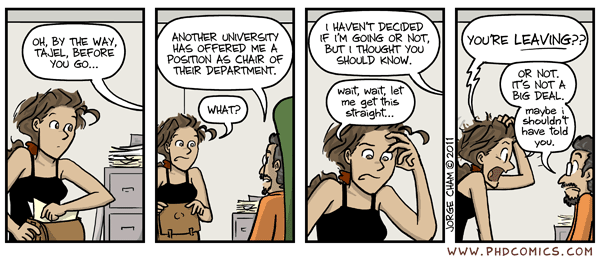 |
| http://www.phdcomics.com/comics/archive.php?comicid=1465 |
 |
| cardinal: Pantone 201 |
rgb(164, 16, 52) crimson
Who eats what

The Economist reports on The moral and culinary merits of exotic flesh
"Andrew Thornton, manager of the Budgens supermarket in the north London suburb of Crouch End, says sales of squirrel meat have soared since he started selling it in 2010.
"The bushy-tailed tree-dwellers are just one category in a burgeoning market. Osgrow, a British-based firm, exports bison, crocodile (“ideal for barbecues”) and kudu meat (“juicy and low-fat”) to customers in countries where controls on wild meat are tighter. One such market is Germany, where hygiene laws forbid the eating of “cat and doglike flesh”. The German environment ministry confirms that this includes squirrel; the country’s media mock English rat-eaters. Australia sent quantities of kangaroo meat to Russia until an import ban in 2009, ostensibly on hygiene grounds (it is now being reconsidered).
...
"No legal obstacle exists to eating the king of beasts, but roars of opposition prevented a restaurant in Tucson, Arizona, from selling lion flesh in tacos."
HT: NicolaLacetera
Tuesday, March 6, 2012
A language is a marketplace: Defending local languages versus teaching in English
A headline in Haaretz takes a strident tone on a sensitive issue, but the story presents both sides of a complicated argument, that revolves around the fact that not only are universities marketplaces, but so are languages: Israel's Academy of the Hebrew Language declares war – on English
"Tali Ben Yehuda, the academy's director-general, said "demands that students study in English represent the gravest expression of the trend" of minimizing Hebrew's role in academia. Demands that students speak or study in English constitute a phenomenon "that is expanding considerably."
"Tali Ben Yehuda, the academy's director-general, said "demands that students study in English represent the gravest expression of the trend" of minimizing Hebrew's role in academia. Demands that students speak or study in English constitute a phenomenon "that is expanding considerably."
"Unless steps are taken, she warned, "academic departments will instruct solely in English, and this will spread to the high schools, because a conscientious parent will not send his or her child to a high school that doesn't prepare the youngster for university study.
...
"Ben-Gurion University of the Negev's chemistry department has sent a letter in English to students saying that research papers written in Hebrew will no longer be accepted. It said advanced research seminars would be conducted in English. This is because "the language of science is English."
Yehuda Band, the head of the university's chemistry department, said last night that this English-use requirement did not apply to undergraduates. He said that "if someone tries to record research results in Hebrew, that consigns his or her work to oblivion - nobody will read the research summary. Every person who deals in science today in Israel reads English."
...
"According to Band, another argument in favor of English is Ben-Gurion University's desire to recruit foreign students. The moment there's a student in a class who doesn't speak Hebrew, the lesson has to be conducted in English.
"Of course, these circumstances make things harder for people whose native tongue is Hebrew, and yet the use of English is something that any scientist has to master to advance in his or her work," Band said. "If a researcher doesn't know English, he's finished. If he doesn't know how to write in English, he won't be able to publish on his own and will depend on the largesse of others."
Monday, March 5, 2012
Podcast on kidney exchange, and ethical issues in organ transplantation
The March 2012 issue of the AMA journal Virtual Mentor is a special issue on Organ Transplantation.
It contains a two part podcast of an interview with me about kidney exchange:
http://www.soundprescribing.org/podcast/ethics-talk-kidney-patient-donor-exchanges-part-one.mp3
http://www.soundprescribing.org/podcast/ethics-talk-kidney-patient-donor-exchanges-part-two.mp3
Organ Transplantation
It contains a two part podcast of an interview with me about kidney exchange:
http://www.soundprescribing.org/podcast/ethics-talk-kidney-patient-donor-exchanges-part-one.mp3
http://www.soundprescribing.org/podcast/ethics-talk-kidney-patient-donor-exchanges-part-two.mp3
Organ Transplantation
Ethics Poll
FROM THE EDITOR
The Frontiers of Organ Transplantation: “Oh, The Places We’ll Go”
Alon B. Neidich
Full Text | PDF
Virtual Mentor. 2012; 14:184-185.
Alon B. Neidich
Full Text | PDF
Virtual Mentor. 2012; 14:184-185.
EDUCATING FOR PROFESSIONALISM
Ethics Cases
Assessing the Motives of Living, Non-Related Donors
Commentary by Katrina A. Bramstedt, and Francis L. Delmonico
Full Text | PDF
Virtual Mentor. 2012; 14:186-189.
Commentary by Katrina A. Bramstedt, and Francis L. Delmonico
Full Text | PDF
Virtual Mentor. 2012; 14:186-189.
Should a Nonadherent Adolescent Receive a Second Kidney?
Commentary by John D. Lantos and Bradley A. Warady
Full Text | PDF
Virtual Mentor. 2012; 14:190-193.
Commentary by John D. Lantos and Bradley A. Warady
Full Text | PDF
Virtual Mentor. 2012; 14:190-193.
Family Physicians’ Role in Discussing Organ Donation with Patients and the Public
Commentary by Keren Ladin and Douglas W. Hanto
Full Text | PDF
Virtual Mentor. 2012; 14:194-200.
Commentary by Keren Ladin and Douglas W. Hanto
Full Text | PDF
Virtual Mentor. 2012; 14:194-200.
Medical Education
Online Ethics-Education Modules and Ethics Forums of the American Society of Transplant Surgeons
John M. Ham
Full Text | PDF
Virtual Mentor. 2012; 14:201-203.
John M. Ham
Full Text | PDF
Virtual Mentor. 2012; 14:201-203.
The Code Says
AMA Code of Medical Ethics’ Opinions on Organ Transplantation
Full Text | PDF
Virtual Mentor. 2012; 14:204-214.
Full Text | PDF
Virtual Mentor. 2012; 14:204-214.
Journal Discussion
Living-Donor Grafts for Patients with Hepatocellular Carcinoma
Mohamed Elhassan Akoad
Full Text | PDF
Virtual Mentor. 2012; 14:215-220.
Mohamed Elhassan Akoad
Full Text | PDF
Virtual Mentor. 2012; 14:215-220.
State of the Art and Science
Severe Brain Injury and Organ Solicitation: A Call for Temperance
Joseph J. Fins
Full Text | PDF
Virtual Mentor. 2012; 14:221-226.
Joseph J. Fins
Full Text | PDF
Virtual Mentor. 2012; 14:221-226.
LAW, POLICY, AND SOCIETY
Health Law
Reproductive Tissue Transplants Defy Legal and Ethical Categorization
Valarie Blake and Kavita Shah
Full Text | PDF
Virtual Mentor. 2012; 14:232-236.
Valarie Blake and Kavita Shah
Full Text | PDF
Virtual Mentor. 2012; 14:232-236.
Policy Forum
Contemporary Debates over the Acceptability of Kidneys for Donation
Benjamin Hippen
Full Text | PDF
Virtual Mentor. 2012; 14:237-244.
Benjamin Hippen
Full Text | PDF
Virtual Mentor. 2012; 14:237-244.
Rationing Livers: The Persistence of Geographic Inequity in Organ Allocation
Bruce C. Vladeck, Sander Florman, and Jonathan Cooper
Full Text | PDF
Virtual Mentor. 2012; 14:245-249.
Bruce C. Vladeck, Sander Florman, and Jonathan Cooper
Full Text | PDF
Virtual Mentor. 2012; 14:245-249.
Implications of the Affordable Care Act for Kidney Transplantation
Christine S. Rizk and Sanjiv N. Singh
Full Text | PDF
Virtual Mentor. 2012; 14:250-255.
Christine S. Rizk and Sanjiv N. Singh
Full Text | PDF
Virtual Mentor. 2012; 14:250-255.
Medicine and Society
HISTORY, ART, AND NARRATIVE
History of Medicine
The Ethics of Organ Transplantation: A Brief History
Albert R. Jonsen
Full Text | PDF
Virtual Mentor. 2012; 14:264-268.
Albert R. Jonsen
Full Text | PDF
Virtual Mentor. 2012; 14:264-268.
Medical Narrative
Liver Transplantation: The Illusion of Choice
Carol Panetta Zazula
Full Text | PDF
Virtual Mentor. 2012; 14:269-271.
Carol Panetta Zazula
Full Text | PDF
Virtual Mentor. 2012; 14:269-271.
OP-ED AND CORRESPONDENCE
Op-Ed
The Limits of Altruism: Selecting Living Donors
Richard B. Freeman Jr.
Full Text | PDF
Virtual Mentor. 2012; 14:272-277.
Richard B. Freeman Jr.
Full Text | PDF
Virtual Mentor. 2012; 14:272-277.
RESOURCES
Sunday, March 4, 2012
Organ donation in Britain
The BBC reports on a new report by the British Medical Association: BMA calls for fresh debate on rate of organ donation. It focuses on some of the same issues that have been discussed in the U.S. and elsewhere.
You can find the report here: Building on Progress: Where next for organ donation policy in the UK? (direct link to pdf here).
"This report documents the changes that have taken place since the Organ Donation Taskforce published its report in January 2008. It records the significant improvements that have been made to the infrastructure and the projected 34% increase in donation rates over the four years to April 2012. The report notes, however, that even if the Taskforce’s target of a 50% increase in donation rates by 2013 is achieved, people will still be dying unnecessarily while waiting for an organ.
"We believe that, as a society, we now need to decide whether we should be satisfied that we have done all we can or whether we should seek to build on what has already been achieved by shifting out attention to additional ways of increasing the number of organ donors.
"The report examines a range of options that have been suggested for increasing the number of donors including a system of mandated choice, reciprocity, a regulated market or paying the funeral expenses of those who sign up to the Organ Donor Register and subsequently donate organs. The report also explains why we remain convinced that an opt-out system with safeguards is the best option for the UK."
You can find the report here: Building on Progress: Where next for organ donation policy in the UK? (direct link to pdf here).
"This report documents the changes that have taken place since the Organ Donation Taskforce published its report in January 2008. It records the significant improvements that have been made to the infrastructure and the projected 34% increase in donation rates over the four years to April 2012. The report notes, however, that even if the Taskforce’s target of a 50% increase in donation rates by 2013 is achieved, people will still be dying unnecessarily while waiting for an organ.
"We believe that, as a society, we now need to decide whether we should be satisfied that we have done all we can or whether we should seek to build on what has already been achieved by shifting out attention to additional ways of increasing the number of organ donors.
"The report examines a range of options that have been suggested for increasing the number of donors including a system of mandated choice, reciprocity, a regulated market or paying the funeral expenses of those who sign up to the Organ Donor Register and subsequently donate organs. The report also explains why we remain convinced that an opt-out system with safeguards is the best option for the UK."
Saturday, March 3, 2012
Organ donation and kidney exchange in Canada
Canada maintains a number of registries for organ donors and patients, including one for kidney exchange (on which see also Q & A: How does the Canadian kidney exchange work?).
However, there's still a big shortage of organs from either deceased or living donors: Thousands still wait for transplants: Organ donor rates stagnate; kidneys most needed
See the report: Canadian Organ Replacement Register Annual Report: Treatment of End-Stage Organ Failure in Canada, 2001 to 2010
Friday, March 2, 2012
Fifth Barcelona LeeX Experimental Economics Summer School in Macroeconomics
Applications are now being accepted for the
Fifth Barcelona LeeX Experimental Economics Summer School
in Macroeconomics, BLESS-M-2012,
to be held: June 11-15 2012 at Universitat Pompeu Fabra in Barcelona, Spain.
The deadline for applications is 1 April 2012.
The aim of the summer school is to introduce
macroeconomists to experimental methods and to further promote the use of
experiments in the evaluation of macroeconomic models. While macroeconomic
theories have traditionally been tested using non-experimental “field” data,
many modern, micro-founded macroeconomic models can also be tested in the
laboratory and researchers have begun to pursue such experimental tests.
Graduate students specializing in macroeconomics or experimental economics, as
well as junior faculty members and other macroeconomic researchers who have an
interest in experimental or behavioral approaches are encouraged to apply.
During the intensive 5-day summer school students will be
taught experimental methods and exposed to a number of macroeconomic
applications that have been tested experimentally. Students will be asked to
participate in experiments and to develop their own experimental macroeconomic
projects. Faculty will assist with and critique these projects. Past summer schools have resulted in the
production of a number of high quality collaborative experimental projects.
For a detailed outline of the program, lectures and
application procedures, please visit the summer school website at: http://www.upf.edu/leex/events/bleess_2012/index.html
As last year the summer school will be followed by the
3rd Leex International Conference on Theoretical and Experimental Macroeconomics,
June 18-19, 2012. Registered summer school students will be invited to attend
that workshop as well. Details on this conference are available at: http://www.upf.edu/leex/
The summer school instructors are:
Guest lecturers
Charles Noussair, Tilburg University
Shyam Sunder, Yale University
Lecturers and Organizers
John Duffy, University of Pittsburgh
Frank Heinemann, Technische Universität Berlin Rosemarie
Nagel, ICREA, Universitat Pompeu Fabra
Thursday, March 1, 2012
Should unpaid internships be repugnant? (Many are already illegal...)
The NY Times hosts a debate: most of the debaters think the answer is "yes": Do Unpaid Internships Exploit College Students?
Alex Peysakhovich writes
"I talked to a friend of mine who is in the music
recording business about this. He started work in a studio as an unpaid intern
(for about 6 months) then got hired onto the staff. For reference: they usually
have about 3-4 interns and 1-2 staff in the studio during business hours, so
most of their labor hours come in from free sources (but it counts as training
since interns do most of the tech work).
"He gave me the "well, that's how the business
works... if they want to enter the business they need to put in the time."
He didn't really buy the "lots of unpaid internships are
exploitative" arguments making the, very economist point, that they're
giving a chance to let the interns signal their actual interest and ability.
"How much of this is selection (he thought it was ok so he
did it) vs how much is "it's hard to make a man understand something when
his paycheck depends on him not understanding it," I'm not sure."
Wednesday, February 29, 2012
From repugnant, to legal, to mandatory?
The Telegraph reports on the intersection of prostitution law (it's now legal) and unemployment law (you can lose your benefits if you turn down a job) in Germany: 'If you don't take a job as a prostitute, we can stop your benefits'
"A 25-year-old waitress who turned down a job providing "sexual services'' at a brothel in Berlin faces possible cuts to her unemployment benefit under laws introduced this year.
"Prostitution was legalised in Germany just over two years ago and brothel owners – who must pay tax and employee health insurance – were granted access to official databases of jobseekers.
"The waitress, an unemployed information technology professional, had said that she was willing to work in a bar at night and had worked in a cafe.
"She received a letter from the job centre telling her that an employer was interested in her "profile'' and that she should ring them. Only on doing so did the woman, who has not been identified for legal reasons, realise that she was calling a brothel.
"Under Germany's welfare reforms, any woman under 55 who has been out of work for more than a year can be forced to take an available job – including in the sex industry – or lose her unemployment benefit. Last month German unemployment rose for the 11th consecutive month to 4.5 million, taking the number out of work to its highest since reunification in 1990.
"The government had considered making brothels an exception on moral grounds, but decided that it would be too difficult to distinguish them from bars. As a result, job centres must treat employers looking for a prostitute in the same way as those looking for a dental nurse."
...
"Tatiana Ulyanova, who owns a brothel in central Berlin, has been searching the online database of her local job centre for recruits.
"Why shouldn't I look for employees through the job centre when I pay my taxes just like anybody else?" said Miss Ulyanova."
**************
So we have here a situation in which a formerly repugnant transaction became legal and might, under some circumstances become mandatory (at least for those seeking unemployment benefits). This reminds me of one of the better arguments against legalizing kidney sales and other payments to organ donors: once they were legal, some future Congress might want to make unemployment benefits available only to people who had already utilized their kidney resources, for example… See my posts on the fraught debate about compensation for donors.
HT: Itay Fainmesser
Update from the comments: no women have been forced into prostitution by this potential legal technicality...http://www.snopes.com/media/notnews/brothel.asp
"A 25-year-old waitress who turned down a job providing "sexual services'' at a brothel in Berlin faces possible cuts to her unemployment benefit under laws introduced this year.
"Prostitution was legalised in Germany just over two years ago and brothel owners – who must pay tax and employee health insurance – were granted access to official databases of jobseekers.
"The waitress, an unemployed information technology professional, had said that she was willing to work in a bar at night and had worked in a cafe.
"She received a letter from the job centre telling her that an employer was interested in her "profile'' and that she should ring them. Only on doing so did the woman, who has not been identified for legal reasons, realise that she was calling a brothel.
"Under Germany's welfare reforms, any woman under 55 who has been out of work for more than a year can be forced to take an available job – including in the sex industry – or lose her unemployment benefit. Last month German unemployment rose for the 11th consecutive month to 4.5 million, taking the number out of work to its highest since reunification in 1990.
"The government had considered making brothels an exception on moral grounds, but decided that it would be too difficult to distinguish them from bars. As a result, job centres must treat employers looking for a prostitute in the same way as those looking for a dental nurse."
...
"Tatiana Ulyanova, who owns a brothel in central Berlin, has been searching the online database of her local job centre for recruits.
"Why shouldn't I look for employees through the job centre when I pay my taxes just like anybody else?" said Miss Ulyanova."
**************
So we have here a situation in which a formerly repugnant transaction became legal and might, under some circumstances become mandatory (at least for those seeking unemployment benefits). This reminds me of one of the better arguments against legalizing kidney sales and other payments to organ donors: once they were legal, some future Congress might want to make unemployment benefits available only to people who had already utilized their kidney resources, for example… See my posts on the fraught debate about compensation for donors.
HT: Itay Fainmesser
Update from the comments: no women have been forced into prostitution by this potential legal technicality...http://www.snopes.com/media/notnews/brothel.asp
Tuesday, February 28, 2012
Just as well he's not the French president...
A recent story about the once likely presidential candidate Dominique Strauss-Kahn sheds some light on his lifestyle, and on French law regarding prostitution: French Police Detain Strauss-Kahn for Questioning
"Magistrates are investigating whether Mr. Strauss-Kahn was aware that women who entertained him were prostitutes. One of his lawyers, Henri Leclerc, has ridiculed the idea. “He could easily not have known, because as you can imagine, at these kinds of parties you’re not always dressed, and I challenge you to distinguish a naked prostitute from any other naked woman,” Mr. Leclerc told a French radio station, Europe 1, in December.
"Prosecutors are also seeking to determine whether Mr. Strauss-Kahn knew that some of the escorts may have been paid with embezzled funds. Prostitution is legal in France but it is unlawful to profit from vice or use embezzled funds to pay prostitutes."
"Magistrates are investigating whether Mr. Strauss-Kahn was aware that women who entertained him were prostitutes. One of his lawyers, Henri Leclerc, has ridiculed the idea. “He could easily not have known, because as you can imagine, at these kinds of parties you’re not always dressed, and I challenge you to distinguish a naked prostitute from any other naked woman,” Mr. Leclerc told a French radio station, Europe 1, in December.
"Prosecutors are also seeking to determine whether Mr. Strauss-Kahn knew that some of the escorts may have been paid with embezzled funds. Prostitution is legal in France but it is unlawful to profit from vice or use embezzled funds to pay prostitutes."
Monday, February 27, 2012
AEA announcements of a market design sort: conference organization and part-time teaching
The AEA announcement email of 2/13/12 contains the following bits of market design aimed at managing congestion in a thick market, and creating thickness in a thin one:
Econ-Harmony helps prospective AEA Annual Meetings individual paper submitters find others with similar interests who might join them to form a complete session submission, and provides an opportunity to volunteer as a session chair. Thirty-one percent of submitted complete sessions and 16% of submitted individual papers made it onto the 2012 Program; 39% of submitted complete sessions and 17 % of submitted individual papers made it onto the 2011 Program. Econ-Harmony is at http://www.aeaweb.org/econ-harmony/.
Retired Faculty Available for part-time or temporary teaching. JOE now lists retired economists interested in teaching on either a part-time or temporary basis at http://www.aeaweb.org/joe/available_faculty/. Individuals can add or delete their name any time. Listings are deleted on November 30; the service is closed during December and January, re-opening February 12.
Econ-Harmony helps prospective AEA Annual Meetings individual paper submitters find others with similar interests who might join them to form a complete session submission, and provides an opportunity to volunteer as a session chair. Thirty-one percent of submitted complete sessions and 16% of submitted individual papers made it onto the 2012 Program; 39% of submitted complete sessions and 17 % of submitted individual papers made it onto the 2011 Program. Econ-Harmony is at http://www.aeaweb.org/econ-harmony/.
Retired Faculty Available for part-time or temporary teaching. JOE now lists retired economists interested in teaching on either a part-time or temporary basis at http://www.aeaweb.org/joe/available_faculty/. Individuals can add or delete their name any time. Listings are deleted on November 30; the service is closed during December and January, re-opening February 12.
Sunday, February 26, 2012
Matching in Budapest in July: call for papers
First announcement and call for papers (with apologies if you receive this
more than once):
MATCH-UP 2012:
the Second International Workshop on Matching Under Preferences
19-20 July 2012
Budapest, Hungary
co-located with SING8: The 8th Spain-Italy-Netherlands Meeting
on Game Theory (http://sing8.iehas.hu)
Celebrating the 50th anniversary of the seminal paper by Gale and Shapley,
and following the success of the first MATCH-UP workshop in Reykjavík in
2008 (http://www.optimalmatching.com/workshop), we are organising another
interdisciplinary workshop on stable matchings and related topics.
Background
----------
Matching problems with preferences occur in widespread applications such
as the assignment of school-leavers to universities, junior doctors to
hospitals, students to campus housing, children to schools, kidney
transplant patients to donors and so on. The common thread is that
individuals have preference lists over the possible outcomes and the task
is to find a matching of the participants that is in some sense optimal
with respect to these preferences.
The remit of this workshop is to explore matching problems with
preferences from the perspective of algorithms and complexity, discrete
mathematics, combinatorial optimization, game theory, mechanism design
and economics, and thus a key objective is to bring together the research
communities of the related areas.
Invited speakers
----------------
* Nicole Immorlica, Northwestern University
* Rob Irving, University of Glasgow
* Fuhito Kojima, Stanford University (on leave at Columbia University)
* Tayfun Sönmez, Boston College
List of topics
--------------
The matching problems under consideration include, but are not limited to:
* two-sided matchings involving agents on both sides (e.g. college
admissions, resident allocation, job markets, school choice, etc.)
* two-sided matchings involving agents and items (e.g. house allocation,
course allocation, project allocation, assigning papers to reviewers,
school choice, etc.)
* one-sided matchings (roommates problem, kidney exchanges, etc.)
* matching with payments (assignment game, auctions, etc.)
Submissions
-----------
We call for two types of contributed papers.
Format A: original contribution
* at most 12 pages
* accepted papers will be published in proceedings (however, this should
not prevent the simultaneous or subsequent submission of contributed
papers to other workshops, conferences or journals)
Format B: not necessarily original work
* no page limit
* only the abstract will be published in proceedings
Authors should indicate which format type their paper should be considered
under.
Important dates
---------------
* Deadline for submission of contributed papers: 19 March 2012
* Notification of acceptance: 20 April 2012
* Early registration deadline: 18 May 2012
* Workshop: 19-20 July 2012
Organising committee
--------------------
* Péter Biró (Institute of Economics, Hungarian Academy of Sciences)
* Tamás Fleiner (Budapest University of Technology and Economics)
* David Manlove (University of Glasgow)
* Tamás Solymosi (Corvinus University, Budapest)
Programme committee
-------------------
* Péter Biró (Chair, Institute of Economics, Hungarian Academy of Sciences)
* Estelle Cantillon (Université Libre de Bruxelles)
* Katarína Cechlárová (Univerzita Pavla Jozefa Safárika)
* Paul Dütting (EPFL, Lausanne)
* Aytek Erdil (University of Cambridge)
* Tamás Fleiner (Budapest University of Technology and Economics)
* Guillaume Haeringer (Universitat Autonoma de Barcelona)
* Elena Inarra (University of the Basque Country)
* Zoltán Király (Eötvös Loránd University, Budapest)
* Flip Klijn (Universitat Autonoma de Barcelona)
* David Manlove (University of Glasgow)
* Eric McDermid (21st Century Technologies)
* Shuichi Miyazaki(Kyoto University)
* Marina Nunez (Universitat de Barcelona)
* Ildikó Schlotter (Budapest University of Technology and Economics)
* Tamás Solymosi (Corvinus University, Budapest)
Further information
-------------------
Saturday, February 25, 2012
Is it possible to be too young or too thin?
Could using too young or too thin fashion models become repugnant?
The NY Times is on the case: Checking Models’ IDs at the Door
"IN the five years since fashion designers got serious about protecting the health and well-being of young models, there has been a measurable improvement in the prevailing ideal of beauty as seen on the runways. Many of the top models working today, like Lara Stone, Joan Smalls and Arizona Muse, reflect a changing aesthetic toward healthier figures and at least some representation of diversity in race and age.
"And yet, season after season, we still see models who appear to be dangerously thin or...models who are as young as 14, even though designers and modeling agencies have pledged not to cast girls younger than 16 in the shows. If you believe them.
"Assessing the impact of a campaign to curb reckless behavior in their industry, Diane Von Furstenberg, the president of the Council of Fashion Designers of America, said this week that some progress had been made but that much work remained to be done. This season, the council urged its members to insist on seeing identification from models to prove that they are 16 by the time of their shows. (Ms. Von Furstenberg herself was embarrassed a year ago, when, after promoting the age requirement, it was discovered that one of the models in her own show was still 15.)
“If we haven’t done anything else,” Ms. Von Furstenberg said, measuring her words, “we certainly have created awareness.”
The NY Times is on the case: Checking Models’ IDs at the Door
"IN the five years since fashion designers got serious about protecting the health and well-being of young models, there has been a measurable improvement in the prevailing ideal of beauty as seen on the runways. Many of the top models working today, like Lara Stone, Joan Smalls and Arizona Muse, reflect a changing aesthetic toward healthier figures and at least some representation of diversity in race and age.
"And yet, season after season, we still see models who appear to be dangerously thin or...models who are as young as 14, even though designers and modeling agencies have pledged not to cast girls younger than 16 in the shows. If you believe them.
"Assessing the impact of a campaign to curb reckless behavior in their industry, Diane Von Furstenberg, the president of the Council of Fashion Designers of America, said this week that some progress had been made but that much work remained to be done. This season, the council urged its members to insist on seeing identification from models to prove that they are 16 by the time of their shows. (Ms. Von Furstenberg herself was embarrassed a year ago, when, after promoting the age requirement, it was discovered that one of the models in her own show was still 15.)
“If we haven’t done anything else,” Ms. Von Furstenberg said, measuring her words, “we certainly have created awareness.”
Friday, February 24, 2012
False positives in the reporting of experiments
Here's an article suggesting that _lots_ of false positives get introduced into the experimental literature, and they suggest some experimental protocols that if widely adopted by authors and journals might help reduce the number.
False-Positive Psychology: Undisclosed Flexibility in Data Collection and Analysis Allows Presenting Anything as Significant
by Joseph P. Simmons, Leif D. Nelson, and Uri Simonsohn
Psychological Science, November 2011, vol. 22, 1359-1366
"First, we show that despite empirical psychologists’ nominal endorsement of a low rate of false-positive findings (<_ .05), flexibility in data collection, analysis, and reporting dramatically increases actual false-positive rates. In many cases, a researcher is more likely to falsely find evidence that an effect exists than to correctly find evidence that it does not. We present computer simulations and a pair of actual experiments that demonstrate how unacceptably easy it is to accumulate (and report) statistically significant evidence for a false hypothesis. Second, we suggest a simple, low-cost, and straightforwardly effective disclosure-based solution to this problem. The solution involves six concrete requirements for authors and four guidelines for reviewers, all of which impose a minimal burden on the publication process."
**************
A very nice paper, in a venerable literature. See my earlier attempt, which also focused on more carefully reporting all aspects of how an experiment was conducted and reported.
Roth, A.E., "Lets Keep the Con out of Experimental Econ.: A Methodological Note" Empirical Economics (Special Issue on Experimental Economics), 1994, 19, 279-289.
HT: Eyal Ert
False-Positive Psychology: Undisclosed Flexibility in Data Collection and Analysis Allows Presenting Anything as Significant
by Joseph P. Simmons, Leif D. Nelson, and Uri Simonsohn
Psychological Science, November 2011, vol. 22, 1359-1366
"First, we show that despite empirical psychologists’ nominal endorsement of a low rate of false-positive findings (<_ .05), flexibility in data collection, analysis, and reporting dramatically increases actual false-positive rates. In many cases, a researcher is more likely to falsely find evidence that an effect exists than to correctly find evidence that it does not. We present computer simulations and a pair of actual experiments that demonstrate how unacceptably easy it is to accumulate (and report) statistically significant evidence for a false hypothesis. Second, we suggest a simple, low-cost, and straightforwardly effective disclosure-based solution to this problem. The solution involves six concrete requirements for authors and four guidelines for reviewers, all of which impose a minimal burden on the publication process."
**************
A very nice paper, in a venerable literature. See my earlier attempt, which also focused on more carefully reporting all aspects of how an experiment was conducted and reported.
Roth, A.E., "Lets Keep the Con out of Experimental Econ.: A Methodological Note" Empirical Economics (Special Issue on Experimental Economics), 1994, 19, 279-289.
HT: Eyal Ert
Subscribe to:
Comments (Atom)

 Posts
Posts

