Sunday, November 2, 2025

Surrogacy, and escrow accounts

 Surrogacy contracts involve a long term relationship, focused on a nine month pregnancy.  So commercial surrogacy depends on secure financial arrangements, which generally require funds to be held in escrow.  The WSJ article below documents that these escrow accounts are insufficiently regulated in some states, which can cause serious problems for surrogates and intended parents when the account holders are dishonest or careless.

Surrogacy Is a Multibillion-Dollar Business. Sometimes the Money Goes Missing.  "The growing industry has little regulation and many cases of financial abuse; escrow funds taken to pay gambling debts, buy bitcoin." By Ben Foldy
 

"Escrow companies, used in the majority of surrogacies, can handle millions of client dollars with almost no oversight, according to a Wall Street Journal review of court filings and interviews with parents and surrogates.

...

"The lack of regulation means that parents and surrogates frequently have little legal recourse and dim hopes of recovering lost funds. Already-pregnant surrogates must carry through with labor that they know they may not be paid for, while potentially being on the hook for medical bills they may not be able to afford. Parents face the prospect of messy litigation from unpaid surrogates. One couple whose surrogacy funds disappeared due to fraud before they were able to successfully transfer an embryo said they gave up hope for a pregnancy.

“Holding other people’s money is usually such a highly regulated industry,” said Andrew Bluebond, an attorney in Texas who helped Gallozzi look into what happened at SEAM. The surrogacy community’s relatively small size and intimate domain, Bluebond said, fostered a false sense of financial security.

“Rather than using the safeguards other industries use, they let their trust betray them,” he said. 

...

"Surrogacy has exploded into a multibillion-dollar industry, driven by increasing rates of infertility, expanded insurance coverage, the growing prevalence of LGBTQ families and an influx of couples from countries where the practice is illegal, including China. Last week, President Trump announced a deal aimed at lowering the price of medications used in IVF. 

There were around 10,850 transfers of embryos to surrogates in the U.S. in 2023 involving clinics reporting to the Society for Assisted Reproductive Technology, which says it represents clinics that perform around 95% of all procedures. That was up from 8,461 in 2021. The group’s data and other analyses expect an annual growth rate of about 15% over the coming years. About half of those embryo transfers resulted in successful deliveries.

Despite the growth, there are no federal laws regulating the financial or other aspects of surrogate pregnancies, and the practice is subject to a patchwork of state regulations. In Louisiana, for example, compensating surrogates is outlawed entirely. In a handful of other states, the contracts that often accompany surrogacy arrangements are legally unenforceable. 

...

"Last month, the nonprofit Society for Ethics in Egg Donation and Surrogacy, which functions as a kind of industry best-practices group in lieu of regulation, passed new guidelines for escrow accounts, although they have no binding power. The suggestions recommend escrow providers have relevant credentials, are subject to audits by certified accountants and have more than $10 million in bond coverage. " 


Saturday, November 1, 2025

European Economic Review Summer School in Experimental and Behavioral Economics, June 1-4, 2026.


 It's never too late to learn about experiments:

3rd European Economic Review Summer School  in Experimental and Behavioral Economics

The European Economic Review is pleased to announce their third Summer School in Experimental and Behavioral Economics to be held at ISEG in Lisbon from June 1 to June 4, 2026. The School will feature lectures by leading researchers in state-of-the-art topics in experimental and behavioral economics in addition to a research workshop. Throughout the School the students will be able to present their own research in poster sessions and receive feedback from leading faculty and fellow participants. 


The 3rd European Economic Review Summer School is very privileged to feature lectures by leading figures such as Isabelle Brocas (University of Southern California), Juan D. Carrillo (University of Southern California), Vincent Crawford (Oxford University and University of California at San Diego), Michalis Drouvelis (University of Birmingham), Ernst Fehr (University of Zurich) and David Levine (Royal Holloway University of London). The goal of the School is to deepen attendants’ understanding and knowledge of recent advances in the field of Experimental and Behavioral Economics. The topics taught will cover a broad range of methodologies such as theory, laboratory and field experiments, as well as applications. The School will provide a unique environment where students can expand their knowledge on topical research issues and engage with leading figures in the field. Scholars who have been admitted to the School will be taught the following subjects:


Further details on the content of the lectures, as well as background material, will be uploaded gradually in the Program of the School. 


The Summer School invites applications from Ph.D and MSc students in Economics, Business, Psychology, Behavioral Science, Political Science and related fields from all over the world. Faculty and professionals are also welcome. To apply to the School, please submit a CV using our Application Form. The deadline for applications is January 31, 2026. Decisions will be sent to applicants by February 14, 2026. 

Experimental economics at the University of Pittsburgh

 I recently had the opportunity to visit my old haunts at the University of Pittsburgh, and took part in a reopening and re-dedication of the famous experimental economics lab there. Here's the announcement:

 PEEL is officially back open after renovations

The Pittsburgh Experimental Economics Laboratory (PEEL) celebrated its grand reopening last week following substantial renovation. Led by PEEL Director Lise Vesterlund, the renovations allow Pitt to continue to lead as one of the preeminent experimental economics research universities in the country.

Alvin Roth, winner of the 2012 Nobel Memorial Prize in Economics, was on site to celebrate the event. Roth, who was the Andrew W. Mellon Professor of Economics at Pitt through the 1980s and 90s and is now a professor at Stanford University, founded the lab in 1988 alongside then-Pitt Professor John Kagel.  His original research at PEEL led to his Nobel Prize for market design and to his design of the National Residency Matching Program (NRMP) and the New England Program for Kidney Exchange.  

“Experiments are very powerful, and I think this [lab] is a huge advantage,” Roth said. “For a long time, economists thought of data as something that governments collected […] but when you do experiments, you can carefully control for what you think are relevant differences and understand causes much better.” 


 Vesterlund, who has held the Mellon chair in economics since 2007, has conducted countless experiments in the lab. Particularly influential has been her research assessing the impact of work assignment on gender differences in advancement, research that lead to her award-winning co-authored book The No Club: Putting a Stop to Women's Dead-End Work.  

Vesterlund says a well-functioning lab is the foundation for Pitt’s strong economics department. “PEEL is a world-renowned experimental economics laboratory.  It has been the home to countless seminal research findings. Findings that seeded fields in the profession and improved the way we design markets and organizations. Few institutions can maintain a well-functioning lab, and PEEL has been essential in drawing an exceptionally strong group of scholars to Pitt. The renovation will ensure that the University of Pittsburgh continues to be the center for cutting-edge research in experimental economics.” 

The ceremony included opening remarks from Dean Adam Leibovich before Vesterlund and Roth cut the ribbon, formally re-opening the lab. The renovated lab comprises 40 computer kiosks, where participants can engage with state-of-the-art research software and make choices that inform us about human decision-making.  

To learn more about research being conducted in the lab, you can visit the PEEL website.


Friday, October 31, 2025

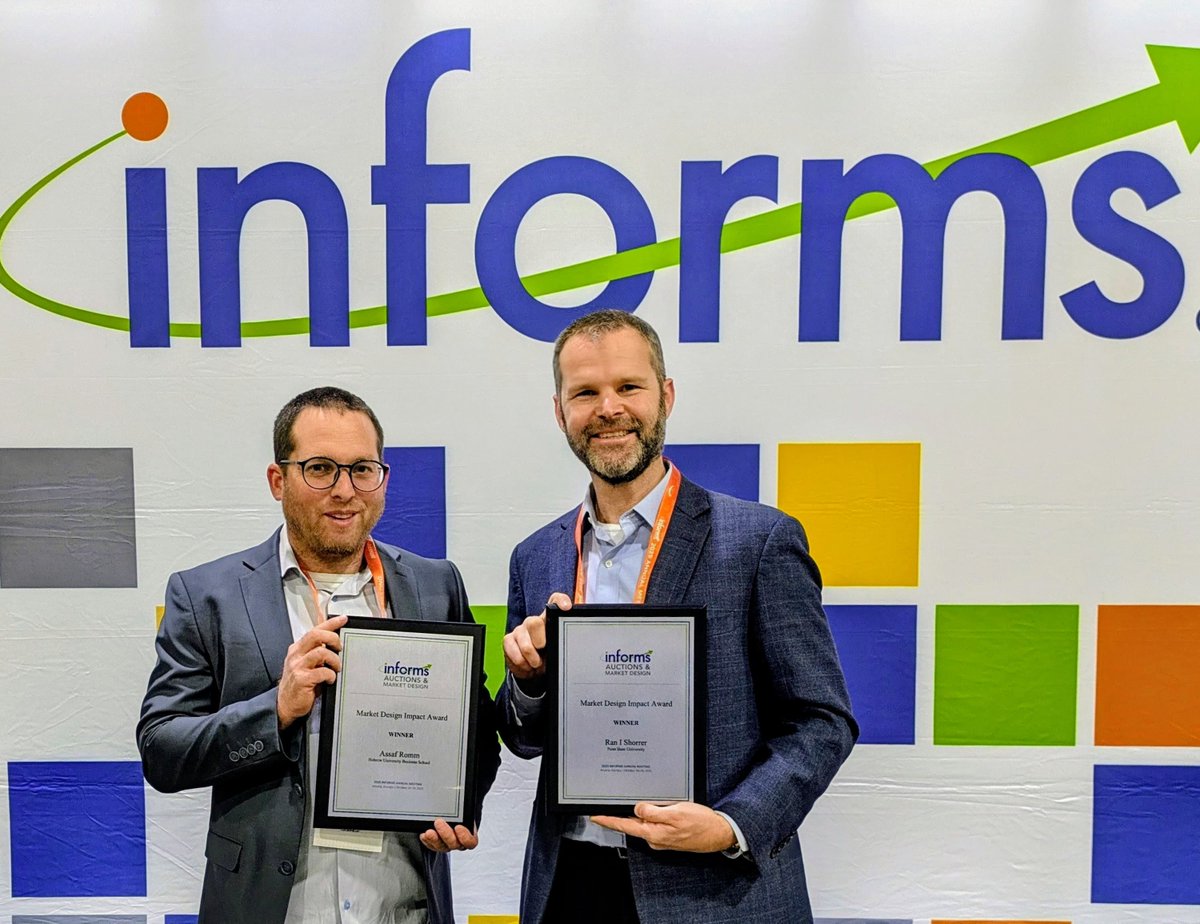
Market Design Impact Award to Hassidim, Romm, and Shorrer

 The Hebrew University breaks the news with this congratulatory message:

"Congratulations to our very own Assaf Romm  and coauthors! 🎉Assaf, along with Avinatan Hassidim and Ran Shorrer , has been awarded the inaugural INFORMS Auctions and Market Design (AMD) Market Design Impact Award- recognizing major contributions in market design over the past 15 years.
Their groundbreaking work has transformed both theory and practice, from redesigning Israel’s Psychology Master’s admissions and Pre-Military Academy programs to improving the medical internship match, impacting thousands of lives. Beyond implementation, their research revealed how real-world behavior can differ from theoretical predictions, helping to pioneer the field of behavioral market design.
Through innovative design, rigorous theory, and a deep understanding of human behavior, Assaf and his coauthors have shown how market design can address pressing social needs while advancing the field.
👏 Remarkable achievement! "


Two men in suits stand side by side holding framed award plaques with text reading INFORMS AMD Market Design Impact Award for Ran Shorrer and Assaf Romm in front of a large blue and green INFORMS logo on a gray background with colorful geometric squares 


I expect that a full(er) account will soon be given on the INFORMS  Market Design Impact Award  page 

Thursday, October 30, 2025

Funeral expense reimbursement to enhance organ donation and transplantation , by Chan and Sweat

 It's legal to pay funeral expenses for whole-body donors (for research) but not for organ donors for transplantation.  Here's a call to change that:

Chan, A., Sweat, K. Funeral expense reimbursement as a strategy to enhance organ donation and transplantation access. npj Health Syst. 2, 39 (2025). https://doi.org/10.1038/s44401-025-00046-z 

Abstract: We propose amending the National Organ Transplant Act to permit reimbursement of funeral expenses for deceased organ donors, analogous to current practices for whole-body donors. This ethically consistent policy could increase organ donation rates by 9–35%, saving 105,000–419,000 life-years and generating $200–800 million annually in Medicare savings—without commodifying human organs, compromising altruism, or undermining established ethical standards governing organ donation. 

Wednesday, October 29, 2025

The role of 'public entrepreneurs' in city government (and a shoutout to Jeremy Lack)

With a focus on New York City's mayoral election  next week,  this Bloomberg.com column considers things that mayors can do, including  school choice reform during the time Michael Bloomberg was mayor of NYC.  It points out the critical role played by Jeremy Lack when he was Director of Strategic Planning for the New York City Department of Education.

How Mayors Can Reclaim Government Efficiency
Amid budget cuts, city leaders are confronting how to get by with less.  By Cara Eckholm 

"Working with university researchers can offer exceptional value for money for cities. Researchers can deliver impartial analysis and technical skills that agencies struggle to hire — and are often willing to work at no cost to the city, in return for access to data and the ability to publish their findings.

"A strong illustration of the potential for impact comes from New York City. In 2003, Jeremy Lack, then the director of strategic planning at the Department of Education, reached out to economist Alvin Roth after reading about his work designing the medical residency match. The DOE had a problem: Its high school admissions process was leaving a third of students unmatched to any school they had ranked. Roth and his coauthors developed a new algorithm that solved the DOE’s matchmaking problem. The algorithm was so successful it was later copied in Boston, and contributed to Roth’s 2012 Nobel Prize.

"But the initial collaboration only happened thanks to the initiative of a public entrepreneur in an agency. Through setting up structured research exchanges, cities can make academic partnerships the norm, rather than the exception."

Tuesday, October 28, 2025

Yuck! and the long journey to a book title

 
As I mentioned in yesterday's post, I'm working on the galleys of my forthcoming book, Moral Economics. This has reminded me of the long journey to a book title.
 
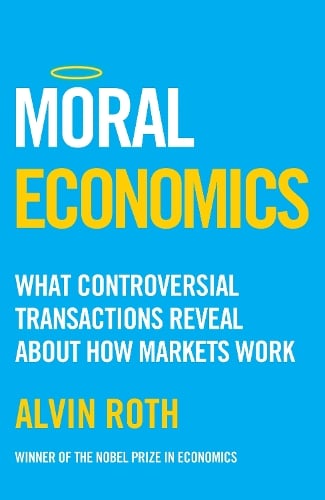
For one thing, the British title isn't exactly  the same as the American title--they have different subtitles. British readers will have to open the book to discover that prostitution and organ sales are among the topics covered, while American readers can see this on the cover.


 Moral Economics 

My original, working title was "Controversial Markets and Repugnant  Transactions," based in part on my 2007 article  "Repugnance as a Constraint on Markets".  But I soon realized that when non-economists heard me mention that a transaction was repugnant, they thought I meant that I didn't like it and that they shouldn't either, when what I did mean was merely that some people object to it, often on moral grounds.

So for a while my working title became "Controversial Markets and Morally Contested Transactions." 

That's descriptive, but clunky.  So I didn't resist too much when my publisher suggested "Moral Economics," although I worried that was too cryptic, so a sub-title would be needed.

And all of this is stored in a folder with the title "Yuck" that I opened on my hard drive when I first started to think about writing a book on repugnant transactions. 

Monday, October 27, 2025

New book! Moral Economics: From Prostitution to Organ Sales, What Controversial Transactions Reveal About How Markets Work--forthcoming!


 I have a forthcoming book, (at long last) and it now even has a cover. (Note the halo:)  I'm reading the galleys right now...


Moral Economics: From Prostitution to Organ Sales, What Controversial Transactions Reveal About How Markets Work    forthcoming – May 12, 2026

also available to preorder at other fine bookstores. (I'll be happy to autograph pre-orders that are mailed to me, btw...)


"A Nobel Prize–⁠winning economist shows us why we have to deal in trade-offs when we can’t agree on what’s right and what’s wrong

"Some of the most intractable controversies in our divided society are, at bottom, about what actions and transactions should be banned. Should women and couples be able to purchase contraception, access in vitro fertilization, and end pregnancy by obtaining an abortion? Should people be able to buy marijuana? What about fentanyl? Can someone be paid to donate blood plasma, or a kidney?

"Disagreements are fierce because arguments on both sides are often made in uncompromising moral or religious terms. But in Moral Economics, Nobel Prize–winning economist Alvin E. Roth asserts that we can make progress on these and other difficult topics if we view them as markets—tools to help decide who gets what—and understand how those markets can be fine-tuned to be more functional. Markets don’t have to allow everything or ban everything. Prudent market design can find a balance between preserving people’s rights to pursue their own interests and protecting the most vulnerable from harm.

"Combining Roth’s unparalleled expertise as market design pioneer with his incisive, witty accounts of complicated issues, Moral Economics offers a powerful and innovative new framework for resolving today’s hardest controversies. "


Sunday, October 26, 2025

Gender Differences in Economics Seminars (forthcoming in the AER)

 Economics seminars are complex, and not always tea parties. Here's a detailed look, by many investigators, via the analysis of many audio recordings.

Gender Differences in Economics Seminars
Pascaline Dupas Amy Handlan Alicia Sasser Modestino Muriel Niederle Mateo Sere Haoyu Sheng Justin Wolfers†
and the Seminar Dynamics Collective‡
 

Abstract
We assess whether men and women are treated differently when presenting their research in economics seminars. We collected data on every interaction between presenters and audience members across thousands of seminars, job market talks and conference presentations, leveraging both human judgment and audio processing algorithms to measure the number, tenor, tone and type of interruptions. Within a seminar series, women are interrupted more than men, and this finding holds when controlling for characteristics of the presenter and their paper topic and for audience size. Interruptions that may not be favorable to the presenter, such as those that are negative in tenor or tone, or cutoff the presenter mid-sentence, are common occurrences in economics seminars, and increase for women presenters. We also find greater engagement with female presenters in the form of larger, more diverse audiences, suggesting a potential role model effect. 

Saturday, October 25, 2025

Enhancing Scientific Integrity in the Social and Behavioral Sciences--Nominate an Expert for an NAS workshop

 The National Academies of Sciences, Engineering, and Medicine are soliciting nominations for a workshop on

 Enhancing Scientific Integrity: Progress and Opportunities in the Social and Behavioral Sciences - A Workshop

"This workshop will bring together researchers, journal editors, publishers, funders, and scientific association leaders to identify practical, forward-looking strategies for strengthening data integrity and transparency in the social and behavioral sciences. Participants will explore innovative tools and frameworks to detect and prevent errors, promote accountability, and reinforce public trust in research. Discussions will also consider how journals, institutions, and professional societies can adopt fair, sustainable practices that support scientific rigor while ensuring accessibility for researchers across many contexts and settings.

Deadline: November 7, 2025

Call for Experts

We invite you to submit suggestions for experts to participate in this activity. The call for experts closes on November 7, 2025 at 11:59 PM PST.

 "The National Academies of Sciences, Engineering, and Medicine proposes to convene a workshop to bring together diverse stakeholders, including journal editors, publishers, scientists, funding agencies, and scientific association leaders, to advance research and data integrity. The workshop will focus on identifying proactive, constructive strategies to enhance transparency and accountability in research practices. Key questions to be addressed include:

• How can the social and behavioral sciences continue to lead the way in advancing data integrity? What successful methods or frameworks from other disciplines might be adapted to strengthen these efforts?

• Could systematic, random audits of published data help detect and correct honest mistakes while discouraging malfeasance? What governance structures would ensure such efforts are fair, sustainable, and constructive? What new tools might facilitate this process?

• How can scientific journals refine their policies (e.g., review processes, data validation) to support transparency and integrity while maintaining accessibility for researchers across diverse contexts?

• What strategies can be employed to ensure potential solutions avoid placing undue burdens on researchers, especially those at institutions with limited resources?"

Friday, October 24, 2025

NBA gambling indictments

 The NYT has the story of the latest sports-gambling scandal in which several NBA players and veterans were arrested for giving gamblers information that certain players could be expected to underperform.


NBA gambling indictments  By Mike Vorkunov

" The alleged betting scheme feasted on and weaponized what law enforcement officials called non-public information about who wasn’t playing in future games. Several games were bet on because bettors found out that players would sit out for tanking teams trying to better position themselves for the league’s draft lottery. This is something the NBA has paid some attention to in the past, but now, it will have to be extremely strict about it. Injury reports have always been important to gamblers, but the indictments show how they can be used and potentially criminalized.

...

"There is a throughline to the Jontay Porter case from last year. Some of the same people were indicted today and named in the court filings that were arrested and named in the case related to Porter. That case also led to an FBI investigation into college basketball and game manipulation. 

######

And by coincidence, here's a timely New Yorker cartoon:

“Some people say sports betting has gone too far, but I like the on-field bookie.”
Cartoon by Brendan Loper October 7, 2025
 

Thursday, October 23, 2025

Algorithmic Collusion Without Threats

 Quanta magazine reports on a recent paper on algorithmic collusion (in which a big class of "dumb" strategies can settle on high prices):

The Game Theory of How Algorithms Can Drive Up Prices
Recent findings reveal that even simple pricing algorithms can make things more expensive
  by Ben Brubaker 

" how can regulators ensure that algorithms set fair prices? Their traditional approach won’t work, as it relies on finding explicit collusion. “The algorithms definitely are not having drinks with each other,” said Aaron Roth(opens a new tab), a computer scientist at the University of Pennsylvania.

...

" if you want to guarantee fair prices, why not just require sellers to use algorithms that are inherently incapable of expressing threats?

"In a recent paper(opens a new tab), Roth and four other computer scientists showed why this may not be enough. They proved that even seemingly benign algorithms that optimize for their own profit can sometimes yield bad outcomes for buyers. “You can still get high prices in ways that kind of look reasonable from the outside,” said Natalie Collina(opens a new tab), a graduate student working with Roth who co-authored the new study.

...

"“Without some notion of a threat or an agreement, it’s very hard for a regulator to come in and say, ‘These prices feel wrong,’” said Mallesh Pai(opens a new tab), an economist at Rice University. “That’s one reason why I think this paper is important.”

...

"So, what can regulators do? Roth admits he doesn’t have an answer. It wouldn’t make sense to ban no-swap-regret algorithms: If everyone uses one, prices will fall. But a simple nonresponsive strategy might be a natural choice for a seller on an online marketplace like Amazon, even if it carries the risk of regret.

“One way to have regret is just to be kind of dumb,” Roth said. “Historically, that hasn’t been illegal.”

#######

And here's the paper:

Algorithmic Collusion Without Threats 

There has been substantial recent concern that pricing algorithms might learn to ``collude.'' Supra-competitive prices can emerge as a Nash equilibrium of repeated pricing games, in which sellers play strategies which threaten to punish their competitors who refuse to support high prices, and these strategies can be automatically learned. In fact, a standard economic intuition is that supra-competitive prices emerge from either the use of threats, or a failure of one party to optimize their payoff. Is this intuition correct? Would preventing threats in algorithmic decision-making prevent supra-competitive prices when sellers are optimizing for their own revenue? No. We show that supra-competitive prices can emerge even when both players are using algorithms which do not encode threats, and which optimize for their own revenue. We study sequential pricing games in which a first mover deploys an algorithm and then a second mover optimizes within the resulting environment. We show that if the first mover deploys any algorithm with a no-regret guarantee, and then the second mover even approximately optimizes within this now static environment, monopoly-like prices arise. The result holds for any no-regret learning algorithm deployed by the first mover and for any pricing policy of the second mover that obtains them profit at least as high as a random pricing would -- and hence the result applies even when the second mover is optimizing only within a space of non-responsive pricing distributions which are incapable of encoding threats. In fact, there exists a set of strategies, neither of which explicitly encode threats that form a Nash equilibrium of the simultaneous pricing game in algorithm space, and lead to near monopoly prices. This suggests that the definition of ``algorithmic collusion'' may need to be expanded, to include strategies without explicitly encoded threats.