Showing posts with label post-Nobel. Show all posts

Friday, October 2, 2026

International Workshop on Bounded Rationality In honour of Professor Reinhard Selten. Poznań, 5 October 2026

 On what would have been his 96th birthday, a hybrid (in person and online) conference in honor of the late Reinhard Selten.

 Here's the announcement: 

International Workshop on Bounded Rationality In honour of Professor Reinhard Selten – the man who changed the way we think about rationality,   Poznań, 5 October 2026 

Poznań University of Economics and Business – Hybrid event (on-site and online)

Dear Researchers, Doctoral Students and Students,

It is our great pleasure to invite you to a unique International Workshop on Bounded Rationality, held in honour of Professor Reinhard Selten – Nobel Laureate in Economics, co-founder of experimental economics and game theory, and a man deeply connected with Poznań, where he lived and passed away.

The event will take place on 5 October 2026, exactly on the day Professor Selten would have celebrated his 96th birthday. This is a perfect opportunity to pay tribute to his remarkable scientific legacy and to draw inspiration from his approach to the study of human rationality.

The event is held under the honorary patronage of the Rector of Poznań University of Economics and Business.

Why should you attend?

  • Outstanding speakers from around the world – including Prof. Rosemarie Nagel, Prof. Eyal Winter, Prof. Daniel Friedman, Prof. Werner Güth, Prof. Eric Guerci, Prof. Ido Erev, Prof. Vincent Crawford, Prof. Axel Ockenfels, Prof. Tibor Neugebauer and Prof. Karim Sadrieh.
  • Current research directions in bounded rationality – from game theory, through experimental economics, to behavioural finance.
  • A unique atmosphere – the workshop combines an on-site session in Poznań with online sessions, enabling participants from all over the world to take part.
  • Honouring Professor Selten’s legacy – his work continues to inspire researchers to push the boundaries of traditional economics.

A few words about the programme

The workshop is divided into three sessions:

  • Morning session– chaired by Prof. Marcin Anholcer. Speakers include Prof. Tibor Neugebauer, Prof. Rosemarie Nagel, Prof. Eyal Winter and Prof. Karim Sadrieh.
  • Afternoon session– chaired by Prof. Krzysztof Malaga. Talks will be given by, among others, Prof. Daniel Friedman, Prof. Werner Güth and Prof. Eric Guerci.
  • Final session– chaired by Prof. Tibor Neugebauer. Speakers include Prof. Ido Erev and Prof. Vincent Crawford.

Each scientific talk lasts 30 minutes. The full programme is presented below.

Workshop programme

All times are Central European Summer Time (CEST).

Morning session – chaired by Prof. Marcin Anholcer (Poznań University of Economics and Business)

  • 9:55 – Opening words · Prof. Marcin Anholcer, Vice-Rector for Scientific Research
  • 10:00 – Prof. Tibor Neugebauer (University of Luxembourg)
    Reinhard Selten’s Life and Bounded Rationality
  • 10:30 – Prof. Rosemarie Nagel (Universitat Pompeu Fabra & ICREA, Barcelona)
    Understanding Human Behavior and Games through Similarity. And how Selten Led Me to 2×2 Games
  • 11:00 – Prof. Eyal Winter (Hebrew University of Jerusalem & Lancaster University)
    Spillover Effects Across Interactive Environments and Social Pollution
  • 11:30 – Prof. Karim Sadrieh (University of Magdeburg)
    Selten’s Impulse Balance Equilibrium: a literature survey and a numerical approach
  • 12:00 – Lunch & informal discussion

Afternoon session – chaired by Prof. Krzysztof Malaga (Poznań University of Economics and Business)

  • 14:15 – Prof. Daniel Friedman (University of California, Santa Cruz)
    Evolving Overconfident Managers
  • 14:45 – Prof. Werner Güth (Max Planck Institute for Research on Behavioral Economics, Bonn)
    (Un)Absorbability of Behavioral Decision Theory — Ideal or Warning —
  • 15:15 – Prof. Eric Guerci (Université Côte d’Azur, Nice)
    Learning to Forecast: A lab-in-the-field experiment with finance professionals
  • 15:45 – Break
  • 15:45 – Prof. Axel Ockenfels (University of Cologne & Max Planck Institute for Research on Behavioral Economics, Bonn)
    Personal address

Final session – chaired by Prof. Tibor Neugebauer

  • 16:00 – Prof. Ido Erev (Technion — Israel Institute of Technology)
    The Coexistence of Under-Investment and Under-Diversification
  • 16:30 – Prof. Vincent Crawford (University of Oxford & UC San Diego)
    Strategic Thinking

Online participation – how to join?

The workshop can be followed free of charge online via the Zoom platform. Participants from all over the world are warmly welcome!

Zoom meeting link:
https://ue-poznan-pl.zoom.us/j/92747785836?pwd=9rDmnm33aD2YJeWNGZPmIkMghNYjpQ.1

Meeting chat link:
https://ue-poznan-pl.zoom.us/launch/jc/92747785836

Meeting ID: 927 4778 5836
Access code: 115438

Start time: 5 October 2026, 8:45 AM Warsaw time


Friday, September 18, 2026

Micheal Kremer's next (post-Nobel) Act: The World Bank

 Michael Kremer, one of the most  creative and dedicated economists of our time, has found his next act, at the World Bank.  (Sometimes the news is encouraging, even nowadays.)

Here's the press release from the World Bank. 

Michael Kremer Appointed as World Bank Group Chief Economist

"WASHINGTON, September 16, 2026—World Bank Group President Ajay Banga announced that Nobel laureate Michael Kremer has been appointed as World Bank Group Chief Economist and Senior Vice President for Development Economics, bringing one of the world’s foremost development economists to lead the institution’s research, data, and analytical agenda.

"Kremer is known not only for tackling real-world problems through innovative solutions grounded in rigorous research but also for translating his findings into programs that have reached hundreds of millions of people, from expanding vaccine access and school health programs to supporting smallholder farmers." 

Tuesday, July 7, 2026

The first minutes after being informed of a Nobel prize

 Here's a one-minute BBC audio recording that somehow found its way into my news feed, of me being queried on the phone in the minutes after the announcement of the 2012 Nobel Prize.  It must have been around 4am in California, and you can tell I wasn't prepared to answer the questions :)

Alvin Roth glad to share Nobel Prize with Lloyd Shapley 

"The Nobel Foundation cited the US academics for their work on the "theory of stable allocations and practice of market design".


Here's a transcript I made now with the voice recorder app on my iPhone: I put "..." wherever the transcript has me in a long pause or re-starting a sentence (it's apparentI was answering these questions for the first time...)

"No, it wasn't expected, but, ... it certainly was expected that Lloyd Shapley should win the prize. It would have been a grave oversight if he did not, so I'm glad to share it with him.
 

Caller: So, what does this prize mean to you and your profession?
 

... I don't know yet. ... of course, it sheds a bright spotlight on the work...

Caller: So that's a good thing.

You know, my colleagues and I work in an area that we're calling market design, which is sort of a newish area of economics, and I'm sure that when I go to class this morning, my students will pay more attention...

Caller:Yeah, that's a good thing, isn't it?  I know it's early in the morning, but I will ask you anyway.  Can you tell us of the reasons for your interest in this field of economic theory?

...

Well, ...you can't be an economist without noticing all the interesting things that we don't understand about the way economy works.

So, ... this is a prize for matching, and many of the most important things we do in our lives, from getting into university, to getting married, to getting jobs, are matching.  So, I think it's a very natural thing to be interested in, and I'm privileged to have been able to study it." 

Friday, March 20, 2026

PS 205: A brief address to my elementary school alma mater, about science in grade school

 A few weeks ago I was surprised to receive this email from a teacher at the elementary school that I attended, PS 205, in the New York City borough of Queens:

"Dear Mr. Roth,

I am a teacher at The Alexander Graham Bell School, PS 205 in Bayside, NY.

This is my 29th year teaching at this school and it is still an amazing school where children acquire the skills to blossom as adults!

It is my understanding that you are a graduate of this school.

We are holding a Career Day on Friday, March 6, 2026.

It would be wonderful if you could participate in some way, whether in person, zoom pre-recorded video or by another method.

As a Nobel Prize winner, this would be very inspiring for our students.

Please let me know if you would like to be part of this awesome event."


After some further correspondence, I sent a video greeting of a bit over a minute.  Here's the transcript:
 

 Transcript:

"Hi PS 205!  I hear that you’re having career day today.


  Mr Blum asked me to say a few words about how my career began to take shape when I was a student at PS 205, way back before your parents were born. I was a PS 205 student from 1957 to 1962, and it was in those years that I started to think about becoming a scientist.


In 1957, when I started school, the Sputnik satellite was launched by Russia, and in 1961 the first American astronaut, Allan Shepherd, rocketed into space. So science was in the news.  My big brother Ted (who was also a PS 205 student, four years older than me) was excited by the idea of becoming a scientist, and that made me excited too. And pretty soon I was entering the school’s annual science fairs, with demonstrations of scientific things.


When I grew up I did become a scientist, a social scientist.  I’m  an economist, which allows me to study how we humans coordinate and cooperate and compete with each other, in ways that have made us, on average, live longer and healthier lives. In fact one of the things I have worked on is to help doctors organize how more people can get kidney transplants if they need them, which helps them live longer and healthier lives.

Science can be a lot of fun.  In 2012 I won the Nobel Prize in Economics, which means I got to go to a big celebration of science and literature in Sweden, which almost everyone in that country watches on television. It’s sort of like their Super Bowl.

I can only imagine the things that you will do as you grow up. It will be an adventure."

Saturday, January 17, 2026

The post-Nobel career of Adam Riess, and controversies in cosmology

The Atlantic has a story about a controversy in cosmology about the expansion of the universe, and whether its explanation requires the hypothesis of dark energy.  But what caught my eye is the author's apparent surprise that a Nobel laureate at the center of the controversy continued his research career, post-Nobel.

Here's the link, and the paragraphs that caught my eye: 

The Nobel Prize Winner Who Thinks We Have the Universe All Wrong  Cosmologists are fighting over everything.  By Ross Andersen 

  "Adam Riess was 27 years old when he began the work that earned him the Nobel Prize in Physics, and just 41 when he received it.

...

"When he returned from Stockholm with his prize in 2011, he found that his academic life had changed. People around him started to behave oddly, he told me. Some clammed up. Others argued with him about trivial things, he said, perhaps so they could boast of having dunked on a Nobel laureate. Riess was besieged with invitations to sit on panels, give talks, and judge science fairs. He was asked to comment on political issues that he knew nothing about. He told me he was even recruited to run major scientific institutions. 

"Riess wondered about that path—being the big boss of a NASA mission or gliding around a leafy university as its chancellor. He could see the appeal, but he hated fundraising, and unlike other, older Nobel laureates, he said, Riess still felt that he had scientific contributions to make, not as an administrator, but as a frontline investigator of capital-n Nature. “Scientists sometimes tell themselves this myth: I’ll go lead this thing, and then I’ll come back and do research,” he told me. But then, by the time they’ve finished up with their administrative roles, they’ve lost touch with the data. They become clumsy with the latest software languages. “The science passes them by,” Riess said.

"Riess decided to stick with research. "

Saturday, November 22, 2025

Philippe Aghion interview in the Financial Times

The FT has lunch with Philippe Aghion:

  Economist Philippe Aghion: ‘Macron’s legacy will be better than people think’
France’s new Nobel laureate on stimulating growth, the power of creative destruction — and why Karl Lagerfeld helped him with his homework by
 Ian Johnston

    “I would see politicians articulating economic reasonings and getting to opposite conclusions,” he recalls. “That’s how I came to economics. I need to understand the world to transform the world: that was my motivation.”
,,,

“Zucman would kill Mistral,” he says. “France just becomes a Camembert country. We’d just produce Camembert, which is great, but no more AI.”

,,,
     “I push the young people with me to be better than me,” he says. “That’s why I chose creative destruction, because the day I become obsolete, it validates the theory.”


Monday, October 6, 2025

Guido Imbens reflects on "What’s it like to win a Nobel Prize?

 What’s it like to win a Nobel Prize? 

"Stanford physical chemist W.E. Moerner, who received the 2014 Nobel Prize in chemistry, and Stanford economist Guido W. Imbens, who received the 2021 Nobel Memorial Prize in economic sciences, reflect on what changed – and what didn’t – after receiving the award."

"Where were you when you learned you had won?

Imbens: I was at home and was woken up by a call from Sweden. It’s just this very strange sensation as they tell you, “Congratulations, we’ve voted to award you the prize and we’re going to have a press conference in half an hour.” So you have this half hour where there’s nothing happening, but there’s also a lot happening. It was this very delightful, exciting moment when the rest of the world didn’t know yet. Once it was announced, there were telephone calls and interviews the whole night and morning. Stanford sent over a team for video, photos, and to help with the press. Our kids made pancakes for the Stanford crew, who had the idea of having the three kids interview me, and the video is an absolute highlight from that morning.

 ...

How did winning the prize change your life?

Imbens: It does change the way people outside of academics treat you, and it opens up a lot of new opportunities. The Swedes are very keen on having people take on this role model part, and they took us to high schools there to talk to the students. That was a very nice and fun experience. The attention and invitations die down, but as far as I hear from other people, it doesn’t really go away. It’s a permanent change.

Within the academic world, it doesn’t change things all that much. I still write my papers, I submit my papers, I get them rejected. But it has broadened my research and changed a little bit of what I try to do. I spend more time trying to leverage what I do by working with students and other groups to do what I can to push the field forward.

...

The Nobel Prize Museum in Stockholm exhibits artifacts from past laureates that offer a glimpse into their lives and work. What object did you donate?

Imbens: When I did the work with Josh Angrist for which I got the prize, we were living in Harvard faculty housing and we didn’t have laundry facilities there. On Saturday mornings we would go to the local laundromat and do our laundry. That’s where we worked on the paper for which we won the prize. So I donated a bottle of laundry detergent to the museum. Recently, the museum had an advertising campaign and they had posters with “the detergent that changed the world.”

###########

And here's an article in Nature about other science prizes, and how none of them have yet captured the world's attention the way the Nobels have:

These science prizes want to rival the Nobels: how do they compare?
By Chris Simms 

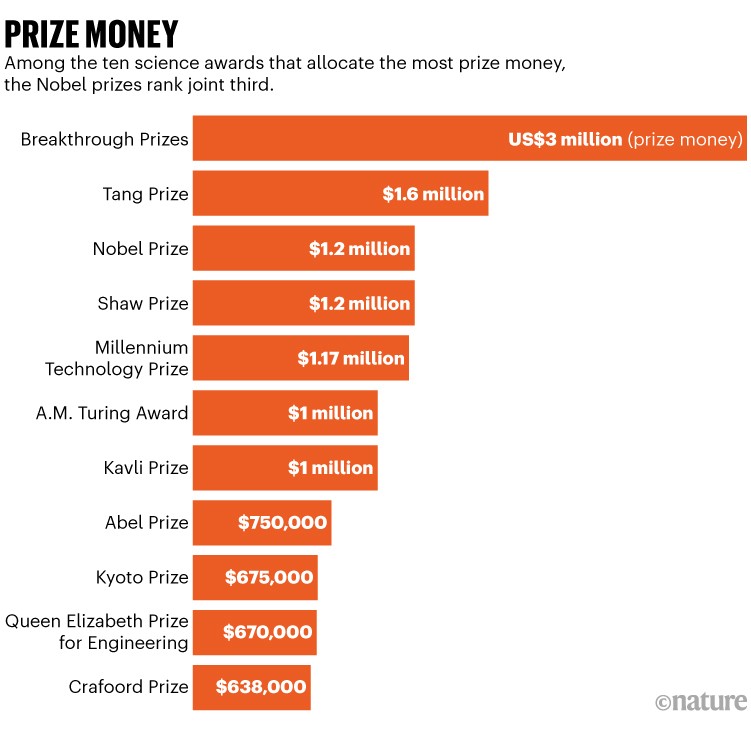
Prize money. Among the ten science awards that allocate the most prize money, the Nobel prizes rank joint third. The Breakthrough Prizes award US$ 3 million, the Tang Prize awards $1.6 million and the Nobel and Shaw Prizes award $1.2 million each. 


Monday, February 10, 2025

Institutions, Technology and Prosperity: Daron Acemoglu's Nobel lecture (now an NBER working paper)

 Here's an NBER paper in this morning's email...

Institutions, Technology and Prosperity  by Daron Acemoglu, NBER Working Paper 33442
DOI 10.3386/w33442, February 2025
 

"This paper reviews the main motivations and arguments of my work on comparative development, colonialism and institutional change, which was often carried out jointly with James Robinson and Simon Johnson. I then provide a simple framework to organize these ideas and connect them with my research on innovation and technology. The framework is centered around a utility-technology possibilities frontier, which delineates the possible distributions of resources in a society both for given technology and working via different technological choices. It highlights how various types of institutions, market structures, norms and ideologies influence moves along the frontier and shifts of the frontier, and it provides a simple formalization of the social forces that lead to institutional persistence and those that can trigger institutional change. The framework also enables us to conceptualize how, during periods of disruption, existing—and sometimes quite small—differences can have amplified effects on prosperity and institutional trajectories. In this way, it suggests some parallels between different disruptive periods, including the onset of European colonialism, the spread (or lack thereof) of industrial technologies in the 19th century, and decisions related to the use, adoption and development of AI today."
 

Saturday, August 3, 2024

Goldin arm

 Here's a great post-Nobel story from the Harvard Gazette.

Time to send in Goldin. Sox go with Nobel laureate southpaw to throw out first pitch by Jill Radsken 


“I’ve been throwing balls my whole life, but it’s been pitching to a dog with its mouth open 25 feet away. Using a real baseball has more heft,” said Goldin, the Henry Lee Professor of Economics."

######

Memory lane:

Sunday, October 28, 2012

Monday, July 29, 2024

Nobel prize medals at auction---two for chemistry (1996 and 1966)

 For charity, to clean up estates of the departed, and for other reasons, Nobel prize medals are sometimes sold at auction.  Here are two recent auctions (conducted in March and July of this year)  for chemistry medals from 1996 (for Robert Curl) and 1966 (for Robert Mulliken), both conducted by the Nate D. Sanders auction company.

Lot #1: Nobel Prize in Chemistry Awarded to Robert F. Curl, Jr. -- Curl Discovered ''Buckyballs'', a Carbon Nanoparticle Transforming Energy, Disease Treatment & Space Exploration via Space Elevators


Lot #11: Nobel Prize Awarded to ''Mr. Molecule'' Robert S. Mulliken -- Mulliken Invented Molecular Orbital Theory, the Revolutionary Equation that Unified Quantum Physics & Chemistry

##########

Some earlier auctions:

Wednesday, June 22, 2022

Thursday, May 28, 2015   The auction of Lederman's Nobel medal goes into extended bidding


Sunday, November 26, 2023

Interview with Vernon L. Smith by Sami Al-Suwailem

 Here's an interview with Vernon Smith, in which he comments on the history of economics and his place in it.

Interview with Vernon L. Smith by Sami Al-Suwailem 

"Smith was born in 1927 in Wichita, Kansas. He received his bachelor’s degree in electrical engineering at Caltech in 1949, an M.A. in economics from the University of Kansas, and a Ph.D. in economics from Harvard University in 1955.

...

"GL: In your recent book, Economics of Markets, coauthored with Sabiou Inoua, you argue (convincingly, I’d say) that “markets succeeded where theory failed.” Does that imply that economic (neoclassical) theory failed to study real-world markets well enough?

"VS: It’s more that they failed to study them at all and, in particular, failed to model price formation or price discovery in market processes.

...

"Walras not only failed to model price discovery but gave us a mechanism that required price mysteriously to be given, then used to model price change depending on the sign of excess demand. This diverted theorists from modeling price discovery and, we believe, created the illusion of progress, but it was more appropriately considered a regress occasioned by marginal analysis, which helped not a wit to address the fundamental task.

...

"GL: In your work, you argue that competitive equilibrium can be quickly achieved under very reasonable experimental conditions for consumption goods, but that this is not the case for assets where speculation may substantially distort the outcomes. Economic theory seems to pay no attention to this important difference. Why is that?

"VS: It is because standard theory tends to be insensitive to close observation: Item A is purchased in preference to item B if and only if U(A) > U(B), a theory that makes no advance prediction but rather concludes only that if A is bought rather than B it must have had higher utility value.

...

"In consumer markets, buyers attempt to buy cheap, constrained by their maximum wtp private value. Sellers try to sell dear but are limited by their minimum willingness-to-accept (wta) costs.

"The problem with asset markets is that they have a value-in-use like any consumer good but also a value-in-resale. This sets up a conflict that has to get resolved before an asset market can settle into any sort of equilibrium.

"All economic stability arises in consumer markets, while all instability arises in asset markets for re-tradable goods. Fortunately, about 75% of private products cannot be re-traded, causing great stability.

"GL: The Nobel Prize in Economics was awarded in 2012 to Lloyd S. Shapley and Alvin Roth for their work on market design. How do you see the relationship between these two branches, market design and experimental economics?

"VS: They are closely and intimately related. Indeed, my work in market design was part of my recognition in 2002, and was part of my presentation in 2001 at the Nobel Conference on Experiments in Economics, the year prior to the award."