Yesterday, Tito Boeri, David Card and I attended the award ceremony of the EconoMia and EcoQuiz competitions for high school and middle school students in Italy.
Here we are with the high school students whose essays received awards.
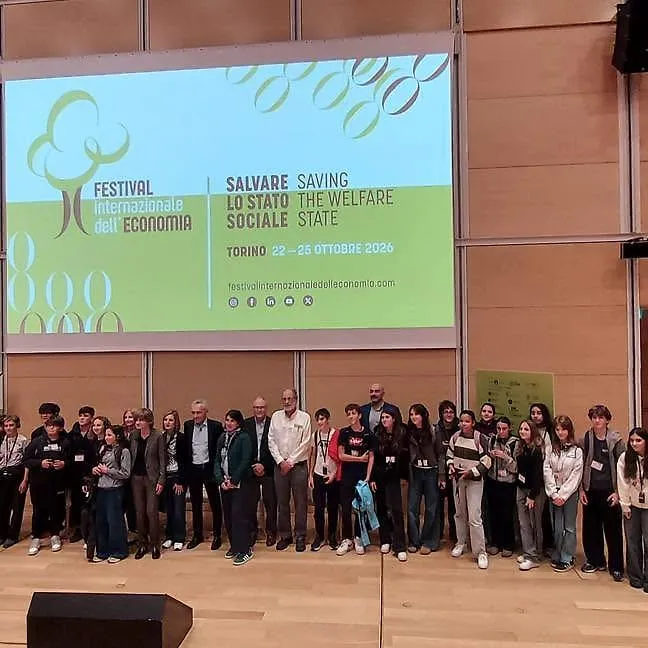
Yesterday, Tito Boeri, David Card and I attended the award ceremony of the EconoMia and EcoQuiz competitions for high school and middle school students in Italy.
Here we are with the high school students whose essays received awards.
Susan Athey is interviewd in JAMA:
How an Economist’s Application of Machine Learning to Target Nudges Applies to Precision Medicine by Roy Perlis and Virginia Hunt JAMA. Published online May 16, 2025. doi:10.1001/jama.2025.4497
"A recent study by economist Susan Athey, PhD, and her colleagues may shed light on how best to target treatments using machine learning. The investigation, published in the Journal of Econometrics, focused on the effectiveness of text and email reminders, or nudges, sent to students about renewing their federal financial aid. The researchers compared causal targeting, which was based on estimates of which treatments would produce the highest effects, and predictive targeting, which was based on both low and high predicted probability of financial aid renewal.
"In the end, the study found hybrid models of the 2 methods proved most effective. However, the result that may be most surprising to Athey was that targeting students at the highest risk of nonrenewal was actually less effective.
...
"Dr Athey:When I
first started working on this, I was like, “Oh, there’s going to be a
gold mine. I’m going to go back and reanalyze all of these experiments
that have already been run, and we’re going to be doing new scientific
discoveries every day.” It didn’t quite work out that way. We had some
big successes, but there has been a lot of lack of success.
What
are the cases where this doesn’t work? Machine learning is using the
data to learn about these treatment effects. You have to do a lot of
sample splitting. There’s always a cost to using the data to discover
the model. You can do it without sample splitting, but then you have to
adjust your P values. There’s no free lunch. If you have a very
small dataset, you probably know what the most important factors are.
You might be better off prespecifying those and just doing your subgroup
analysis. If [there are] hundreds of observations, it’s just unlikely.
These techniques are too data hungry to work.
Generally, you need
thousands of people in the experiment. Then more than that, the
statistical power needed to get treatment effect heterogeneity is large.
And even treatment effect heterogeneity is easier—trying to get
differential targeting is another thing. Imagine you have 3 drugs. It’s
hard enough to say that something works relative to nothing. If you’re
trying to say that one drug works better than another drug where both
work, that’s hard. Usually you need really large, expensive trials to do
that.
Then you add on top of that that I want to say, “This drug is better for these people, and this other drug is better for these other people.” You need 10 times
as much data as you would for the basic “is there a treatment effect at
all?” Now, of course, sometimes there’s a genetic thing: this drug
literally doesn’t work or it has this terrible side effect for some
people. That will pop out of the data.
For more subtle effects,
you do need larger studies. That’s really been the main impediment. And
as an economist, it’s like, why are all these things just barely
powered? Why are there so many clinical studies with a t-statistic of 2?
Of course, people did the power calculations, and they had some data
already when they planned the experiments. If you have more data, maybe
you add another treatment arm or something else. You don’t actually
overpower an experiment. In my own research, I’ve ended up running my
own experiments that are designed to get heterogeneity. I’ve also had a
lot of luck when there’s very big administrative datasets, and there’s a
really good natural experiment. Then you have lots of data. But former
clinical trials are selected to not be good because the researcher
themself didn’t overpower their own experiment. That’s why this isn’t so
useful.
But nonetheless, that’s not to say it’s not out there.
Like in any discovery, if it’s going to save lives and money, it’s worth
doing. It’s just that there’s not a whole bunch of low-hanging fruit.
There’s no dollars lying on the sidewalk."
Here's a podcast with Nicole Immorlica, in which she talks about her research origins (including a course and a poem), what computer science brings to economics, and the role of theory in the age of generative AI.
When research manager Nicole Immorlica discovered she could use math to make the world a better place for people, she was all in. She discusses working in computer science theory and economics, including studying the impact of algorithms and AI on markets.

Behind every emerging technology is a great idea propelling it forward. In the Microsoft Research Podcast series Ideas, members of the research community at Microsoft discuss the beliefs that animate their research, the experiences and thinkers that inform it, and the positive human impact it targets.
In this episode, host Gretchen Huizinga talks with Senior Principal Research Manager Nicole Immorlica. As Immorlica describes it, when she and others decided to take a computational approach to pushing the boundaries of economic theory, there weren’t many computer scientists doing research in economics. Since then, contributions such as applying approximation algorithms to the classic economic challenge of pricing and work on the stable marriage problem have earned Immorlica numerous honors, including the 2023 Test of Time Award from the ACM Special Interest Group on Economics and Computation and selection as a 2023 Association for Computing Machinery (ACM) Fellow. Immorlica traces the journey back to a graduate market design course and a realization that captivated her: she could use her love of math to help improve the world through systems that empower individuals to make the best decisions possible for themselves.
I get asked to sign many letters, and while I'm generally reluctant to venture beyond my own specific areas of expertise into areas in which others are more expert, I recently signed one circulated by Joe Stiglitz, aimed to respond to some egregious campaign disinformation.
Sixteen Nobel Prize-winning economists warn a second Trump term would ‘reignite' inflation By Rebecca Picciotto,CNBC https://www.nbcnewyork.com/news/business/money-report/sixteen-nobel-prize-winning-economists-warn-a-second-trump-term-would-reignite-inflation/5538998/
The letter got this reaction from the campaign in question:
"The American people don't need worthless out of touch Nobel peace prize winners to tell them which president put more money in their pockets," Trump campaign spokesperson Karoline Leavitt said in a statement to CNBC." (emphasis added)
I'll listen for that line in tomorrow night's debate.
Update: here's a link that contains the whole letter https://www.cbsnews.com/news/trump-economy-nobel-prize-winners-letter-inflation-warning/
It begins this way:
"We the undersigned are deeply concerned about the risks of a second Trump administration for the U.S. economy.
"Among the most important determinants of economic success are the rule of law and economic and political certainty. For a country like the U.S., which is embedded in deep relationships with other countries, conforming to international norms and having normal and stable relationships with other countries is also an imperative. Donald Trump and the vagaries of his actions and policies threaten this stability and the U.S.'s standing in the world. "
Nick Arnosti sends along the following call for papers (with a deadline on Wednesday):
We are excited to announce
the Call for Participation for the 4th ACM Conference on Equity and Access in
Algorithms, Mechanisms, and Optimization (EAAMO '24). The conference will be
held from October 29-31, 2024 in San Luis
Potosí, Mexico.
EAAMO '24 will bring together academics and practitioners from diverse disciplines and sectors. The conference will highlight work along the research-to-practice pipeline aimed at improving access to opportunity for historically underserved and disadvantaged communities, as well as mitigating harms concerning inequitable and unsafe outcomes. In particular, we seek contributions from different fields that offer insights into the intersectional design and impacts of algorithms, optimization, and mechanism design with a grounding in the social sciences and humanistic studies.
Submissions can include research, survey, and position papers as well as problem- and practice-driven submissions by academics and practitioners from any disciplines or sectors alike.
Important Dates:
Paper Submission
Deadline: 17 April 2024, AoE
Submission
Notification: 18 July 2024
Paper Submission Page: https://eaamo24.hotcrp.com/u/0/
Event Dates: 29
October - 31 October 2024
The conference will offer opportunities to engage with leading experts, share innovative research and practices, and network with peers. We look forward to your participation, and we encourage you to disseminate the Call for Papers to any interested colleagues.
EAAMO '24 Organizers
Nick Arnosti, University of
Minnesota
Caterina Calsamiglia, IPEG
Salvador Ruiz-Correa, IPIYCT
John P. Dickerson, Arthur & University of
Maryland
Now is the time to be thinking of submitting papers for the summer sessions at Stanford. (Some deadlines are in April.)
Here's the call for papers:
SITE 2024 Conference: Call For Papers
Stanford Economics is proud to host its annual Stanford Institute for Theoretical Economics (SITE) Conference from July 1 to September 11 2024. SITE sponsors sessions that encompass both economic theory and empirical work and cover a broad range of topics. It brings together established and emerging scholars to present leading-edge economic research, to educate, and to collaborate.
These sessions are scheduled:

 Posts
All Comments


