Showing posts with label books. Show all posts

Wednesday, July 15, 2026

Two economists on the Behavioral Scientist’s Summer Book List 2026

The Behavioral Scientist’s Summer Book List 2026 By Heather Graci and Evan Nesterak includes two economists:


"

Bringing data to a gunfight

Economists Alvin Roth and Jennifer Doleac share the conviction that using a data-driven approach to answer moral questions is itself a matter of morality. 

In Moral Economics, Nobel-winner Roth shows how conceptualizing divisive social issues like drugs, abortion, and organ donation as markets can expose new ways to make progress in contexts where both sides refuse to compromise. And in The Science of Second Chances, Jennifer Doleac illuminates how many criminal justice policies—no matter how well-meaning—are far from just. But she also shows that where our intuition fails, science can succeed in helping us build a system that leaves everyone better off.

In Doleac’s words: “I see a lack of rigor as unethical. Policies that don’t work don’t help people. If we are serious about improving lives, we need to test our policies carefully to ensure they’re effective.”

Moral Economics: From Prostitution to Organ Sales, What Controversial Transactions Reveal About How Markets Work
By Alvin E. Roth

From the back cover: “Some of the most intractable controversies in our divided society are, at bottom, about what actions and transactions should be banned. . . . Disagreements are fierce because arguments on both sides are often made in uncompromising moral or religious terms. But in Moral Economics, Nobel Prize–winning economist Alvin E. Roth asserts that we can make progress on these and other difficult topics if we view them as markets—tools to help decide who gets what—and understand how those markets can be fine-tuned to be more functional. Markets don’t have to allow everything or ban everything. Prudent market design can find a balance between preserving people’s rights to pursue their own interests and protecting the most vulnerable from harm.”

The Science of Second Chances: A Revolution in Criminal Justice
By Jennifer Doleac

From the back cover: “When criminal justice expert Jennifer Doleac thinks about reform, she’s not just hopeful, she’s optimistic that second chances are possible—for the justice-involved population and the system as a whole. In The Science of Second Chances, she reveals her powerful approach to reducing crime and incarceration. Drawing on cutting-edge economic research and real-world experiments, the book presents a blueprint for reform that runs all the way through the system . . . From DNA databases that increase the likelihood of catching reoffenders to leniency programs for first-time defendants, she reveals a series of surprising interventions that actually work, along with cautionary tales about great ideas that never panned out.”

Read an excerpt from The Science of Second Chances in Behavioral Scientist: “It’s as if they’re standing at a fork in the road, considering what to do next. One direction leads toward more criminal behavior and criminal justice involvement, and the other leads toward a productive, law-abiding life. It turns out that many first-time defendants will choose the better path if we simply get out of their way.”

Monday, June 29, 2026

A dozen books enjoyed by venture capitalists (from a16z)

 Reading lists are interesting both for the books they describe, and for what they say about the list makers. Here are a dozen interesting-looking books from people at the venture capital firm Andreeason Horowitz (aka A16Z).

A reading list for the deeply curious
Part one of our summer reading list: 12 books on technology, markets, AI, code, and the systems behind change.   a16z crypto 

Four of the twelve recommended books come under the heading  How markets are designed.

These are those: 

Moral Economics: From Prostitution to Organ Sales, What Controversial Transactions Reveal About How Markets Work by Alvin E. Roth

“My doctoral advisor, Al Roth, has been thinking for decades about ‘repugnance’ – why some people prefer that some markets should not exist. In Moral Economics, he tackles the motivation for these prohibitions and the trade-offs they force, head-on. And he explores, in particular, how such non-market norms emerge and sometimes later collapse — limitations on alcohol and drugs, and, in a completely different category, same-sex marriage have all been relaxed in recent years — and what this means for making markets in the future.” – Scott Duke Kominers, research

Why Nations Fail by Daron Acemoglu and James A. Robinson

“Acemoglu and Robinson’s central thesis, that inclusive institutions drive prosperity while extractive ones cause stagnation, maps surprisingly well onto crypto. Decentralized protocols are essentially an attempt to hard-code inclusive institutions: open access, no gatekeepers, rules enforced by code rather than by whoever’s in power. The book is a great lens for understanding why certain blockchain ecosystems thrive while others are captured by insiders. A must-read for anyone thinking seriously about governance, whether at the nation-state or protocol level.” – Kira Song, finance

An Engine, Not a Camera: How Financial Models Shape Markets by Donald MacKenzie

“Sociologist Donald MacKenzie’s An Engine, Not a Camera is nominally a book about financial economics, but its real subject is more provocative: What happens when theories stop describing the world and start changing it? MacKenzie traces how academic models of markets escaped the university and became embedded in the markets themselves. First published in 2006, it remains relevant today in a number of contexts — not least because of the recent interest from TradFi in crypto. But I wanted to read it again because of the book I’m working on with colleague Robert Hackett, about how computer science theories acted on the world.” – Tim Sullivan, editorial

A Man for All Markets: From Las Vegas to Wall Street, How I Beat the Dealer and the Market by Edward O. Thorp

“Growing up, I was obsessed with the movie 21 and the idea that you could actually use math to beat the house. This book is the autobiography of the man who essentially started it all. Edward Thorp went on to apply those same principles to Wall Street, becoming the father of quantitative investing. It’s an incredible story about using pure logic to disrupt rigged legacy systems, which perfectly captures the same builder mindset we see in crypto today.” – Ben Wu, talent

Friday, June 12, 2026

Best books of 2026 so far (a small publishing adventure, with pictures)

 At one month post-publication of Moral Economics, I continue to get small bits of feedback.  Here's one, from the editors of Amazon.

Best Business & Leadership Books of 2026 So Far 


 Neither first nor last on the list:

 ,,,

And that list is one among many that Amazon compiles:


With so many best books, I asked Microsoft Copilot for an estimate of total numbers of new books annually, and got this table, which notes that the vast majority of new books are self-published. (I wonder how many are written by A.I....):


While I'm on the subject, here's a picture a friend sent me from a bookstore in Chicago's OHare airport. (Maybe Moral Economics is an airport book after all:)

IMG_0878.jpeg 

###########

Afternoon update (this just in, still June 12): It turns out Moral Economics is a Best  Book Club book too:)


Saturday, April 4, 2026

Nonfiction Publishing, Under Threat, Is More Important Than Ever (New Republic)

 As an author with a forthcoming non-fiction book, it's both depressing to read that non-fiction book sales are down, but inspiring to read of the importance of books.

The New Republic considers the (diminishing) prospects and (continuing) importance of non-fiction books.

Nonfiction Publishing, Under Threat, Is More Important Than Ever
Cuts in publishing and book reviewing imperil the future of narrative nonfiction, and our understanding of the world around us. 
 by Paul Elie

 “The decline in sales of new nonfiction might reflect a changing information ecosystem,” Elizabeth Harris observed. “People looking for information can now easily turn to chatbots, YouTube, podcasts and other free online sources.” Last December, The Guardian cited NielsenIQ figures indicating a one-year drop of 8.4 percent in nonfiction book sales (twice that of fiction) and quoted a writer who had “heard publishers have soured on any nonfiction that isn’t ‘Hollywood friendly.’”

... 

"Fretful narratives about the demise of books and the rise of devices have been in play for half a century or longer. “Our world of books, like most other worlds now, is the arena of an increasingly bitter struggle for space, and for the limited reading time that a busy citizen in this electronic age can afford,” John Updike lamented when accepting the American Book Award in 1982. Narrative nonfiction in particular has faced headwinds in mass culture before. And in many respects, the challenges it faces are built in. Long fact is hard to publish and always has been. Reportage and research take time, resources, attention, and fortitude. A book can require several years to write and another year and a half to be edited, checked, printed, and publicized—only to wind up coming out during a news cycle dominated by a sex scandal, school shooting, pandemic, or war. It was as true half a century ago as it is today that readers expect to pay for fiction but are used to getting nonfiction passively through the media. 

...

"In societies where freedom is under threat, an informed citizen is countercultural and deep reading is an act of resistance. Just as protest and vigilance are essential, so is the ability to read and think. In a would-be autocracy, the autocrat aims to subsume our society’s particular narratives into his master narrative—in which his name fills the headlines, his voice and image dominate the broadcasts, and his airbrushed visage appears on the facades of government. To read a book, however, is to enter a narrative that stands outside the politics-and-media maelstrom. In a would-be autocracy, even a small bookstore—with hundreds of books, classic, recent, and current—is a space of contrary narratives, where truth is recognized as both essential and complicated." 

Wednesday, October 22, 2025

Divergent views on behavioral economics: books by Loewenstein and Chater, and Thaler and Imas

 You could hardly have two more different books on behavioral economics, both by important contributors to the field. Chater and Loewenstein regret their part in what they feel has turned into a scam, while Thaler and Imas celebrate how it has gone from victory to victory.

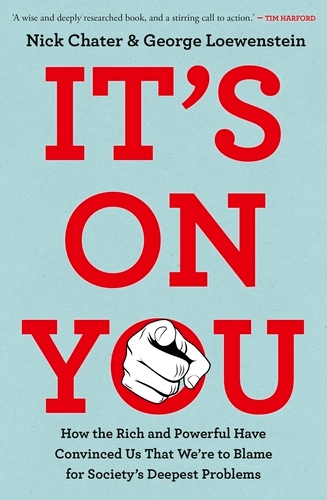
It's On You.  How they rig the rules and we get the blame for society's problems 
by
Nick Chater and George Loewenstein
 

"Two decades ago, behavioral economics burst from academia to the halls of power, on both sides of the Atlantic, with the promise that correcting individual biases could help transform society. The hope was that governments could deploy a new approach to addressing society’s deepest challenges, from inadequate retirement planning to climate change—gently, but cleverly, nudging people to make choices for their own good and the good of the planet.

"It was all very convenient, and false. As behavioral scientists Nick Chater and George Loewenstein show in It’s On You, nudges rarely work, and divert us from policies that do. For example, being nudged to switch to green energy doesn’t cut carbon, and it distracts from the real challenge of building a low-carbon economy.

"It’s on You shows how the rich and powerful have repeatedly used a clever sleight of hand: blaming individuals for social problems, with behavioral economics an unwitting accomplice, while lobbying against the systemic changes that could actually help. As two original proponents of the nudge principle, Nick and George now argue that rather than trying to “fix” the victims of bad policies, real progress requires rewriting the social and economic rulebook for the common good."

Book cover of It's On You by Nick Chater, George Loewenstein 

###### 


The Winner's Curse: Behavioral Economics Anomalies, Then and Now
by Richard H. Thaler  and Alex Imas  

"Nobel Prize winner Richard H. Thaler and rising star economist Alex O. Imas explore the past, present, and cutting-edge future in behavioral economics in The Winner’s Curse.

"Why do people cooperate with one another when they have no obvious motivation to do so? Why do we hold on to possessions of little value? And why is the winner of an auction so often disappointed?

"Over thirty years ago, Richard H. Thaler introduced readers to behavioral economics in his seminal Anomalies column, written with collaborators including Daniel Kahneman and Amos Tversky. These provocative articles challenged the fundamental idea at the heart of economics that people are selfish, rational optimizers, and provided the foundation for what became behavioral economics. That was then.

"Now, three decades later, Thaler has teamed up with economist Alex O. Imas to write a new book with an original and creative format. Each chapter starts with an original Anomaly, retaining the spirit of its time stamp. Then, shifting to the present, the authors provide updates to each, asking how the original findings have held up and how the field has evolved since then.

"It turns out that the original findings not only hold up well, but they show up almost everywhere. Anomalies pop up in people’s decisions to save for retirement and how they carry outstanding credit card debt. Even experts fail to optimize. The key concept of loss aversion explains missed putts by PGA pros and the selection of which stocks to sell by portfolio managers. In this era of meme stocks and Dogecoin, it is hard to defend the view that financial markets are highly efficient. The good news, however, is that the anomalies have gotten funnier." 


Tuesday, May 28, 2024

Gonzalo Arrieta defends his dissertation

Gonzalo Arrieta defended his dissertation last week.


Here's his job market paper:

Procedural Decision-Making In The Face OfComplexity by Gonzalo Arrieta and Kirby Nielsen

Abstract: A large body of work documents that complexity affects individuals’ choices, but the literature has remained mostly agnostic about why. We provide direct evidence that individuals use different choice processes for complex and simple decisions. We hypothesize that individuals resort to “procedures”—cognitively simpler choice processes that we characterize as being easier to describe to another person—as the complexity of the decision environment increases. We test our hypothesis using two experiments, one with choices over lotteries and one with choices over charities. We exogenously vary the complexity of the decision environment and measure the describability of choice processes by how well another individual can replicate the decision-maker’s choices given the decision-maker’s description of how they chose. We find strong support for our hypothesis: Both of our experiments show that individuals’ choice processes are more describable in complex choice environments, which we interpret as evidence that decision-making becomes more procedural as complexity increases. We show that procedural decision-makers choose more consistently and exhibit fewer dominance violations, though we remain agnostic about the causal effect of procedures on decision quality. Additional secondary evidence suggests that procedural decision-making is a choice simplification that reduces the cognitive costs of decision-making."

##########
Another of his papers is a really creative investigation of human welfare:

Abstract: The dominant approach to welfare is based on revealed preferences and thus is restricted to settings where the individual knows their preferences have been fulfilled. We use a choosing-for-others framework to experimentally study welfare when what the individual believes to be true differs from what is actually true. About 42% of participants see welfare as independent of beliefs; 22% see welfare as only depending on beliefs; and 29% see a lower, but still positive, welfare effect when beliefs are fixed. Furthermore, the average participant values accurate beliefs. Our results suggest most people support the idea that welfare goes beyond awareness, which can inform media regulation, informational policies, and government communication.


Here's a figure from the instructions about the creation of "real" and "fake" inscribed copies of books. A third party judged the welfare to the recipient

"Our altruistically revealed preference paradigm consists of asking surrogate participants to trade off a monetary bonus given to the Receiver, and the Receiver getting the books with the original notes over those with the fake notes. The bonus amount is a surprise to the Receiver to minimize concerns that they use it to deduce which books they got (i.e., to maintain obliviousness). Our three requirements allow us to interpret the bonus amount that leaves participants indifferent between giving the original and fake notes as a measure of the change in the Receiver’s welfare. As a benchmark, we also elicit the welfare effect when the Receiver does learn which notes they get."
********
Welcome to the club, Gonzalo.


Saturday, April 27, 2024

No Prices No Games! Four Economic Models by Michael Richter and Ariel Rubinstein

 Here's a new book on economic theory by Richter and Rubinstein.

No Prices No Games!  Four Economic Models  by Michael Richter and Ariel Rubinstein  

At the link you can download a pdf or read it online for free, or purchase a printed edition.

"While current economic theory focuses on prices and games, this book models economic settings where harmony is established through one of the following societal conventions:

• A power relation according to which stronger agents are able to force weaker ones to do things against their will.

• A norm that categorizes actions as permissible or forbidden.

• A status relation over alternatives which limits each agent's choices.

• Systematic biases in agents' preferences.

"These four conventions are analysed using simple and mathematically straightforward models, without any pretensions regarding direct applied usefulness. While we do not advocate for the adoption of any of these conventions specifically – we do advocate that when modelling an economic situation, alternative equilibrium notions should be considered, rather than automatically reaching for the familiar approaches of prices or games."


By email, Ariel tells me that he designed the cover.

Contents

0. Introduction

(pp. 1–12)
  • Michael Richter
  • Ariel Rubinstein
  • Michael Richter
  • Ariel Rubinstein
  • Michael Richter
  • Ariel Rubinstein
  • Michael Richter
  • Ariel Rubinstein
  • Michael Richter
  • Ariel Rubinstein
  • Michael Richter
  • Ariel Rubinstein


"In the final chapter, we compare this book's modeling approaches with each other and to those of standard Game Theory on two ``battlegrounds''.
The first is the matching economy. An even-sized population of agents must match into exclusive pairs (pairings). Each agent possesses a preference relation over potential mates.
The standard cooperative game theory solution concept for matching economies is ``pairwise stability''. Following Richter and Rubinstein (2024), we compare this concept with the jungle equilibrium, the Y-equilibrium and the status and initial status equilibrium concepts.
The second battleground is a ``political economy'' situation. A group of agents hold views on a political issue. Each agent chooses a position and has preferences only regarding the position he himself chooses (and not the choices of others). However, there is a need that a majority of agents choose the same position.
Traditionally, such a situation is modeled as a non-cooperative game and its Nash equilibria are calculated. Extending Richter and Rubinstein (2021), we compare this approach with the convex Y-equilibrium and the biased preferences equilibria.
On both battlegrounds, the new approaches lead to very different outcomes than the traditional ones."