Showing posts with label market design. Show all posts

Monday, August 31, 2026

Market design from the Perspective of Theological Anthropology, by Christina McRorie (in the January 2027 ASSA program)

I'm always on the lookout for different perspectives on market design, and here's a paper that caught my eye in the  ASSA Preliminary Program for the January 2027 meetings in Washington DC.

 It's in a session called  What Economic Models Can and Cannot See: Human Flourishing, Freedom, and the Common Good (B4)  Hosted by the Association of Christian Economists 

Can Market Design Make Us More Free? Some Notes on the Use of Experimental Economics from the Perspective of Theological Anthropology  by Christina McRorie, Boston College 

Abstract
Although modern thought tends to construe freedom as freedom from constraint or freedom of choice, Catholic theological anthropology has long defined true freedom as the state of being agentially oriented toward the good. As Servais Pinckaers puts it, it is “freedom for,” rather than “freedom from”—specifically, freedom for living in a Christ-like way, which becomes possible as we come to participate in Christ’s character. This perspective suggests that social influences which encourage our growth in character are not only helping us become more good, but also more free. Moreover, because this conception of freedom is not based in autonomy, this remains true even if these formative influences are not chosen by us, and work on us without our awareness.
Using this concept of freedom, this paper considers the theological implications of experimental research on prosocial behavior in markets. It appears that certain conditions encourage subjects to act with more fairness, trustworthiness, and even generosity than they might under other conditions. (E.g., when market participants can observe each other’s behavior and communicate, and when the social framing of various options emphasizes values, or at least does not emphasize competition or the threat of loss, among other factors.) Insofar as laboratory studies replicate conditions present in actual markets, this indicates that some real markets elicit more moral behaviors than others.
Moreover, because virtue theory assumes that character is built through repeated moral action, markets which encourage individuals to act in prosocial ways can be read as supporting their growth in virtue, insofar as these elicited actions eventually influence individuals’ dispositions and habits. To the extent that this occurs, this paper proposes that good market design can encourage us to become more good, and thus more free. 

Wednesday, August 26, 2026

Axel Ockenfels, interviewed about market design

Here's a recent interview of Axel Ockenfels, about market design.

Interview Marc Kley

Porträt Axel Ockenfels Copyright Fabian Stürtz

1. Professor Ockenfels, your work focuses on the design of markets and incentives. How can founders leverage your scientific insights when developing their business models?

Every business model is, to some extent, an exercise in incentive and market design, whether founders are aware of it or not. Whoever builds a platform, a pricing scheme or an app decides who can trade with whom, what information they see, and what incentives they face. Market design research offers three lessons for founders. First, details matter: seemingly minor rules can make or break a market. I have seen many systems fail because of seemingly innocuous design mistakes. Second, behavior matters: people reciprocate, care about fairness, are loss averse, and are quickly overwhelmed by complexity. Third, testing matters: experiments are the wind tunnel of market design and the gold standard for finding out what works and what does not. 

... 

4. In your opinion, which major societal challenge could be solved more effectively if we designed markets, platforms, and incentives more intelligently?

Almost any. Take climate change. It is often framed as a moral problem, but at its core it is a cooperation problem: everyone benefits if emissions fall, yet each country, company and individual prefers others to bear the cost. A uniform carbon price would steer billions of everyday decisions toward climate protection without micromanaging any of them. Not less importantly, our research shows that carbon pricing facilitates international negotiations built on reciprocity, which can stabilize cooperation where unilateral pledges fail. A similar logic creates value elsewhere: kidney exchange programs save lives, well-designed electricity markets keep the energy transition affordable, and clever matching systems allocate school places more fairly. Wherever incentives are misaligned, better economic design can unlock large social value


Friday, August 21, 2026

NBER workshop on Market Design, Stanford, Oct 16-17, call for papers

 Here's the call for papers for the NBER workshop on market design, at Stanford in October.

"To: NBER Market Design Working Group

From: Michael Ostrovsky and Eric Budish

 The National Bureau of Economic Research workshop on Market Design is a forum to discuss new academic research related to the design of market institutions, broadly defined. The next meeting will be held in Stanford, California on October 16 & 17, 2026.  We are planning for an in-person only meeting. There will not be an option to attend virtually.

 We welcome new and interesting research and are happy to see papers from a variety of fields.  Participants in the past meeting covered a range of topics and methodological approaches. Last year's program can be viewed at:

https://urldefense.com/v3/__https://www.nber.org/conferences/market-design-working-group-meeting-fall-2025__;!!G92We9drHetJ8EofZw!dlT9ZZcoCaeO7GqTUkKgKVVgvGpB5MDHs3RNvyJj9679UKlOmu2AuKoOlSYuYRe1c8QYnkLCcm9R5cJtdME$


The conference does not publish proceedings or issue NBER working papers - most of the presented papers are presumed to be published later in journals.


We would appreciate it if you could pass this call for papers on to colleagues who might be interested, but who may not be on the Bureau's mailing list. Submissions are welcome from researchers with and without NBER affiliations and from researchers at all career stages.


If you are interested in presenting a paper this year, please upload a PDF version by midnight EDT on August 23, 2026, to this link:

 https://urldefense.com/v3/__https://conference.nber.org/confsubmit/backend/cfp?id=MDf26__;!!G92We9drHetJ8EofZw!dlT9ZZcoCaeO7GqTUkKgKVVgvGpB5MDHs3RNvyJj9679UKlOmu2AuKoOlSYuYRe1c8QYnkLCcm9RUJB5pBU$

 Preference will be given to papers for which at least a preliminary draft is ready by the time of submission. Only authors of accepted papers will be contacted.

 Unfortunately, the NBER cannot cover the travel costs or hotel expenses of participants.

 There are a limited number of spaces available for graduate students to attend the conference, though we cannot cover their costs. Please email ostrovsky@stanford.edu and eric.budish@chicagobooth.edu  a short nominating paragraph.

 Please forward this announcement to any potentially interested scholars. We look forward to hearing from you."

Monday, July 13, 2026

Why markets fail — and how to fix them, a conversation about market design, among Scott Kominers, Tim Roughgarden and Al Roth

 I've now been the guest on many podcasts, aimed at many different kinds of listeners. This is the one for people with an academic interest in market design as a growing part of economics (as well as Scott Kominers' academic origin story, and an inside joke about a colleague at HBS:)

Why markets fail — and how to fix them, a conversation among Scott Kominers, Tim Roughgarden and Al Roth 


Why markets fail — and how to fix them (ft. Nobel economist Alvin Roth)
22.7K subscribers
Jul 10, 2026
Long before crypto made coordination programmable, Nobel Prize winner Alvin Roth was designing markets where coordination could save lives.

In this episode of First Principles, Roth tells the story of how he helped build systems for some of the hardest matching problems in the world, from where doctors train and where students go to school to how kidney donors can reach the patients who need them.

He joins Tim Roughgarden, Head of Research at a16z crypto, and Scott Kominers — Harvard Business School professor, a16z crypto research partner, and one of Roth’s former students — for a conversation about how market design moves from theory into the real world.

They explore how economic theory becomes practical engineering, whether that's matching riders to Ubers, doctors to medical residencies, students to New York City high schools, or organ donors to people whose lives depend on it. They also cover how these same problems show up in today’s crypto networks. 

Roth explains why markets are not just natural forces, but engineered systems; why the details of timing, congestion, incentives, and trust can make or break a marketplace; and why some of the most important markets are the ones where simply exchanging money can’t do the work.

This is a conversation about economics at its most practical and profound: how to design systems that coordinate people, solve real problems, and sometimes save lives.

00:00 Intro: Why market design matters
04:18 The economist as engineer
08:09 When theory meets the real world
07:02 Fixing the medical residency match
15:32 Why markets unravel
18:22 Redesigning NYC high school admissions
28:05 The hidden problem of congestion
34:47 How kidney exchange saves lives
45:26 How the internet changed market design
48:25 Airbnb, Uber and smarter marketplaces
51:28 Repugnant transactions and moral economics
53:32 When markets need social support
54:32 The unexpected effects of criminalizing surrogacy
01:04:58 Preference signals and the job market 01:18:53 A broken market: resettling refugees and other migrants
 

Hear more from: Tim Roughgarden:   / tim_roughgarden   Scott Kominers:   / skominers   Follow a16z crypto: X:   / a16zcrypto   LinkedIn:   / posts   YouTube:    / @a16zcrypto   Substack: https://a16zcrypto.substack.com/subsc...

Friday, May 1, 2026

Introduction to market design and medicine: video of my public lecture in Taiwan

 Here's a video of the talk I gave in Taiwan on Markets, marketplaces and medicine. My talk begins at around minute 9:35, after introductions and photographs, and the camera focuses on me rather than on my slides, but I think you can follow the talk well even without seeing the slides.  A Q&A session begins at around minute 59:45, with the first question being about marriage (in which I get to quote Claudia Goldin on dads versus duds:)*

 ###########

* See, earlier

Tuesday, September 23, 2025  The Downside of Fertility by Claudia Goldin---Dads versus duds


Saturday, November 15, 2025

Judd Kessler: the most helpful advice I ever got (YouTube short video)

 I was charmed by this very short video featuring Judd Kessler (and I'm very grateful to whoever gave him that advice):


https://youtube.com/shorts/zBTlYwvYE2M?si=q6_vRIflWvAmMDYb 


You can see his new book, Lucky By Design in the background 

“Lucky by Design is that rarest of things: an economics PAGE-TURNER.” —Lin-Manuel Miranda 

Friday, October 31, 2025

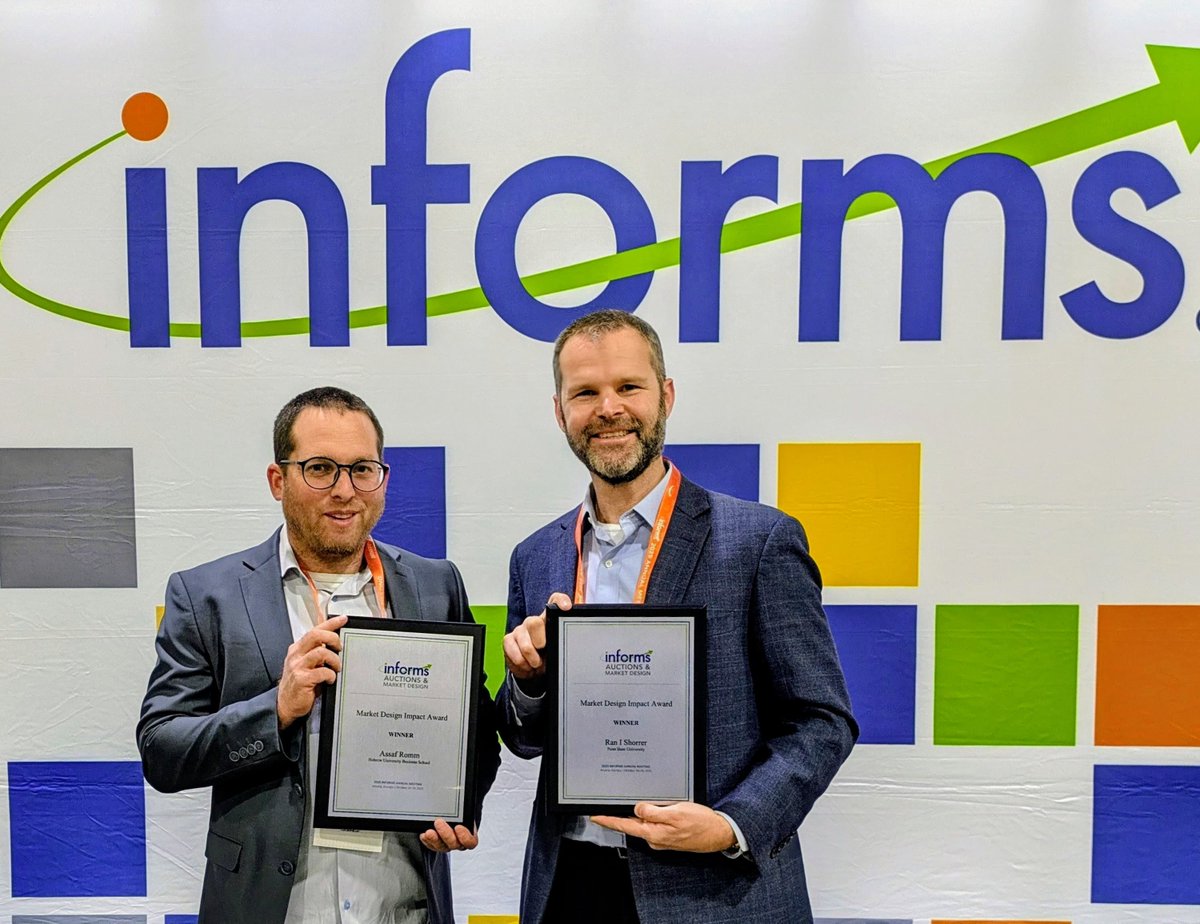
Market Design Impact Award to Hassidim, Romm, and Shorrer

 The Hebrew University breaks the news with this congratulatory message:

"Congratulations to our very own Assaf Romm  and coauthors! 🎉Assaf, along with Avinatan Hassidim and Ran Shorrer , has been awarded the inaugural INFORMS Auctions and Market Design (AMD) Market Design Impact Award- recognizing major contributions in market design over the past 15 years.
Their groundbreaking work has transformed both theory and practice, from redesigning Israel’s Psychology Master’s admissions and Pre-Military Academy programs to improving the medical internship match, impacting thousands of lives. Beyond implementation, their research revealed how real-world behavior can differ from theoretical predictions, helping to pioneer the field of behavioral market design.
Through innovative design, rigorous theory, and a deep understanding of human behavior, Assaf and his coauthors have shown how market design can address pressing social needs while advancing the field.
👏 Remarkable achievement! "


Two men in suits stand side by side holding framed award plaques with text reading INFORMS AMD Market Design Impact Award for Ran Shorrer and Assaf Romm in front of a large blue and green INFORMS logo on a gray background with colorful geometric squares 


I expect that a full(er) account will soon be given on the INFORMS  Market Design Impact Award  page 

Thursday, October 16, 2025

Experiments and behavioral market design at Pitt (tomorrow)

 I'm flying  back to my old haunts in Pittsburgh today, for (among other things) two events at the University of Pittsburgh tomorrow:

 October 17, 2025 PEEL Reopening Ceremony with Professor Vesterlund & Professor Roth

"The History of PEEL: The Pittsburgh Experimental Economics Laboratory (PEEL) was founded by John Kagel and Alvin Roth, a Nobel Laureate in Economics. Since its inception, PEEL has served as a hub for pioneering research in experimental economics. Notably, the lab contributed to foundational work on market design, which played a significant role in Roth’s Nobel Prize-winning contributions. Over the decades, PEEL has maintained its reputation as a center of excellence, attracting top scholars and fostering innovation in economic research. +


October 17, 2025 BEDI Workshop (Behavioral Economics and Design Initiative)

BEDI Workshop - Friday, October 17th, 2025

Breakfast | 8:15 am – 8:45 am
Wesley W. Posvar Hall, 4130, 230 S Bouquet St, Pittsburgh, PA 15213 


Conference Welcome | 8:45 am – 9:00 am
Lise Vesterlund, BEDI Director, Andrew W. Mellon Professor, University of Pittsburgh


Session 1 | 9:00 am – 10:40 am
Erina Ytsma– Assistant Professor, Carnegie Mellon University, “Gender Differences in the
Response to Incentives: Evidence from Academia”
Stephanie Wang – Professor, University of Pittsburgh
Claire Duquennois – Assistant Professor, University of Pittsburgh, “Minority athletic performance,
racial attitudes, and racial hate”
Jonathan Woon – Professor & Associate Dean, University of Pittsburgh, “The Epistemology of
Justice: Awareness and Institutional Choice”

Refreshment Break | 10:40 am – 11:10 am

Session 2 | 11:10 am – 12:00 pm
Jenny Chang – Graduate Student, Carnegie Mellon University, “When Women Self-Promote:
Evidence on Beliefs and Downstream Consequences”
Aden Halpern – Graduate Student, University of Pittsburgh 

Brandon Williams – Graduate Student, University of Pittsburgh
Dhwani Yagnaraman – Graduate Student, Carnegie Mellon University, “Crowd-in and crowd-out of
climate policies”
Aaron Balleisen– Graduate Student, Carnegie Mellon University, “Cheap Talk and Pluralistic
Ignorance”

Lunch | 12:00 am – 1:15 pm

Session 3 | 1:15 pm – 2:30 pm
Osea Giuntella – Associate Professor, University of Pittsburgh, “Beliefs, Resilience, and Leadership: Evaluating Trauma-Informed Training”
John Conlon – Assistant Professor, Carnegie Mellon University, “Memory Rehearsal and Belief Biases”
Alex Chan – Professor, Harvard University, “Preference for Explainable AI”


PEEL Re-Opening + Refreshment Break | 2:30 pm to 3:30 pm

Session 4 | 3:30 pm – 4:45 pm
Alistair Wilson – Professor, University of Pittsburgh, “Veto Delegation: A Mechanism that works! (Kinda)”
Yucheng Liang – Assistant Professor, Carnegie Mellon University, “Asking the Right Questions: Information Acquisition for Choices under Risk”
Muriel Niederle - Professor, Stanford University


Friday, September 19, 2025

Stanford celebrates 100 years of GSB

 GSB at 100: A Century of Impact, by Michael McDowell  interviews leading faculty members including

"Susan Athey: The GSB has had so many impacts, but let me just pick one particular issue that’s close to my heart, which is that it’s been several times in its history, it’s really been on the frontier of important ideas. One of the big ideas in the group that I’m in was market design and the use of formal strategic thinking and game theory and information economics to understand real phenomena. And Bob Wilson, who’s one of the grandfathers of the group that I sit in, Economics, he worked with oil companies in 1960s and looked at their bidding data and then developed formal theories that helped understand what was going wrong in those markets and how to fix it. And then later, he advised one of my advisors, Paul Milgrom, and they shared the Nobel Prize for some of their work on market design.

"And so, there’s many different takes on that, but one of my takes was that there was the connection to the world and the fact that the problem they were solving was coming out of a real problem leading to cutting edge theory that then created a field that didn’t exist. More recently, we were on the cutting edge of using machine learning for decision problems and what’s called causal inference, formally, and now Stanford is the best place in the world to do this kind of research. To go from zero in 2012 to best in the world with multiple amazing young scholars doing cutting edge research in 12 years is really stunning. And the GSB really supported us in that endeavor.

"So I think the GSB has been a really fabulous place for helping us stay grounded and really connected to real problems, but also allowing us to hire the kind of talent and giving us the space to do the pure research that doesn’t just solve today’s practical problems, but that actually builds the foundation for many people to solve applied problems."

Saturday, September 13, 2025

Kidney exchange in Operations Research (and elsewhere)

 Kidney exchange is an important medical innovation that has given rise to literatures not only in medicine but in economics, computer science and operations research. (That diversity of literatures is related to the interdisciplinary growth of market design.)

Here's a new survey of the OR literature on kidney exchange.

Mathijs Barkel, Rachael Colley, Maxence Delorme, David Manlove, William Pettersson, Operational research approaches and mathematical models for kidney exchange: A literature survey and empirical evaluation,  European Journal of Operational Research, 2025, ISSN 0377-2217, https://doi.org/10.1016/j.ejor.2025.08.059.


Abstract: Kidney exchange is a transplant modality that has provided new opportunities for living kidney donation in many countries around the world since 1991. It has been extensively studied from an Operational Research (OR) perspective since 2004. This article provides a comprehensive literature survey on OR approaches to fundamental computational problems associated with kidney exchange over the last two decades. We also summarise the key integer linear programming (ILP) models for kidney exchange, showing how to model optimisation problems involving only cycles and chains separately. This allows new combined ILP models, not previously presented, to be obtained by amalgamating cycle and chain models. We present a comprehensive empirical evaluation involving all combined models from this paper in addition to bespoke software packages from the literature involving advanced techniques. This focuses primarily on computation times for 49 methods applied to 4320 problem instances of varying sizes that reflect the characteristics of real kidney exchange datasets, corresponding to over 200,000 algorithm executions. We have made our implementations of all cycle and chain models described in this paper, together with all instances used for the experiments, and a web application to visualise our experimental results, publicly available.
Keywords: Combinatorial Optimisation; OR in health services; Kidney paired donation; Cycle packing; Computational experiments


Wednesday, August 20, 2025

Market design podcast on NPR's Planet Money (with Alex Teytelboym)

 Alex Teytelboym comments throughout a program about market design on NPR's Planet Money:


 The episode focuses on the design of markets regulated by governments, and  touch on the regulation of fisheries, and on the spectrum incentive auction (about which they interviewed Glen Weyl instead of Paul Milgrom).

##########

Earlier related posts:

Monday, February 16, 2009  Sustainable fisheries

Sunday, January 30, 2011  Fishing as an endangered but protected transaction

Tuesday, July 24, 2018  Design of fisheries--EURO Excellence in Practice Award to Bichler, Ferrell, Fux, and Goeree

Friday, July 9, 2021 Fishery regulation involves onboard observers at sea--a very dangerous job

 ##########

 Monday, March 9, 2020 Paul Milgrom et al. on the incentive auction--two recent papers, and two pictures

 Monday, June 15, 2020  Paul Milgrom corrects the record on spectrum auctions and market design


Monday, August 11, 2025

Lucky by Design: The Hidden Economics You Need to Get More of What You Want, by Judd Kessler

 Here's a great new book about how to navigate markets, by Judd Kessler, who knows his way around.


Lucky by Design: The Hidden Economics You Need to Get More of What You Want
– forthcoming,  October 14, 2025  by Judd Kessler 

"What’s the secret to scoring a reservation at a hot new restaurant? When should you enter a lottery to increase your odds of winning? Why did your neighbor’s kid get into a nearby preschool while yours didn’t? Who gets priority for a life-saving organ donation?

These outcomes are not a matter of luck. Instead, they depend on how we navigate hidden markets that arise to decide who gets what when many of us want something and there isn’t enough to go around. Every day we play in these markets, yet few of us fully understand how they work.

In familiar markets, what we get depends on how much we’re willing to pay. Hidden markets do not rely on prices: you can’t buy your way in to a better position. Instead, what you receive hinges on the rules by which the market operates, and the choices you make in them.

Judd Kessler has spent a career studying and designing these very markets. Now, he reveals the secrets of how they work, and how to maneuver in them. Whether you want to snag a coveted ticket, secure a spot in an oversubscribed college course, get better matches in the dating and job markets, do your fair share of the household chores (but no more), or more efficiently allocate your time and attention, this must-read guide will show you how to get Lucky by Design."

#####

Market design advice: pre-order now to be the first on your block, and to help the book.

Thursday, July 24, 2025

INFORMS celebrates Yash Kanoria

Last month, INFORMS' Division of Manufacturing and Service Operations Management awarded Yash Kanoria  the 2025  MSOM Young Scholar Prize.

Here's a slide from the prize announcement (shared with me by Omar Besbes).


Here are two papers of his that I admire:

Ashlagi, Itai, Yashodhan Kanoria, and Jacob D. Leshno, (2017). “Unbalanced Random Matching Markets: The Stark Effect of Competition”,  Journal of Political Economy 125, 1: 69-98. https://www.journals.uchicago.edu/doi/full/10.1086/689869 

  Ashlagi, Itai, Mark Braverman, Yash Kanoria, and Peng Shi, (2020). Clearing matching markets efficiently: informative signals and match recommendations. Management Science66(5), 2163-2193 https://pubsonline.informs.org/doi/abs/10.1287/mnsc.2018.3265


Friday, July 11, 2025

Market design search at WU Vienna's new Department of Business Analytics and Decision Science

 Ben Greiner writes to remind me that "Vienna is a beautiful place to live and work" and that there is a 27 July deadline for the first wave of recruiting for a new department, including two full professor slots for market designers.

" WU Vienna is establishing a new Department of Business Analytics and Decision Sciences, with a research focus on predictive and prescriptive analytics in support of data-informed strategic decision-making. This initiative reflects WU’s commitment to strengthening its academic profile at the intersection of analytics, artificial intelligence, and decision sciences.

As part of the department’s launch, approximately 24 new academic positions will be opened. These include 6 professorships, up to 6 tenure-track positions, 6 postdoctoral positions, and 6 pre-doctoral positions.

First call for professorships in June 2025

The first call launches on June 4, 2025 featuring 4 professorships.

These positions are distinguished by two different methodological orientations, with two different professorships per orientation:

  • The first group focuses on candidates with a methodological focus on machine learning, symbolic or sub-symbolic AI (including deep learning, reinforcement learning, generative AI, and automated decision-making), or modern statistics and economicetrics.

  • The second group focuses on candidates with a methodological focus in simulation, optimization, experimentation, algorithmic game theory, and/or market design.

To learn more about the call and application process, please visit the website for our job offerings.


Thursday, July 10, 2025

Job search for Professor of Market Design: U. Mannheim and ZEW--Leibniz Centre for European Economic Research

Professor Achim Wambach writes with news of a job opening in market design:

Professor of Economics, Market Design (W3)
Department of Economics, University of Mannheim
 

"In a joint appointment process, the Department of Economics at the School of Law and Economics at the University of Mannheim and the ZEW – Leibniz Centre for European Economic Research in Mannheim are looking to fill the position of

Professor of Economics, Market Design (W3).

The job holder will be assigned to the Centre for European Economic Research immediately upon her/his appointment. She/he will remain a member of the department with a reduced teaching obligation of two credit hours per term (so called Jülicher Modell). The position is permanent.

We are looking for an individual who, thanks to her/his outstanding scientific qualifications, will strengthen both institutions' competencies in the analysis of markets and market design. She/he has proven her/his expertise in the game-theoretical analysis of market rules with a particular focus on auction or matching markets. The successful candidate has an affinity to field experiments and applied research.

The job holder will lead the Research Department 'Market Design' at ZEW, conduct research in market design and publish this research in internationally leading academic journals. She/he will also be responsible for third-party fundraising. The successful candidate should have experience in policy-advising, particularly in the practical application of market design. The position requires a distinguished academic record, demonstrated by high-level publications in international economic journals, and ideally experience by leading policy advisory projects. The candidate should also possess the ability to lead larger research teams and to effectively communicate research findings to a broader audience, including policymakers and the general public."

Friday, July 4, 2025

Coffee and science at Stanford

 Julio Elias is welcomed home by the Universidad del CEMA after a great visit to Stanford.

Julio Elías, Director del MAE, fue Tinker Visiting Professor en Stanford University [Julio Elías, Director of the MAE, was Tinker Visiting Professor at Stanford University]

Featured in the story is this photo of Stanford's weekly market design coffee.

Café/Reunión de Market Design junto a Alvin Roth


Wednesday, June 4, 2025

INFORMS Market Design Impact Award: call for nominations

 Here's the call for nominations for a new prize to recognize practical market design.

 Call for Submissions: Market Design Impact Award

The INFORMS Auctions and Market Design (AMD) is happy to announce the Market Design Impact Award. The prize is awarded annually and is intended to recognize major contributions in market design. It may be awarded to one individual or a small team when the research is joint. The award may be given for original research from the last 15 years that has made a lasting impact (directly or indirectly) on the field and/or the practice of market design.

Nomination Procedure

Anyone in the market design community may nominate a candidate. The committee is seeking nominations, which include a nomination letter and two letters of recommendation, highlighting the nominee's accomplishments with emphasis on the criteria for the award. Please send nominations to amdimpactaward@gmail.com by July 30 with the subject "Market Design Submission"

A nomination letter of no more than 1000 words describing the content of the contributions.
Bibliographic data (and links or the papers) as needed.
One-two sentences that describe the contribution.
At least two (and most three)  endorsement letters that describe in at most 500 words the lasting contribution, significance, and impact of the paper(s) and work. The letters should specify the relationship of the endorser to the nominees. The nominator should solicit these letters.
The Award Committee welcomes questions from anyone considering or intending to submit a nomination. The committee may be contacted by email at amdimpactaward@gmail.com.

Committee 2025

Jose Correa, University of Chile

Alvin Roth, Stanford University

David Shmoys, Cornell University

The winner(s) will be recognized at the AMD business meeting of the 2025 INFORMS Annual Meeting. Information on this prize can also be found at the AMD webpage.