Friday, October 2, 2026

International Workshop on Bounded Rationality In honour of Professor Reinhard Selten. Poznań, 5 October 2026

 On what would have been his 96th birthday, a hybrid (in person and online) conference in honor of the late Reinhard Selten.

 Here's the announcement: 

International Workshop on Bounded Rationality In honour of Professor Reinhard Selten – the man who changed the way we think about rationality,   Poznań, 5 October 2026 

Poznań University of Economics and Business – Hybrid event (on-site and online)

Dear Researchers, Doctoral Students and Students,

It is our great pleasure to invite you to a unique International Workshop on Bounded Rationality, held in honour of Professor Reinhard Selten – Nobel Laureate in Economics, co-founder of experimental economics and game theory, and a man deeply connected with Poznań, where he lived and passed away.

The event will take place on 5 October 2026, exactly on the day Professor Selten would have celebrated his 96th birthday. This is a perfect opportunity to pay tribute to his remarkable scientific legacy and to draw inspiration from his approach to the study of human rationality.

The event is held under the honorary patronage of the Rector of Poznań University of Economics and Business.

Why should you attend?

  • Outstanding speakers from around the world – including Prof. Rosemarie Nagel, Prof. Eyal Winter, Prof. Daniel Friedman, Prof. Werner Güth, Prof. Eric Guerci, Prof. Ido Erev, Prof. Vincent Crawford, Prof. Axel Ockenfels, Prof. Tibor Neugebauer and Prof. Karim Sadrieh.
  • Current research directions in bounded rationality – from game theory, through experimental economics, to behavioural finance.
  • A unique atmosphere – the workshop combines an on-site session in Poznań with online sessions, enabling participants from all over the world to take part.
  • Honouring Professor Selten’s legacy – his work continues to inspire researchers to push the boundaries of traditional economics.

A few words about the programme

The workshop is divided into three sessions:

  • Morning session– chaired by Prof. Marcin Anholcer. Speakers include Prof. Tibor Neugebauer, Prof. Rosemarie Nagel, Prof. Eyal Winter and Prof. Karim Sadrieh.
  • Afternoon session– chaired by Prof. Krzysztof Malaga. Talks will be given by, among others, Prof. Daniel Friedman, Prof. Werner Güth and Prof. Eric Guerci.
  • Final session– chaired by Prof. Tibor Neugebauer. Speakers include Prof. Ido Erev and Prof. Vincent Crawford.

Each scientific talk lasts 30 minutes. The full programme is presented below.

Workshop programme

All times are Central European Summer Time (CEST).

Morning session – chaired by Prof. Marcin Anholcer (Poznań University of Economics and Business)

  • 9:55 – Opening words · Prof. Marcin Anholcer, Vice-Rector for Scientific Research
  • 10:00 – Prof. Tibor Neugebauer (University of Luxembourg)
    Reinhard Selten’s Life and Bounded Rationality
  • 10:30 – Prof. Rosemarie Nagel (Universitat Pompeu Fabra & ICREA, Barcelona)
    Understanding Human Behavior and Games through Similarity. And how Selten Led Me to 2×2 Games
  • 11:00 – Prof. Eyal Winter (Hebrew University of Jerusalem & Lancaster University)
    Spillover Effects Across Interactive Environments and Social Pollution
  • 11:30 – Prof. Karim Sadrieh (University of Magdeburg)
    Selten’s Impulse Balance Equilibrium: a literature survey and a numerical approach
  • 12:00 – Lunch & informal discussion

Afternoon session – chaired by Prof. Krzysztof Malaga (Poznań University of Economics and Business)

  • 14:15 – Prof. Daniel Friedman (University of California, Santa Cruz)
    Evolving Overconfident Managers
  • 14:45 – Prof. Werner Güth (Max Planck Institute for Research on Behavioral Economics, Bonn)
    (Un)Absorbability of Behavioral Decision Theory — Ideal or Warning —
  • 15:15 – Prof. Eric Guerci (Université Côte d’Azur, Nice)
    Learning to Forecast: A lab-in-the-field experiment with finance professionals
  • 15:45 – Break
  • 15:45 – Prof. Axel Ockenfels (University of Cologne & Max Planck Institute for Research on Behavioral Economics, Bonn)
    Personal address

Final session – chaired by Prof. Tibor Neugebauer

  • 16:00 – Prof. Ido Erev (Technion — Israel Institute of Technology)
    The Coexistence of Under-Investment and Under-Diversification
  • 16:30 – Prof. Vincent Crawford (University of Oxford & UC San Diego)
    Strategic Thinking

Online participation – how to join?

The workshop can be followed free of charge online via the Zoom platform. Participants from all over the world are warmly welcome!

Zoom meeting link:
https://ue-poznan-pl.zoom.us/j/92747785836?pwd=9rDmnm33aD2YJeWNGZPmIkMghNYjpQ.1

Meeting chat link:
https://ue-poznan-pl.zoom.us/launch/jc/92747785836

Meeting ID: 927 4778 5836
Access code: 115438

Start time: 5 October 2026, 8:45 AM Warsaw time


Thursday, October 1, 2026

First Date: Singapore's government dating app

The government of Singapore is rolling out a dating site, initially as "A pilot for public officers only."  It infers preferences from questionnaire responses, and uses the deferred acceptance algorithm to produce one match per participant in each match run.

Here it is: FirstDate.
"Start something real.
An initiative to support singles aged 21-35 in their dating journey, verified using Singpass."
"Find your match.  Applications close on 05 Oct 23:59" 

"Swipe fatigue ends here. Receive one match at a time, so you can focus on building a thoughtful connection.

"Designed with your privacy in mind. Only your match sees your profile, and you decide if your contact details are shared. 

...

"What is FirstDate?
"FirstDate started with a question among a group of GovTech officers: does having more potential matches necessarily make it easier to find a suitable match?

"The team shared an interest in exploring some of the challenges people can face when meeting someone new. They wondered whether a different approach that places greater emphasis on compatibility through values and preferences, and offers fewer matches at a time, could give users more space to consider each introduction and decide whether they would like to take the next step. They explored the idea at GovTech Singapore's annual {build} hackathon, where officers develop and test new ideas.

"That idea became FirstDate, a ground-up pilot initiative currently being tested across Public Service.


"How does the matching work?
FirstDate uses your questionnaire responses, including your interests, habits, values and preferences, to understand what you're looking for in a potential partner.

"It then applies the Gale-Shapley Stable Marriage algorithm, an established mathematical approach that generates pairings based on participants' preferences to recommend matches based on compatibility."

#########

Here's some  coverage from Singapore Samizdat:

How Singapore’s government-run dating service works, and why it won’t solve the nation’s dating woes
Here are the 30+ questions in the matchmaking tool that Singapore is deploying to solve the incel problem. 

"Three years after the demise of the Social Development Network, it looks like a new government-run matchmaker is back on the cards for Singapore.

Earlier this month, a pilot progamme by GovTech called FirstDate was announced, with government workers set to be the first batch of daters. If this sounds familiar, that’s because I was the first to report on GovTech testing the waters with this idea all the way back in April for The Straits Times."

#######

Financial Times,
Singapore taps Nobel-winning formula for government dating app


Tuesday, September 29, 2026

The Carob Trust Prize for Academic Courage: An award for scientists who overcome unjustified attacks on their work

 Here's the announcement of a new prize, initially to be awarded for work in the social sciences, reflecting the fact that social science can be politically contentious.

The Carob Trust Prize for Academic Courage: Celebrating the Pursuit of Knowledge 

"The Carob Trust Prize honors academics who pursue bold ideas that challenge prevailing orthodoxies—whether political, intellectual, or methodological—and hold the potential to reshape knowledge, policy, or society. The Prize supports scholars whose work is original, rigorous, impactful, and courageous—even when it is unpopular. " 

"Selection Criteria
Intellectual Independence: A proven commitment to following logic and evidence wherever they lead, regardless of academic or political pressure.
 

Non-Conformist Ideas: Originality and boldness of research agenda. Willingness to ask questions that others avoid—whether uncomfortable, underfunded, or unfashionable.
 

Impact and Vindication: Work of excellent quality that has shifted academic debate, public discourse, or policy. Evidence that ideas criticized at the time have proven—through data, replication, or influence—to possess enduring value. "

"Timeline
Nov. 1, 2026:  Nominations due
Spring 2027:Announcement of Prize winners "

 #######

Here's a column in the WSJ about the prize:

An Award for Scholars Who Tell the Truth
The Carob Trust Prize for Academic Courage will honor social scientists who face unjustified attacks.

By Roland Fryer and Bill Ackman 

Monday, September 28, 2026

Ukraine weighs legalizing pornography to raise tax revenue and buy drones

 Here's a story from the WaPo whose headline already conveys a lot about the economics of tradeoffs:

Ukraine weighs legalizing pornography to raise tax revenue and buy drones
Facing a massive defense budget shortfall, Ukraine has not been able to cash in on the millions of dollars earned by its clandestine adult-content industry.
 By Francesca Ebel and Anastacia Galouchka
 

"KYIV — For years, Ukraine’s huge but illegal porn industry has operated in the shadows. Law enforcement generally looked the other way, while some officials abused their power to extort bribes from people found to be skirting the law.

"Then, two years into Russia’s full-scale invasion, the federal tax authorities discovered that nearly 8,000 Ukrainian OnlyFans creators had made more than $131 million during 2023 alone.

"Now, with Ukraine facing giant military expenses and a $27 billion budget gap, lawmakers are moving to decriminalize pornography — a momentous step for a country long stained by a reputation for exploiting and exporting women as sex workers. 

...

"Raising money on the backs of adult-content creators, however, is a fraught proposal in Ukraine, where the women’s protest group Femen rose to worldwide fame by demonstrating topless to decry sexual exploitation and patriarchal authoritarianism.

"Critics of the bill fear that it could undermine public morality, as well as increase the risk of human trafficking and child sexual abuse. 

...

"Supporters of legalization say that it will protect women, not encourage abuse.

“Human trafficking is based on coercion: A person is deceived; their documents are taken away,” Oksana said. “The modern creator economy is completely different. An adult woman verifies her identity and age on the platform and determines her own boundaries.”
 

Sunday, September 27, 2026

Iran's kidney market, reviewed in Al-Madina: Journal of Islamic Law

The new English language journal Madina: Journal of Islamic Law has, in it's inaugural issue, a literature review of the Iranian kidney market. (It appears only to have reviewed papers that were also published in English.) The title summarizes the conclusion, that the market aligns with the goals of Islamic law.

Faisal, Ahmad, Abdul Khakim Mahfud Zubaidi, Ahmad Nizar Zuhdi Al Hakimi, and Roya Goldoust. “The Iranian government’s efforts to facilitate foundation-led kidney donation align with the Maqāsid al-Sharī’ah.” Al-Madina: Journal of Islamic Law 1, no. 1 (2026): 28–48. 

Abstract
The issue of kidney transplantation, particularly through compensated living-unrelated donors, represents a complex intersection of medical necessity, ethical debate, and international governance. Iran is unique in legally regulating compensated kidney donation, aiming to address the chronic shortage of transplantable organs while providing structured financial incentives to donors. This study analyzes Iran’s
kidney donation system through the lens of maqāsid al-sharī’ah, emphasizing the objective of hifz al-nafs (preservation of life), to evaluate both the ethical legitimacy and life-saving effectiveness of the policy. Employing a qualitative-descriptive approach, the research synthesizes empirical evidence on donor demographics, motivations, compensation mechanisms, and clinical outcomes, alongside normative Islamic ethical considerations and international standards such as the WHO Guiding Principles and the Declaration of Istanbul. Findings reveal that while Iran’s system significantly enhances patient survival and fulfills the core goal of hifz al-nafs, donor participation is heavily influenced by economic necessity, raising ethical concerns about voluntariness, long-term welfare, and equitable access. Moreover, the system’s interaction with foreign patients highlights challenges in cross-border governance and the potential for transplant tourism. The study contributes academically by integrating empirical outcomes with Islamic normative ethics, and practically by offering insights for policymakers, religious authorities, and international health organizations on navigating the tension between life preservation, ethical legitimacy, and socioeconomic realities. The research underscores that while the Iranian model demonstrates pragmatic life-saving benefits, ethical safeguards for donors must remain central to uphold the objectives of maqāsid al-sharī’ah."

Saturday, September 26, 2026

Organ trafficking research

 Frederike Ambagtsheer is the principal investigator of a Dutch project conducting organ trafficking research, whose website discusses their work:

welcome to organ trafficking research

This platform presents research projects on the human organ trade that are conducted by Erasmus MC's Organ Trafficking Research Group. We further provide information for interested audiences (e.g. students, researchers, law enforcement, law -and policy-makers, etc) about the complexities of this crime and the responses there-to.

The organ trafficking research group is based at Erasmus MC's Department of Internal Medicine, Section Nephrology and Kidney Transplantation in Rotterdam(opens in new tab), The Netherlands. This department is part of the recently established Erasmus MC Transplant Institute (opens in new tab)which houses one of the largest kidney transplantation centers in Europe.

...

what we do

We are an enthusiastic and dedicated team of researchers that conduct empirical research on different facets of organ trade and trafficking. Our research is structured into various projects. Methods include a mix of qualitative and quantitative research strategies including systematic literature reviews, surveys, ethnographic research, crime scripting and network analysis.

We conduct research in countries across the globe and we focus on all stages of the organ trading chain, including organ buying, selling, the organisation of illegal transplants and law enforcement responses. We also explore alternative measures such as allowing financial rewards for organ donation. In addition, we advise governments and (inter)national organizations on how to address organ trade problems.

Our research is funded by organisations including the European Commission, the European Research Council and the Dutch Research Council (NWO)."


Friday, September 25, 2026

Heroin, hitmen and black markets on Behavioral Grooves

The hosts of the podcast Behavioral Grooves open by chatting about heroin and hitmen, followed by a discussion among the three of us: 

  Behavioral Economics: When Markets Clash with Morals | Al Roth

"Horse meat, kidneys, prostitution. What happens when the things people want to buy, sell, and trade collide with what society has deemed “off-limits”? Nobel Prize-winning economist Alvin “Al” Roth joins us to explore the behavioral science behind controversial markets, from repugnance and social norms to black markets, incentives, and informed consent. We also dig into his work redesigning the kidney exchange market and how asking a different question can open up new possibilities for solving seemingly impossible problems.

Topics
[0:00] Intro and Speed Round with Alvin “Al” Roth
[9:21] What Is a Market?
[13:10] Repugnance vs. Disgust
[20:00] How Social Norms Shape Markets and Morality
[24:12] Do Laws Change Morality, or Does Morality Change Laws?
[28:25] Drugs, Hitmen, and the Social Support Behind a Ban
[34:23] Rethinking the Market for Prostitution
[38:12] Can Money Be Coercive?
[46:12] Redesigning Kidney Donation With Incentives
[50:42] What Do We Do When the Data Can't Change Minds?
[52:47] “Ought Implies Can” and the Limits of Moral Rules
[1:03:05] Grooving Session: What We Learned From Al Roth"

Thursday, September 24, 2026

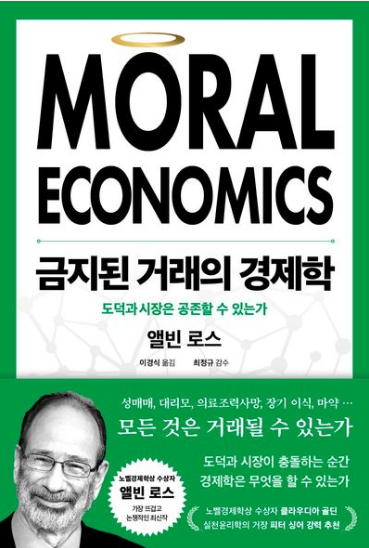
Moral Economics in Korean

Here's the first commercial translation I've seen of my book Moral Economics, which appeared in English in May 2026.

 I suspect that, now that A.I. can offer substantial assistance, some translations will appear more rapidly than in the past. 

The title in Korean is 금지된 거래의 경제학도덕과 시장은 공존할 수 있는가, The Economics of Forbidden Transactions: Can Morality and Markets Coexist? (You can buy it here.)


New release

Here's a book review in the Seoul Economic Daily.

Here's another. Both are in English.

Wednesday, September 23, 2026

School choice: peer effects and social justice

 The not-so-secret secret of building a good school is to have good students. And sometimes that can lead to conflicts between the desire to build better school systems to serve children in the aggregate, and the desire to put your child in the best school for him or her.  

A NYT columnist talks about this, writing "In New York, a combination of housing segregation and “academic” sorting, called school choice, that begins as early as pre-K means most Black students — even middle-class ones — are forced to attend racially segregated schools with high rates of poverty." (emphasis added)

In Fighting for Every Black Child, Did I Betray My Own?
A decade ago, I made a decision about my daughter’s education that I hoped would challenge New York City’s separate and unequal school system. Now 16, she thinks I made the wrong choice.
 By Nikole Hannah-Jones

#######

On a somewhat related note, when I speak to prospective PhD students who are visiting universities after being admitted to multiple PhD programs, I encourage them to talk to the graduate students already there, and discover how happy, productive, and collaborative they are.  A good PhD program is one where you learn a lot by collaborating with your fellow students in study and research. 

Tuesday, September 22, 2026

There's life after tenure denial: Emily Oster (on Mary in America)

 That there is life after tenure-denial is robustly proclaimed and manifested by Emily Oster, in the opening minutes of an interview by Mary Childs on her podcast Mary in America.  There is also, apparently, a Tshirt advertised on the internet saying "Emily Oster is wrong."


x 


Sunday, September 20, 2026

Market Design Impact Award to Yan Chen

 Here's the announcement from INFORMS:

Announcing the Winner of 2026 Market Design Impact Award

 "The Auctions and Market Design section of INFORMS is pleased to announce that Yan Chen, Daniel Kahneman Collegiate Professor of Information at the University of Michigan School of Information, has been selected as the recipient of the 2026 Market Design Impact Award. The award will be presented at the AMD Business Meeting at the INFORMS Annual Meeting in San Francisco, tentatively scheduled for Monday, November 2, 6:45–7:45 PM.

Award citation:
"For pioneering behavioral market design-combining theory, digital experiments, and large-scale field experiments-with lasting impact on the practice of market design, including the reform of Chinese college admissions, the organization of gig workers on ride-sharing platforms, and the design of recommender systems that increase contributions to digital public goods."

Now in its second year, the Market Design Impact Award recognizes major contributions to market design-original research from the past fifteen years that has had a lasting impact, directly or indirectly, on the field and/or the practice of market design.

Award Committee:
Eric Budish, The University of Chicago Booth School of Business
Tim Roughgarden, Columbia University
Nicolas Stier, Meta

Conflicts of interest were carefully handled such that they would not influence the committee decision. "

#########

Here's last year's (inaugural) award:

Friday, October 31, 2025 Market Design Impact Award to Hassidim, Romm, and Shorrer


Saturday, September 19, 2026

A passionate proponent of transplants is (temporarily) unregistered as a donor: Greg Segal in the NYT

I'm a little shaken to learn that (even*) Greg Segal has temporarily suspended his registration as a potential deceased organ donor.  My registration remains active, but I'm watching with attention the regulatory and other reforms that are being contemplated for the system of deceased donation in the U.S.

What I Found Out About Organ Donation Shocked Me
By Greg Segal
Mr. Segal is the founder and chief executive of Organize, a nonprofit focused on reforming the organ donation system. 

 "I founded Organize, a nonprofit making it easier to register to become an organ donor. In 2015, Organize was selected for a role embedded inside the U.S. Department of Health and Human Services, which put us on the radar of whistle-blowers. I soon became inundated with allegations from people working inside the organ donation industry who felt they had nowhere else to turn.

"I know as well as anyone that organ donation saves lives — over 40,000 annually in the United States in recent years. But I was stunned to learn that organ procurement organizations — the federal contractors that coordinate organ donation from the deceased — that made those transplants possible were routinely violating ethical standards and putting patients at risk.

"I heard allegations of negligence and financial fraud, including industry executives’ billing taxpayers for joyrides on private jets meant to transport organs; of organizations performing unnecessary procedures as part of a scheme to overbill Medicare. (Organ procurement organizations are nonprofits, but that doesn’t mean they aren’t trying to maximize financial reimbursements.) I’ve heard of poorer Americans waiting to receive organs passed over in favor of wealthier ones.

"But one case in particular led me to remove myself from the donor registry and testify before Congress."

#######

He goes on to recount one of the most disturbing cases reported recently in the NYT (which I think were at least in part uncovered through the work of his Organization).

See

Friday, June 6, 2025 Disturbing NYT report about an Organ Procurement Organization in Kentucky

 and

Sunday, July 20, 2025  Organ donation after circulatory death: the NYT recounts some disturbing cases

also

*Saturday, August 9, 2025  Withdrawals from deceased donor registries   

Friday, September 18, 2026

Micheal Kremer's next (post-Nobel) Act: The World Bank

 Michael Kremer, one of the most  creative and dedicated economists of our time, has found his next act, at the World Bank.  (Sometimes the news is encouraging, even nowadays.)

Here's the press release from the World Bank. 

Michael Kremer Appointed as World Bank Group Chief Economist

"WASHINGTON, September 16, 2026—World Bank Group President Ajay Banga announced that Nobel laureate Michael Kremer has been appointed as World Bank Group Chief Economist and Senior Vice President for Development Economics, bringing one of the world’s foremost development economists to lead the institution’s research, data, and analytical agenda.

"Kremer is known not only for tackling real-world problems through innovative solutions grounded in rigorous research but also for translating his findings into programs that have reached hundreds of millions of people, from expanding vaccine access and school health programs to supporting smallholder farmers." 

Thursday, September 17, 2026

Would Jesus like Waymo?

Are robots (and robot cars) repugnant?  To Baptists?  

The Washington Post has the story:

Would Jesus like Waymo? Baptists have thoughts.
As religious groups contend with artificial intelligence, some Baptist pastors are lobbying against a bill that would allow driverless cars to operate commercially in D.C. They say autonomous vehicles are antihuman
. By Liam Scott
 

"Would Jesus like Waymo? The Rev. A. Michael Charles Durant doesn’t think so.

“Jesus either walked or rode a beast,” Durant said in an interview at the Tenth Street Baptist Church in Washington, where he serves as pastor. “He would be opposed to technology that was opposed to people, and I believe that this is opposed to people.”

...

"In recent months, Durant has joined local Baptist pastors and other top leaders in the National Baptist Convention — which bills itself as the largest Black religious organization in the United States — in opposing autonomous vehicles, including in the District, where the D.C. Council is weighing a bill that would legalize their commercial operation.

...

“God created us to be interdependent,” Durant said from his green-carpeted office. “The greatest danger is not that humans will be not needed, but that we create an environment where humans don’t need each other.”

"Their opposition to autonomous vehicles comes as religious communities grapple with artificial intelligence and what the technology means for the human condition and all its messy beauty.

“Automation can dehumanize humanity. The Book of Genesis declares that God created man, and then he breathed into man’s nostrils, and man became a living soul,” said C.H. Johnson, the pastor at Christ Missionary Baptist Church in Maryland. “If we’re not careful, technology can rob us of our humanity, can rob God’s creation of our humanity.” 

...

"In his first encyclical, published in May, Pope Leo XIV elevates the ethics of AI to a religious imperative. In “Magnifica Humanitas,” Leo argues that the unconstrained proliferation of AI may threaten humanity and foster inequity.

...

"Not all religious leaders oppose robotaxis. At an April event hosted by the Innovation Majority Institute think tank, the Rev. Thomas Bowen, from Shiloh Baptist Church in D.C., recalled when taxis drove right by him as a Black man in the District and New York years ago. He said he was excited when Uber and Lyft came on the scene but that he has faced similar issues with those services.

“Why should I have to put on a suit to get a taxi?” said Bowen, who is the general secretary of the Washington-based Progressive National Baptist Convention.

...

"For the National Baptist Convention’s annual gathering this week in Florida, Durant, chairman of the group’s board, prepared a video to screen in which he called on his fellow pastors to oppose autonomous vehicles in their communities around the U.S."