I post market design related news and items about repugnant markets. See my Stanford profile. I have a forthcoming book : Moral Economics The subtitle is "From Prostitution to Organ Sales, What Controversial Transactions Reveal About How Markets Work."
Showing posts with label controversial markets. Show all posts
Showing posts with label controversial markets. Show all posts
The latest episode of Freakonomics looks at the controversies and philosophies involved in the growing legalization of medical aid in dying (MAID). Stephen Dubner interviews people with multiple perspectives, and offers a personal insight of his own.
"DUBNER: I have a sister who died last year, it was a pretty rotten death, honestly, and she wanted to hasten it. We couldn’t physically orchestrate it. And it really made me see this issue in a new way. It just seemed, you know, I don’t want to say the scales fell from my eyes, but I’d never encountered it first-hand. And it made me think that almost anyone who did encounter it first-hand might have a reckoning, might be in favor of it. But I don’t know, maybe that’s just me. Do you have any sense of how broad the support is for it generally?
ROTH: We’re an aging population, so I think not only do more people have a reason to contemplate their own death, but more people know a peer who’s died, and certainly parents have died, and relatives, you know, siblings and friends. So I would think that anyone who’s seen an agonizing death should at least give some thought to whether we should be legalizing medical aid in dying."
You can listen or read the transcript at this link:
Who Gets to Choose a “Good Death”? New York is the latest state to legalize medical aid in dying. Stephen Dubner speaks with the governor who signed the law, a Nobel Prize-winning economist, a death doula — and an ethicist who thinks the very idea is wrong.
"SOURCES: Kathy Hochul, governor of New York. Suzanne O'Brien, death doula, founder of Doulagivers Institute. Al Roth, economist at Stanford University. Daniel Sulmasy, physician, philosopher, director of the Kennedy Institute of Ethics at Georgetown University.
I'll be speaking Sunday at the American Transplant Congress, on kidney exchange. It will be hard to squeeze in all the recent developments in my half hour, including current controversies.
I'm no expert on the production of foie gras, but I am glad to see arguments about repugnant transactions and controversial markets that take seriously the concerns of opponents.
"There is now a proposedballot initiativemoving through Washington that wouldban foie gras entirely. No producing it, no selling or serving it. Fines between $1,000 and $5,000 per violation. License suspension for repeat offenses
...
""I am asking you to not sign the petition. But first I want to do something the other side rarely does, which is to take their concerns seriously.
"Gavage — force-feeding through a tube inserted down a bird’s throat — looks terrible. I know because I have seen it. I understand completely why someone sees footage of it and reacts with horror. If you imagine the same thing done to human beings, it looks like violence.
"But here is what I also know, and what the activists with the megaphones do not know and do not want to know because it would complicate the argument they have decided to make.
...
' A duck’s esophagus, where the gavage tube is inserted, is desensitized, without a gag reflex, and it is capable of swallowing whole crustaceans and scaly fish in the wild. Its windpipe is separate from the esophagus, meaning the gavage process has no impact on breathing. More importantly, this overfeeding is something the bird does naturally. Before their annual migration, ducks gorge — they stuff themselves with excess food. The calories are stored as fat, not only in the liver but in the expanded esophagus. (The verb “gorge” comes from this behavior.) What foie gras farming does is amplify a natural biological process rather than invent a cruel one .
...
"The producer I buy foie gras from exemplifies the kind of care and attention good farming demands. Their ducks are raised for 15 weeks, about twice the poultry industry standard, in open barns, on a vegetarian diet. Force-feeding by hand happens three times a day for the final three weeks. Each feeding takes approximately 1½ seconds, and, from my observation, the ducks barely seem to notice it."
"I asked Roth if he’s a libertarian, since libertarians say people should be free to do what they want as long as it doesn’t hurt others. No, Roth told me.
“People who call themselves libertarians often don’t like market regulation of any sort, but I’m a market designer,” Roth said. “I think that good regulations help markets work well.”
" Peter Coy, the veteran New York
Times economics columnist, writes about kidney exchange, after an
interview/conversation sparked by a recent working paper of mine, Market Design and Maintenance. (He's a rare economic journalist who reads economists' papers.)
He's
also a rare interviewer: his column includes the names of more of my
coauthors than I can recall in any other interview. In order of
appearance: Tayfun Sonmez and Utku Unver, Frank Delmonico, Susan
Saidman, Mike Rees (implicitly) when he names Mike's nonprofit Alliance for Paired Kidney Donation, and Elliott Peranson. Market design is, after all, a team sport."
Medical aid in dying and hospice care are now available for pets too.
The New Yorker has the story:
When Should You Say Goodbye to a Pet? Across the country, the booming industry of pet hospice is teaching people how to face the loss of their beloved companions. By Sunita Puri
" In the nineteen-seventies, hospice care evolved as more people resisted the compulsion to extend life at all costs, preferring instead to focus on dying comfortably, often at home. Now caring for a sick pet involved the same questions: What is a good quality of life? How much suffering is too much? And when is the right time to let go?
...
"The concept of pet hospice emerged in the eighties and nineties. In 1994, Amir Shanan, a Chicago-based veterinarian, was asked by a couple to euthanize their beloved dog at home. He started to advertise his work, and more people began calling. Their desire to give their pets a graceful end was so strong that they were willing to invite a stranger into their homes to do it. Shanan was astounded.
"Eventually, pet owners began to tell Shanan that they needed his help well before it was time for euthanasia. “With euthanasia, the focus is on the time of death, and grief after the loss, but there is so much more that happens in the time between a bad diagnosis and death,” Shanan told me.
...
" In 2009, he founded the International Association for Animal Hospice and Palliative Care, which now has more than fifteen hundred veterinarian-members around the world. Shanan recruited a team that helped him develop guidelines, create a training program for veterinarians, and write an early textbook on the subject, which was published in 2017. The organization believes that dying is “a normal process,” and that its work allows pets and their families “to attain a degree of mental and spiritual preparation for death.”
"Although pet hospice is modelled on human hospice, there are fundamental differences between the two. Human hospice, which is covered by most insurance, involves treating the emotional, spiritual, and physical suffering caused by a terminal illness as it unfolds naturally. Enrollment requires a prognosis of less than six months to live, and euthanasia is never considered. (Some states have legalized medical aid-in-dying, in which patients self-administer a life-ending medication, but euthanasia, in which the medication is administered intravenously by a health-care provider, is illegal in the United States.) "
"For generations, the world’s top horse breeders have carefully mixed bloodlines for temperament, strength, conformation and athleticism. Each new foal bore the promise of outperforming a carefully chosen set of parents. It isn’t quite natural selection, but it isn’t far off.
"Now the equestrian world might be hitting a plateau: exact genetic replicas of successful horses and ponies. In other words, clones.
...
"Polo player Adolfo Cambiaso, regarded by many in the sport as the greatest of all time, essentially created the sporthorse cloning industry when he made a slew of genetic copies of his best ponies, starting in the early 2000s—and began winning tournaments on them.
"In 2010, a clone of his champion mare Cuartetera sold at auction for $800,000, an eye-popping sum for a polo pony at the time
...
"Cloning is a controversial practice, but particularly so in horse sports. It is banned in thoroughbred racing and competitors in other disciplines are divided, with some saying it creates unrealistic expectations and stifles advances in breeding.
...
"The Fédération Equestre Internationale, the governing body for Olympic horse sports, banned clones from competition in 2007. But it reversed that decision in 2012 after determining they didn’t provide competitors with an unfair advantage, due to the myriad environmental factors that go into producing a champion, like parentage, training, the rider, the type of food it eats and even the shoes it wears.
...
"Buenos Aires-based Kheiron Biotech, an equine cloning company, produced around 400 cloned horses during the season that ended in February, mostly of various polo ponies. "
If A.I. assisted "surveillance pricing" is going to identify you as a high willingness-to-pay consumer, maybe it will be a good idea to train an A.I. shopping agent to impersonate a low willingness-to-pay consumer on your behalf.
"Businesses have long tracked customers’ search behavior and buying history and used that information, along with other factors like a consumer’s location, to offer promotions and discounts to motivate purchases. Dynamic pricing, where the same fare or rate shifts for everyone based on supply and demand, also has become common across industries, including airfares and ride-shares. What is different now and concerning to researchers is the possibility that online retailers could use personal data to set a higher base price for individual consumers, without their knowledge, when algorithms detect things like urgent need or high disposable income.
...
"It is difficult to find more than isolated cases currently. However, many researchers believe personalized pricing will become increasingly common as the technology to make it possible improves. ...
" Software that automates price-setting—often driven by artificial intelligence—can help retailers seamlessly turn that data into tailored pricing.
"In early 2025, the Federal Trade Commission released initial findings of an investigation into surveillance pricing (another term for personalized pricing). It determined that companies were selling pricing and consumer-data tools to help retailers across various industries set individualized prices—a strong indication to some researchers that retailers were headed in that direction.
"To really understand the nuts and bolts of economics, look to the black market. Alvin E. Roth is Craig and Susan McCaw Professor of Economics at Stanford University and the George Gund Professor of Economics and Business Administration Emeritus at Harvard University. He was awarded the Nobel Prize in Economics in 2012. He joins host Krys Boyd to discuss his work on organ donation which led him to study what he called “repugnant transactions” like sex and drugs and why he feels banning them completely doesn’t always have the effect we think it does. His book is “Moral Economics: From Prostitution to Organ Sales, What Controversial Transactions Reveal About How Markets Work.”
Transcript (also at the above link)
Here's a very contemporary Texas question:
"Krys Boyd [00:25:48] I’m really curious, Alvin, about whether making things illegal has much of an effect on things. I live in Texas, where recreational marijuana is against the law. I can tell you just anecdotally that it appears to not stop very many people. You pose this interesting question about why the laws work pretty well to keep people from committing murder for hire, but not so well at all from buying and selling illegal drugs. "
"Kidneys, surrogacy, prostitution, gambling, price gouging, assisted dying: some transactions make people recoil, even when all parties consent. Cato’s Ryan Bourne talks with Nobel Prize-winning economist Alvin Roth about his new book, Moral Economics, what makes markets “repugnant,” what economists can add to moral debates, and why banning exchange rarely makes scarcity, exploitation, or hard trade-offs disappear."
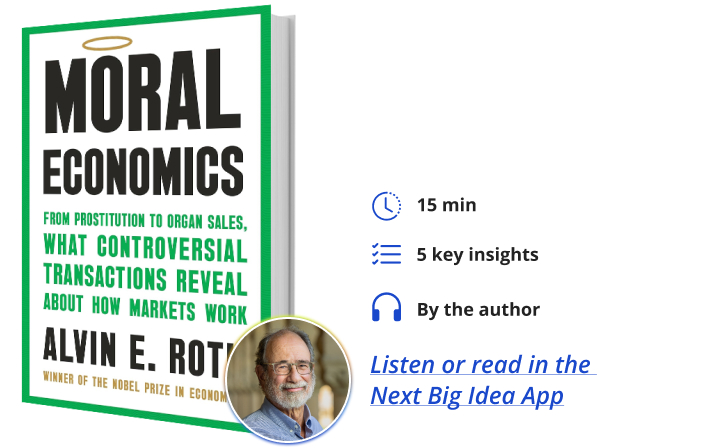
Below, Alvin Roth shares five key insights from his new book, Moral Economics: From Prostitution to Organ Sales, What Controversial Transactions Reveal About How Markets Work.
Alvin is the Craig and Susan McCaw Professor of Economics at Stanford
University and the George Gund Professor of Economics and Business
Administration Emeritus at Harvard University. A pioneering expert in
the field of market design, he was awarded the Nobel Prize in Economics
in 2012. He is also a member of the National Academy of Sciences and
past president of the American Economic Association.
What’s the big idea?
There’s an old joke about economics and sociology that says
economists try to understand the choices people make, and sociologists
try to understand why people don’t really have any choices. Alvin looks at how societies try to decide whether to allow some choices and ban others.
There are lots of morally contested markets and transactions that
some people would like to engage in, but others think shouldn’t be
allowed. Often, the objections are stated in terms of moral or religious
reasons. And the transactions that the opponents seek to ban don’t harm
them personally—they might not even know the transactions had occurred
unless someone tells them.
For example, same-sex marriage is a morally contested transaction:
two people want to marry each other, and some other people don’t think
same-sex marriages should be allowed—even though you can’t tell if
someone is married unless they tell you, for instance, by wearing a
wedding ring. For centuries, marriage was regarded as inherently
heterosexual. But, after considerable controversy, the U.S. and many
other countries have legalized same-sex unions.
This isn’t a unique situation. Lots of controversial markets are
connected to reproduction. There have been bans at different times and
places on contraceptives, in vitro fertilization, abortion, and
surrogacy. That is, there have been laws enshrining opposing views about
whether a woman should be able to prevent becoming pregnant during sex (by buying contraception), should be able to initiate a pregnancy without sexual intercourse (via IVF), or be able to terminate
a pregnancy via abortion, not to mention being a surrogate or having a
surrogate bear a baby. In the U.S., all those things have been through
the courts multiple times and with different results.
Notice that reliable contraception and IVF involve modern disputes
about modern technologies. Before reliable contraception, sex between a
man and a woman often resulted in pregnancy, and before assisted
reproductive technology, like IVF, sex was the only avenue to
pregnancy. Many traditional laws and norms that attempted to keep sex
within the bounds of marriage between a man and a woman were attempts to
ensure that babies would be born into families. But if pregnancy
becomes a choice, and if there are other ways to have a child than
intercourse between a man and a woman, then the door opens to more
expansive views about who can have sex with whom, and who can start a
family. So, while expanding marriage to include same-sex couples doesn’t
depend on modern technology, we can see that the changes in
reproductive technology may have moved the needle on what kinds of
marriages and related transactions receive social support.
Of course, bans on extra-marital sex, prostitution, or abortion never
succeeded in making those things disappear, even though they raised
barriers.
2. Bans on markets need social support to work well.
Some bans work well while others give rise to active black markets.
For example, why is it so easy to buy drugs, but so hard to hire a
hitman? U.S. laws aren’t so different for drug dealers and hitmen: if we
catch them, we send them to prison for a long time. Yet our prisons are
filled with drug dealers, and there have been years in which more than
100,000 people died from opioid overdoses. But murder for hire is so
rare that it doesn’t even make it into the national crime statistics,
and homicides from any cause are vastly fewer than drug overdose deaths.
At least some of the difference has to do with how people think about
drugs and murder. If I told you I was looking to buy some heroin, you
would be surprised, but you wouldn’t call the police (and if you did,
they would tell you that they were busy with more pressing calls). But
if I told you I was looking to hire a killer, you might very well call
the police, and when you did, they would encourage you to tell me that I
might find an available hitman at a certain bar, where I would find
myself trying to hire an undercover detective. To put it another way,
there are neighborhoods where drugs are readily available, and the
neighbors look away, but not so many neighborhoods where killers are the
norm, in part reflecting that the social norm against drugs is much
more porous than against murder.
“At least some of the difference has to do with how people think about drugs and murder.”
I don’t know how we should best make progress in dealing with the
markets for addictive, lethal drugs. Not only are we losing the “War on
Drugs,” but it won’t even accept our surrender: experiments with
decriminalizing drug use have shown the potential to make cities less
livable. We’re going to need to experiment, to find better ways to
proceed.
It’s worth noticing that we’ve learned to live with legal markets for
tobacco and alcohol, even though each of those causes more deaths than
are due to drug overdoses. And we’re wrestling with some other kinds of
addiction, such as gambling (particularly on your phone, during a game).
The drug epidemic teaches us that well-intentioned policies can fail.
By and large no one approves of heroin, but we haven’t succeeded in
vanquishing it any more than we succeeded in making alcohol disappear
during Prohibition.
3. Moral intuitions aren’t enough by themselves.
We need to gather and pay attention to evidence about the
consequences of particular policies. This is hard when moral intuitions
collide, partly because much moral argumentation rests on weak or no
evidence. But we can’t afford to judge our policies just by their
intentions. We have to at least look at their consequences, too.
Nevertheless, moral intuitions are important and consequential, so we
need to understand them better. There are some things that many moral
intuitions have in common. For example, concern about the possible
exploitation of vulnerable people is often an issue.
4. Sometimes adding money to a transaction arouses repugnance.
For example, paying in cash is what turns sex into prostitution.
Often, the objection to introducing money into transactions is that it
might be an undue influence that could coerce the poor into
transactions that they (or we) would prefer not to take part in. But
that’s over-broad: many people work for financial pay at jobs they
wouldn’t otherwise do. And many goods and services that we need wouldn’t
be available if they couldn’t be paid for.
“Many people work for financial pay at jobs they wouldn’t otherwise do.”
Pharmaceuticals made from blood plasma are a good example. Many
countries ban payments to plasma donors and try (almost always
unsuccessfully) to generate as much as they need of the large amounts of
plasma required to treat many diseases from unpaid donors. How do they
make up for the shortfall? Fortunately, you can buy plasma and
plasma-derived medicines from the U.S. We’re the Saudi Arabia of blood
plasma, exporting tens of billions of dollars of plasma products each
year, collected largely from plasma donors who are paid.
5. Religion remains important in many controversies.
It plays a large role in the growth of legal medical aid in dying, in the U.S. and elsewhere.
Overall, in pursuing moral economics, we have to keep in mind the maxim that ought implies can, and the things we feel morally obligated to do, whether by supporting them or banning them, have to be things that we can
do. To understand those limits, we need evidence, including
experimentation, to figure out how to proceed when we’re worried by all
our options.
"despite the severity of the allegations — an affair that raised serious blackmail risks, attending openly partisan events, and lying to investigators when caught — the Eleventh Circuit and the Judicial Conference both concealed the judge’s identity. They even adjusted the very minor sanction to allow the judge “to word the letters of apology vaguely so as to ensure that a letter could not be ‘used against [the Subject Judge] in some way.’”
...
"The Eleventh Circuit thought it had been so clever in anonymizing its report. The reports don’t include a name or a district, and refer only to “Subject Judge” throughout. The reports even assiduously avoid identifying the judge by gender, proving that even conservative judges can figure out how pronouns work with minimal effort. And yet the reports failed to obscure a number of details that made working out the judge’s identity possible.
...
Handing the reports into two different AI models and turning on all the “deep research” modes, the bots churned for several minutes comparing the reports to publicly available information. Both models delivered lengthy reports reaching the same conclusion. So how did these models do it?
...
"the models instantly filtered out the entire state of Florida. The official reports are littered with references, in varying contexts, to the office of “District Attorney.” Florida uses “State Attorneys” for its local prosecutors. After that, the bots noted that the sanction barred the judge from ever serving as chief judge of their district — meaning the judge was not senior status and not currently the chief judge. The report indicates that investigators spoke with clerks dating back to 2020, disqualifying anyone elevated after that. Discussing the judge attending a DA’s primary victory party, the bot pointed out that the judge had claimed to know the candidate based on their time at the office, narrowing the scope to judges with state prosecutorial experience who overlapped with a sitting DA who won a primary. And had martinis at the victory party. The AI models decided that matched with Atlanta’s Fani Willis. [as the DA]
Once it narrowed the list down, the bot also searched the dockets of possible judges to match the claim in the reports that the high-ranking law enforcement officer did not materialize into a conflict because no cases involving that police department showed up on the judge’s docket.
For good measure, the bot went ahead and took a guess at the officer’s identity too.
In about 10 minutes of work, the AI unraveled all the work these judges put in to keep this confidential. With nothing but a couple of published court documents and the open web. In the time someone might brew a cup of coffee, the most basic possible workflow defeated the Eleventh Circuit’s entire anonymization strategy."
"On June 9, 2025, after the [NY State] Assembly approved the bill, Ms. Netherland was in the State Senate chamber, watching the aye votes mount, and seeing it pass.Gov. Kathy Hochul signedan amended version in February; it is scheduled to take effect Aug. 5.
“A breakthrough moment,” said Kevin Díaz, president of Compassion & Choices, which has spearheaded the long campaign for such laws. After almost 30 years — Oregon’s law, the first in the country, was enacted in 1997 — the addition of two populous states means that almost a third of Americans will live in one where medical aid in dying is legally available. “It shows that there’s broad support for this model,” Mr. Díaz said.
Polls consistently back that claim. APew Research Center surveylast spring found that almost two-thirds of respondents didn’t consider the practice “morally wrong,” either because they thought it was acceptable or not a moral issue."
As the title suggests, the statement focuses on removing financial disincentives for organ donation.
But I'm struck by the last item on the list:
"Additional Steps "In advocating for the elimination of disincentives to living donation, AST will examine, in parallel, the legal,ethical, and practical considerations involved in a pilot study of financial incentives for living organ donation."
"A Nobel Prize-winning economist makes the case that our moral objections to controversial markets are getting people killed.
Alvin Roth won the Nobel Prize in Economics for figuring out how to build markets that work. Now he's turned his attention to the markets we refuse to build, and why that refusal has consequences nobody wants to talk about.
In this episode, Mary and Al dig into what he calls "repugnant transactions" — the deals that some people want to make and others think shouldn't be allowed. They get into why banning organ sales creates black markets where donors get operated on in apartments, why the same logic that ended Prohibition applies to the war on drugs, how surrogacy bans in Europe are turning babies into stateless people, and why it's easy to buy heroin but nearly impossible to hire a hit man.
Al's argument isn't that everything should be for sale. It's that if you care about outcomes more than intentions, you have to confront what your bans are actually doing.
Subscribe for new episodes every week.
Chapters:
00:00 Friendship Isn't A Market
00:32 Meet Nobel Economist Al Roth
01:02 What Makes a Market "Repugnant"?
02:58 Should We Pay People for Kidneys?
08:31 Why Drugs Thrive But Hit Men Don't
15:58 Surrogacy, Politics, and Unintended Consequences
21:45 Why Prohibition Keeps Failing
25:19 Markets, Morality, and Reality
28:19 The Rise of Prediction Markets
34:30 What Money Can't Buy"
"Nobel Prize-winning economist Alvin E. Roth discusses the moral limits of markets, how bans create black markets, and why harm reduction often works better than prohibition."
He talks with Nick Gillespie about why some voluntary transactions
provoke moral outrage even when no one is being directly harmed. Roth
explains why black markets often emerge when governments try to ban
activities with persistent demand, why both markets and prohibitions
require social support to function, and how unintended consequences can
make moralistic policies backfire. They discuss the war on drugs,
prostitution, surrogacy, same-sex marriage, price gouging, and why Iran
remains the only country in the world with a legal market for kidney
donors.
They also explore Roth's work designing kidney exchange
networks and school choice systems, how digital technology and private
transactions make certain bans harder to enforce, and why harm reduction
may work better than prohibition in areas ranging from drug policy to
sex work."
"A Swedish minister has accused France of mounting “an attack on the Swedish way of living” with its ban on nicotine pouches, setting aflame a single market fight over how governments should regulate smoke-free alternatives to tobacco.
"France last month implemented one of Europe’s strictest bans on the pouches, a flavoured sachet that users tuck under their lip to release nicotine.
"France’s decree goes beyond other EU countries’ prohibitions by banning not just sales but import, possession and use of the pouches. A Swede carrying a tin of pouches legally bought at home could face French penalties of up to five years in prison and a €375,000 fine.
“It is as if we would prohibit French baguettes or French wine in Sweden,” Swedish trade minister Benjamin Dousa told the FT. “It is absurd.”
Speaking with the great sociologist Mark Granovetter gave me the opportunity to tell the joke "“Economists study how people make choices; sociologists study why people don’t have choices," since Moral Economics is about the controversial markets over which society struggles with which choices should be allowed and which should be banned.
Stanford's Center for the History of Capitalism sponsored the conversation, and here it is on YouTube, but it's just a podcast, there's audio of our conversation, but no video.
"A kidney transplant does not work like buying a gallon of milk. Neither does hiring or getting into a medical residency. In these markets, both sides care deeply about who they end up with, and a good outcome depends on more than money.
Alvin Roth has spent his career studying what makes those systems succeed or fail. His work designing kidney exchange programs showed that even when people desperately want to help each other, the market can still break down unless the rules create the right kind of match. In this episode, Dart and Al discuss matching markets, moral economics, and the hidden rules that shape opportunity, fairness, and work itself.
Alvin Roth is an economist and professor at Stanford University best known for his work on market design and matching theory. He received the 2012 Nobel Prize in Economic Sciences for his work on stable matching and the design of markets used in medical residencies, school choice, and kidney exchange.
In this episode, Dart and Al discuss: - Why some markets depend on matching - Why fit matters more than money - What makes a market stable - Why real markets are messy - The difference between theory and engineering - What “repugnant transactions” are - Why societies ban some exchanges - How social norms shape markets - Why work is also a matching problem - And other topics…
Alvin Roth is the Craig and Susan McCaw Professor of Economics at Stanford University and recipient of the 2012 Nobel Memorial Prize in Economic Sciences, awarded with Lloyd Shapley for the theory of stable allocations and the practice of market design. His work has helped design matching systems for medical residencies, public school admissions, and kidney exchange programs. He is the author of Who Gets What — and Why and Moral Economics: Why Good and Bad Markets Exist.
"It was so fun talking to Alvin Roth, winner of the 2012 Nobel Prize in Economics.
"One of my favorite books of all time is Who Gets What and Why, which has shaped the way I view labor markets. His second book, Moral Economics, came out last week and it’s so so good - endlessly thought provoking, funny, and sharp. In the podcast, we talk about controversial markets and what makes something repugnant, how to think about exploitation and coercion, and what that means for labor markets.
"Check out the latest episode of The Economics of Work and Al's new book Moral Economics!
"Moral Economics from Basic Books:
Amazon: https://a.co/d/0cu6ZCLm
Podcast Episode:
Apple: https://lnkd.in/esVGQQx5
Spotify: https://lnkd.in/e4sr844Q
Youtube: https://lnkd.in/eif7DHMS"




 Posts
Posts

