Saturday, November 1, 2025

Experimental economics at the University of Pittsburgh

 I recently had the opportunity to visit my old haunts at the University of Pittsburgh, and took part in a reopening and re-dedication of the famous experimental economics lab there. Here's the announcement:

 PEEL is officially back open after renovations

The Pittsburgh Experimental Economics Laboratory (PEEL) celebrated its grand reopening last week following substantial renovation. Led by PEEL Director Lise Vesterlund, the renovations allow Pitt to continue to lead as one of the preeminent experimental economics research universities in the country.

Alvin Roth, winner of the 2012 Nobel Memorial Prize in Economics, was on site to celebrate the event. Roth, who was the Andrew W. Mellon Professor of Economics at Pitt through the 1980s and 90s and is now a professor at Stanford University, founded the lab in 1988 alongside then-Pitt Professor John Kagel.  His original research at PEEL led to his Nobel Prize for market design and to his design of the National Residency Matching Program (NRMP) and the New England Program for Kidney Exchange.  

“Experiments are very powerful, and I think this [lab] is a huge advantage,” Roth said. “For a long time, economists thought of data as something that governments collected […] but when you do experiments, you can carefully control for what you think are relevant differences and understand causes much better.” 


 Vesterlund, who has held the Mellon chair in economics since 2007, has conducted countless experiments in the lab. Particularly influential has been her research assessing the impact of work assignment on gender differences in advancement, research that lead to her award-winning co-authored book The No Club: Putting a Stop to Women's Dead-End Work.  

Vesterlund says a well-functioning lab is the foundation for Pitt’s strong economics department. “PEEL is a world-renowned experimental economics laboratory.  It has been the home to countless seminal research findings. Findings that seeded fields in the profession and improved the way we design markets and organizations. Few institutions can maintain a well-functioning lab, and PEEL has been essential in drawing an exceptionally strong group of scholars to Pitt. The renovation will ensure that the University of Pittsburgh continues to be the center for cutting-edge research in experimental economics.” 

The ceremony included opening remarks from Dean Adam Leibovich before Vesterlund and Roth cut the ribbon, formally re-opening the lab. The renovated lab comprises 40 computer kiosks, where participants can engage with state-of-the-art research software and make choices that inform us about human decision-making.  

To learn more about research being conducted in the lab, you can visit the PEEL website.


Friday, October 31, 2025

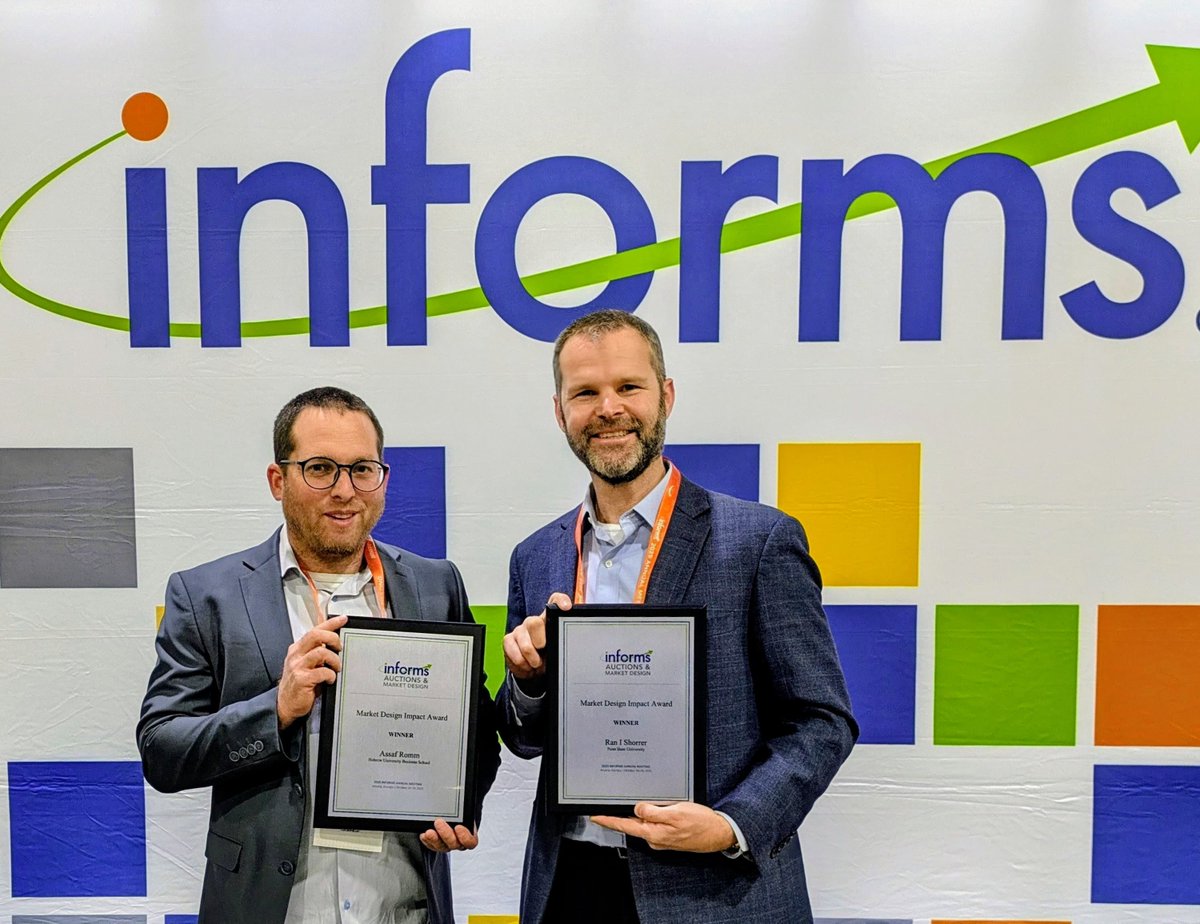
Market Design Impact Award to Hassidim, Romm, and Shorrer

 The Hebrew University breaks the news with this congratulatory message:

"Congratulations to our very own Assaf Romm  and coauthors! 🎉Assaf, along with Avinatan Hassidim and Ran Shorrer , has been awarded the inaugural INFORMS Auctions and Market Design (AMD) Market Design Impact Award- recognizing major contributions in market design over the past 15 years.
Their groundbreaking work has transformed both theory and practice, from redesigning Israel’s Psychology Master’s admissions and Pre-Military Academy programs to improving the medical internship match, impacting thousands of lives. Beyond implementation, their research revealed how real-world behavior can differ from theoretical predictions, helping to pioneer the field of behavioral market design.
Through innovative design, rigorous theory, and a deep understanding of human behavior, Assaf and his coauthors have shown how market design can address pressing social needs while advancing the field.
👏 Remarkable achievement! "


Two men in suits stand side by side holding framed award plaques with text reading INFORMS AMD Market Design Impact Award for Ran Shorrer and Assaf Romm in front of a large blue and green INFORMS logo on a gray background with colorful geometric squares 


I expect that a full(er) account will soon be given on the INFORMS  Market Design Impact Award  page 

Thursday, October 30, 2025

Funeral expense reimbursement to enhance organ donation and transplantation , by Chan and Sweat

 It's legal to pay funeral expenses for whole-body donors (for research) but not for organ donors for transplantation.  Here's a call to change that:

Chan, A., Sweat, K. Funeral expense reimbursement as a strategy to enhance organ donation and transplantation access. npj Health Syst. 2, 39 (2025). https://doi.org/10.1038/s44401-025-00046-z 

Abstract: We propose amending the National Organ Transplant Act to permit reimbursement of funeral expenses for deceased organ donors, analogous to current practices for whole-body donors. This ethically consistent policy could increase organ donation rates by 9–35%, saving 105,000–419,000 life-years and generating $200–800 million annually in Medicare savings—without commodifying human organs, compromising altruism, or undermining established ethical standards governing organ donation. 

Wednesday, October 29, 2025

The role of 'public entrepreneurs' in city government (and a shoutout to Jeremy Lack)

With a focus on New York City's mayoral election  next week,  this Bloomberg.com column considers things that mayors can do, including  school choice reform during the time Michael Bloomberg was mayor of NYC.  It points out the critical role played by Jeremy Lack when he was Director of Strategic Planning for the New York City Department of Education.

How Mayors Can Reclaim Government Efficiency
Amid budget cuts, city leaders are confronting how to get by with less.  By Cara Eckholm 

"Working with university researchers can offer exceptional value for money for cities. Researchers can deliver impartial analysis and technical skills that agencies struggle to hire — and are often willing to work at no cost to the city, in return for access to data and the ability to publish their findings.

"A strong illustration of the potential for impact comes from New York City. In 2003, Jeremy Lack, then the director of strategic planning at the Department of Education, reached out to economist Alvin Roth after reading about his work designing the medical residency match. The DOE had a problem: Its high school admissions process was leaving a third of students unmatched to any school they had ranked. Roth and his coauthors developed a new algorithm that solved the DOE’s matchmaking problem. The algorithm was so successful it was later copied in Boston, and contributed to Roth’s 2012 Nobel Prize.

"But the initial collaboration only happened thanks to the initiative of a public entrepreneur in an agency. Through setting up structured research exchanges, cities can make academic partnerships the norm, rather than the exception."

Tuesday, October 28, 2025

Yuck! and the long journey to a book title

 
As I mentioned in yesterday's post, I'm working on the galleys of my forthcoming book, Moral Economics. This has reminded me of the long journey to a book title.
 
For one thing, the British title isn't exactly  the same as the American title--they have different subtitles. British readers will have to open the book to discover that prostitution and organ sales are among the topics covered, while American readers can see this on the cover.


 Moral Economics 

My original, working title was "Controversial Markets and Repugnant  Transactions," based in part on my 2007 article  "Repugnance as a Constraint on Markets".  But I soon realized that when non-economists heard me mention that a transaction was repugnant, they thought I meant that I didn't like it and that they shouldn't either, when what I did mean was merely that some people object to it, often on moral grounds.

So for a while my working title became "Controversial Markets and Morally Contested Transactions." 

That's descriptive, but clunky.  So I didn't resist too much when my publisher suggested "Moral Economics," although I worried that was too cryptic, so a sub-title would be needed.

And all of this is stored in a folder with the title "Yuck" that I opened on my hard drive when I first started to think about writing a book on repugnant transactions. 

Monday, October 27, 2025

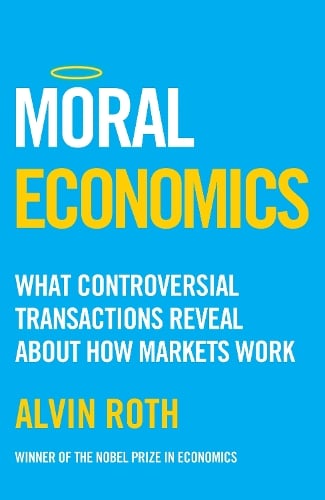
New book! Moral Economics: From Prostitution to Organ Sales, What Controversial Transactions Reveal About How Markets Work--forthcoming!


 I have a forthcoming book, (at long last) and it now even has a cover. (Note the halo:)  I'm reading the galleys right now...


Moral Economics: From Prostitution to Organ Sales, What Controversial Transactions Reveal About How Markets Work    forthcoming – May 12, 2026

also available to preorder at other fine bookstores. (I'll be happy to autograph pre-orders that are mailed to me, btw...)


"A Nobel Prize–⁠winning economist shows us why we have to deal in trade-offs when we can’t agree on what’s right and what’s wrong

"Some of the most intractable controversies in our divided society are, at bottom, about what actions and transactions should be banned. Should women and couples be able to purchase contraception, access in vitro fertilization, and end pregnancy by obtaining an abortion? Should people be able to buy marijuana? What about fentanyl? Can someone be paid to donate blood plasma, or a kidney?

"Disagreements are fierce because arguments on both sides are often made in uncompromising moral or religious terms. But in Moral Economics, Nobel Prize–winning economist Alvin E. Roth asserts that we can make progress on these and other difficult topics if we view them as markets—tools to help decide who gets what—and understand how those markets can be fine-tuned to be more functional. Markets don’t have to allow everything or ban everything. Prudent market design can find a balance between preserving people’s rights to pursue their own interests and protecting the most vulnerable from harm.

"Combining Roth’s unparalleled expertise as market design pioneer with his incisive, witty accounts of complicated issues, Moral Economics offers a powerful and innovative new framework for resolving today’s hardest controversies. "


Sunday, October 26, 2025

Gender Differences in Economics Seminars (forthcoming in the AER)

 Economics seminars are complex, and not always tea parties. Here's a detailed look, by many investigators, via the analysis of many audio recordings.

Gender Differences in Economics Seminars
Pascaline Dupas Amy Handlan Alicia Sasser Modestino Muriel Niederle Mateo Sere Haoyu Sheng Justin Wolfers†
and the Seminar Dynamics Collective‡
 

Abstract
We assess whether men and women are treated differently when presenting their research in economics seminars. We collected data on every interaction between presenters and audience members across thousands of seminars, job market talks and conference presentations, leveraging both human judgment and audio processing algorithms to measure the number, tenor, tone and type of interruptions. Within a seminar series, women are interrupted more than men, and this finding holds when controlling for characteristics of the presenter and their paper topic and for audience size. Interruptions that may not be favorable to the presenter, such as those that are negative in tenor or tone, or cutoff the presenter mid-sentence, are common occurrences in economics seminars, and increase for women presenters. We also find greater engagement with female presenters in the form of larger, more diverse audiences, suggesting a potential role model effect. 

Saturday, October 25, 2025

Enhancing Scientific Integrity in the Social and Behavioral Sciences--Nominate an Expert for an NAS workshop

 The National Academies of Sciences, Engineering, and Medicine are soliciting nominations for a workshop on

 Enhancing Scientific Integrity: Progress and Opportunities in the Social and Behavioral Sciences - A Workshop

"This workshop will bring together researchers, journal editors, publishers, funders, and scientific association leaders to identify practical, forward-looking strategies for strengthening data integrity and transparency in the social and behavioral sciences. Participants will explore innovative tools and frameworks to detect and prevent errors, promote accountability, and reinforce public trust in research. Discussions will also consider how journals, institutions, and professional societies can adopt fair, sustainable practices that support scientific rigor while ensuring accessibility for researchers across many contexts and settings.

Deadline: November 7, 2025

Call for Experts

We invite you to submit suggestions for experts to participate in this activity. The call for experts closes on November 7, 2025 at 11:59 PM PST.

 "The National Academies of Sciences, Engineering, and Medicine proposes to convene a workshop to bring together diverse stakeholders, including journal editors, publishers, scientists, funding agencies, and scientific association leaders, to advance research and data integrity. The workshop will focus on identifying proactive, constructive strategies to enhance transparency and accountability in research practices. Key questions to be addressed include:

• How can the social and behavioral sciences continue to lead the way in advancing data integrity? What successful methods or frameworks from other disciplines might be adapted to strengthen these efforts?

• Could systematic, random audits of published data help detect and correct honest mistakes while discouraging malfeasance? What governance structures would ensure such efforts are fair, sustainable, and constructive? What new tools might facilitate this process?

• How can scientific journals refine their policies (e.g., review processes, data validation) to support transparency and integrity while maintaining accessibility for researchers across diverse contexts?

• What strategies can be employed to ensure potential solutions avoid placing undue burdens on researchers, especially those at institutions with limited resources?"

Friday, October 24, 2025

NBA gambling indictments

 The NYT has the story of the latest sports-gambling scandal in which several NBA players and veterans were arrested for giving gamblers information that certain players could be expected to underperform.


NBA gambling indictments  By Mike Vorkunov

" The alleged betting scheme feasted on and weaponized what law enforcement officials called non-public information about who wasn’t playing in future games. Several games were bet on because bettors found out that players would sit out for tanking teams trying to better position themselves for the league’s draft lottery. This is something the NBA has paid some attention to in the past, but now, it will have to be extremely strict about it. Injury reports have always been important to gamblers, but the indictments show how they can be used and potentially criminalized.

...

"There is a throughline to the Jontay Porter case from last year. Some of the same people were indicted today and named in the court filings that were arrested and named in the case related to Porter. That case also led to an FBI investigation into college basketball and game manipulation. 

######

And by coincidence, here's a timely New Yorker cartoon:

“Some people say sports betting has gone too far, but I like the on-field bookie.”
Cartoon by Brendan Loper October 7, 2025
 

Thursday, October 23, 2025

Algorithmic Collusion Without Threats

 Quanta magazine reports on a recent paper on algorithmic collusion (in which a big class of "dumb" strategies can settle on high prices):

The Game Theory of How Algorithms Can Drive Up Prices
Recent findings reveal that even simple pricing algorithms can make things more expensive
  by Ben Brubaker 

" how can regulators ensure that algorithms set fair prices? Their traditional approach won’t work, as it relies on finding explicit collusion. “The algorithms definitely are not having drinks with each other,” said Aaron Roth(opens a new tab), a computer scientist at the University of Pennsylvania.

...

" if you want to guarantee fair prices, why not just require sellers to use algorithms that are inherently incapable of expressing threats?

"In a recent paper(opens a new tab), Roth and four other computer scientists showed why this may not be enough. They proved that even seemingly benign algorithms that optimize for their own profit can sometimes yield bad outcomes for buyers. “You can still get high prices in ways that kind of look reasonable from the outside,” said Natalie Collina(opens a new tab), a graduate student working with Roth who co-authored the new study.

...

"“Without some notion of a threat or an agreement, it’s very hard for a regulator to come in and say, ‘These prices feel wrong,’” said Mallesh Pai(opens a new tab), an economist at Rice University. “That’s one reason why I think this paper is important.”

...

"So, what can regulators do? Roth admits he doesn’t have an answer. It wouldn’t make sense to ban no-swap-regret algorithms: If everyone uses one, prices will fall. But a simple nonresponsive strategy might be a natural choice for a seller on an online marketplace like Amazon, even if it carries the risk of regret.

“One way to have regret is just to be kind of dumb,” Roth said. “Historically, that hasn’t been illegal.”

#######

And here's the paper:

Algorithmic Collusion Without Threats 

There has been substantial recent concern that pricing algorithms might learn to ``collude.'' Supra-competitive prices can emerge as a Nash equilibrium of repeated pricing games, in which sellers play strategies which threaten to punish their competitors who refuse to support high prices, and these strategies can be automatically learned. In fact, a standard economic intuition is that supra-competitive prices emerge from either the use of threats, or a failure of one party to optimize their payoff. Is this intuition correct? Would preventing threats in algorithmic decision-making prevent supra-competitive prices when sellers are optimizing for their own revenue? No. We show that supra-competitive prices can emerge even when both players are using algorithms which do not encode threats, and which optimize for their own revenue. We study sequential pricing games in which a first mover deploys an algorithm and then a second mover optimizes within the resulting environment. We show that if the first mover deploys any algorithm with a no-regret guarantee, and then the second mover even approximately optimizes within this now static environment, monopoly-like prices arise. The result holds for any no-regret learning algorithm deployed by the first mover and for any pricing policy of the second mover that obtains them profit at least as high as a random pricing would -- and hence the result applies even when the second mover is optimizing only within a space of non-responsive pricing distributions which are incapable of encoding threats. In fact, there exists a set of strategies, neither of which explicitly encode threats that form a Nash equilibrium of the simultaneous pricing game in algorithm space, and lead to near monopoly prices. This suggests that the definition of ``algorithmic collusion'' may need to be expanded, to include strategies without explicitly encoded threats.


Wednesday, October 22, 2025

Divergent views on behavioral economics: books by Loewenstein and Chater, and Thaler and Imas

 You could hardly have two more different books on behavioral economics, both by important contributors to the field. Chater and Loewenstein regret their part in what they feel has turned into a scam, while Thaler and Imas celebrate how it has gone from victory to victory.

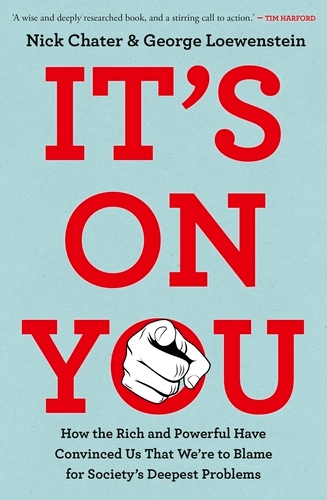
It's On You.  How they rig the rules and we get the blame for society's problems 
by
Nick Chater and George Loewenstein
 

"Two decades ago, behavioral economics burst from academia to the halls of power, on both sides of the Atlantic, with the promise that correcting individual biases could help transform society. The hope was that governments could deploy a new approach to addressing society’s deepest challenges, from inadequate retirement planning to climate change—gently, but cleverly, nudging people to make choices for their own good and the good of the planet.

"It was all very convenient, and false. As behavioral scientists Nick Chater and George Loewenstein show in It’s On You, nudges rarely work, and divert us from policies that do. For example, being nudged to switch to green energy doesn’t cut carbon, and it distracts from the real challenge of building a low-carbon economy.

"It’s on You shows how the rich and powerful have repeatedly used a clever sleight of hand: blaming individuals for social problems, with behavioral economics an unwitting accomplice, while lobbying against the systemic changes that could actually help. As two original proponents of the nudge principle, Nick and George now argue that rather than trying to “fix” the victims of bad policies, real progress requires rewriting the social and economic rulebook for the common good."

Book cover of It's On You by Nick Chater, George Loewenstein 

###### 


The Winner's Curse: Behavioral Economics Anomalies, Then and Now
by Richard H. Thaler  and Alex Imas  

"Nobel Prize winner Richard H. Thaler and rising star economist Alex O. Imas explore the past, present, and cutting-edge future in behavioral economics in The Winner’s Curse.

"Why do people cooperate with one another when they have no obvious motivation to do so? Why do we hold on to possessions of little value? And why is the winner of an auction so often disappointed?

"Over thirty years ago, Richard H. Thaler introduced readers to behavioral economics in his seminal Anomalies column, written with collaborators including Daniel Kahneman and Amos Tversky. These provocative articles challenged the fundamental idea at the heart of economics that people are selfish, rational optimizers, and provided the foundation for what became behavioral economics. That was then.

"Now, three decades later, Thaler has teamed up with economist Alex O. Imas to write a new book with an original and creative format. Each chapter starts with an original Anomaly, retaining the spirit of its time stamp. Then, shifting to the present, the authors provide updates to each, asking how the original findings have held up and how the field has evolved since then.

"It turns out that the original findings not only hold up well, but they show up almost everywhere. Anomalies pop up in people’s decisions to save for retirement and how they carry outstanding credit card debt. Even experts fail to optimize. The key concept of loss aversion explains missed putts by PGA pros and the selection of which stocks to sell by portfolio managers. In this era of meme stocks and Dogecoin, it is hard to defend the view that financial markets are highly efficient. The good news, however, is that the anomalies have gotten funnier." 


Monday, October 20, 2025

Do we need to worry that surrogacy will be banned in the US? (by the UN??)

  Stat News has a call to prevent surrogacy from being banned, following a recent UN resolution to do just that.

How to keep commercial surrogacy from getting banned
An unlikely alliance working to end surrogacy is gaining power
    By Arthur L. Caplan  Oct. 20, 2025
Caplan is head of the Division of Medical Ethics at the NYU Grossman School of Medicine. 


Caplan calls for more regulation, which might be a fine idea.  But I don't share his concern that the UN call to ban surrogacy will lead to it being banned in the US. Surrogacy in one form or another has been legalized in every US state (or maybe all but one.)   This is one of those times where it's good that the UN is toothless. 


HT: Martha Gershun 

Sunday, October 19, 2025

Harvard University's Financial Report for 2025

 Here is Harvard's Financial Report FISCAL YEAR 2025 

Here's the first paragraph of the Message from the President

"Message from the President
I am pleased to submit Harvard University’s financial results. Even by the standards of our centuries-long history, fiscal year 2025 was extraordinarily challenging, with political and economic disruption affecting many sectors, including higher education. Following the termination of federal research funding awarded to Harvard, an act the US District Court has since found to be unlawful, the University committed $250 million in contingency funding, which the Schools supplemented with additional funding. To focus our resources on the University’s core mission of teaching, learning, and research, we made difficult but necessary choices. We announced a hiring freeze and painful layoffs, kept salary increases flat for exempt employees, and scaled back projects and expenditures ."


Here are the first paragraphs of the Financial Overview:

"Fiscal year 2025 tested Harvard in ways few could have anticipated.
 

"We began the year with challenges already in view: expenses rising faster than revenues, inflationary pressures amid broader economic uncertainty, and the ongoing work of renewing and rebuilding our
community. We closed it confronting the abrupt termination of nearly all of Harvard’s federal research grants, facing potential constraints on the exchange of international scholars, and considering how we will absorb the enactment of a substantial increase to the federal tax on endowment income, scheduled to take effect in fiscal 2027.
 

"All of these developments have raised new questions about the financial foundations of higher education and underscore a shifting federal policy environment that will shape the future. 

"The consequences of these shifts are only beginning to be felt. Harvard ended the year with a $113 million deficit, a -1.7% margin on a $6.7 billion operating revenue base." 

Friday, October 17, 2025

The international black market in stolen smartphones

Modern "pick pockets" are now  mounted on ebikes and swiping smartphones...

 The NYT has the story:

London Became a Global Hub for Phone Theft. Now We Know Why.
About 80,000 phones were stolen in the British capital last year. The police are finally discovering where many of them went. 
 By Lizzie Dearden and Amelia Nierenberg

" Increasingly brazen thieves, often masked and on e-bikes, have become adept at snatching phones from residents and tourists. A record 80,000 phones were stolen in the city last year, according to the police, giving London an undesirable reputation as a European capital for the crime.

...

"But last December, they got an intriguing lead from a woman who had used “Find My iPhone” to track her device to a warehouse near Heathrow Airport. Arriving there on Christmas Eve, officers found boxes bound for Hong Kong. They were labeled as batteries but contained almost 1,000 stolen iPhones.

...

"Some phones are reset and sold to new users in Britain. But many are shipped to China and Algeria as part of a “local-to-global criminal business model,” the police said, adding that in China, the newest phones could be sold for up to $5,000, generating huge profits for the criminals involved.
"
Joss Wright, an associate professor at the University of Oxford who specializes in cybersecurity, said that it is easier to use stolen British phones in China than elsewhere because many of the country’s network providers do not subscribe to an international blacklist that bars devices that have been reported stolen. 

...

"Sgt. Matt Chantry, one of the leaders of the raid last month, said in an interview that thieves on e-bikes were “a real problem.” They mount sidewalks and swipe phones from people’s hands at high speed, he said, while making themselves “unidentifiable” by wearing balaclavas and hoods. “How do you police that?” he asked.

"Attempting to chase them on London’s sometimes gridlocked streets is “high-risk,” he said, endangering pedestrians, other drivers and the offender. Ultimately, he said, the police had to ask, is the risk of a fatality worth it for a cellphone? 

...

"But the police are also hoping users will become more savvy about their personal security. Even as smartphones have become more advanced and valuable, many people’s handling of them has become less protective. For the modern phone thief, a classic mark is a pedestrian walking close to the curb, deeply absorbed by the content on a cell screen — a map, a text, a video.

“You wouldn’t count your money on the street,” said Lawrence Sherman, an emeritus criminology professor at the University of Cambridge. “But when the phone is worth £1,000, it’s like pulling £1,000 out of your wallet and looking at it as you walk.”
 

Thursday, October 16, 2025

Experiments and behavioral market design at Pitt (tomorrow)

 I'm flying  back to my old haunts in Pittsburgh today, for (among other things) two events at the University of Pittsburgh tomorrow:

 October 17, 2025 PEEL Reopening Ceremony with Professor Vesterlund & Professor Roth

"The History of PEEL: The Pittsburgh Experimental Economics Laboratory (PEEL) was founded by John Kagel and Alvin Roth, a Nobel Laureate in Economics. Since its inception, PEEL has served as a hub for pioneering research in experimental economics. Notably, the lab contributed to foundational work on market design, which played a significant role in Roth’s Nobel Prize-winning contributions. Over the decades, PEEL has maintained its reputation as a center of excellence, attracting top scholars and fostering innovation in economic research. +


October 17, 2025 BEDI Workshop (Behavioral Economics and Design Initiative)

BEDI Workshop - Friday, October 17th, 2025

Breakfast | 8:15 am – 8:45 am
Wesley W. Posvar Hall, 4130, 230 S Bouquet St, Pittsburgh, PA 15213 


Conference Welcome | 8:45 am – 9:00 am
Lise Vesterlund, BEDI Director, Andrew W. Mellon Professor, University of Pittsburgh


Session 1 | 9:00 am – 10:40 am
Erina Ytsma– Assistant Professor, Carnegie Mellon University, “Gender Differences in the
Response to Incentives: Evidence from Academia”
Stephanie Wang – Professor, University of Pittsburgh
Claire Duquennois – Assistant Professor, University of Pittsburgh, “Minority athletic performance,
racial attitudes, and racial hate”
Jonathan Woon – Professor & Associate Dean, University of Pittsburgh, “The Epistemology of
Justice: Awareness and Institutional Choice”

Refreshment Break | 10:40 am – 11:10 am

Session 2 | 11:10 am – 12:00 pm
Jenny Chang – Graduate Student, Carnegie Mellon University, “When Women Self-Promote:
Evidence on Beliefs and Downstream Consequences”
Aden Halpern – Graduate Student, University of Pittsburgh 

Brandon Williams – Graduate Student, University of Pittsburgh
Dhwani Yagnaraman – Graduate Student, Carnegie Mellon University, “Crowd-in and crowd-out of
climate policies”
Aaron Balleisen– Graduate Student, Carnegie Mellon University, “Cheap Talk and Pluralistic
Ignorance”

Lunch | 12:00 am – 1:15 pm

Session 3 | 1:15 pm – 2:30 pm
Osea Giuntella – Associate Professor, University of Pittsburgh, “Beliefs, Resilience, and Leadership: Evaluating Trauma-Informed Training”
John Conlon – Assistant Professor, Carnegie Mellon University, “Memory Rehearsal and Belief Biases”
Alex Chan – Professor, Harvard University, “Preference for Explainable AI”


PEEL Re-Opening + Refreshment Break | 2:30 pm to 3:30 pm

Session 4 | 3:30 pm – 4:45 pm
Alistair Wilson – Professor, University of Pittsburgh, “Veto Delegation: A Mechanism that works! (Kinda)”
Yucheng Liang – Assistant Professor, Carnegie Mellon University, “Asking the Right Questions: Information Acquisition for Choices under Risk”
Muriel Niederle - Professor, Stanford University


Tuesday, October 14, 2025

Investigating human and LLM psychology by prompting LLMs to play experimental economics games: Xie, Mei, Yuan, and Jackson in PNAS

 The great science fiction writer of my youth was Isaac Asimov, who not only wrote space opera (The Foundation Trilogy), but also wrote about intelligent robots, i.e. about robots with artificial general intelligence.  So, like you and me, they had complicated psychological lives, and one of the main characters in these stories was the robopsychologist  Dr. Susan Calvin (see e.g. the short story collection I, Robot, and also several of the robot novels).

I'm reminded of this by the several papers now reporting how large language models respond when asked to play games that have been used to study human behavior.  Those papers are framed as using LLMs to learn about the human behavior on which they were trained. But they can also be read as telling us about the 'psychology' of LLMs. Here's a good one from the PNAS. 

Xie, Yutong, Qiaozhu Mei, Walter Yuan, and Matthew O. Jackson. "Using large language models to categorize strategic situations and decipher motivations behind human behaviors." Proceedings of the National Academy of Sciences 122, no. 35 (2025): e2512075122. 

Abstract: By varying prompts to a large language model, we can elicit the full range of human behaviors in a variety of different scenarios in classic economic games. By analyzing which prompts elicit which behaviors, we can categorize and compare different strategic situations, which can also help provide insight into what different economic scenarios might induce people to think about. We discuss how this provides a step toward a nonstandard method of inferring (deciphering) the motivations behind the human behaviors. We also show how this deciphering process can be used to categorize differences in the behavioral tendencies of different populations. 


Monday, October 13, 2025

Peace is a process (and so is disarmament)

 Peace is a process, not always a quick one.

This, from the NYT:

A Crackdown on a Deadly Wedding Custom
Marriages and other glad occasions in Syria are often celebrated by firing shots in the air. But after nearly 14 years of war, people want the guns to go silent.
   By Raja Abdulrahim 

"For as long as people can remember, the crack of celebratory gunfire has filled the sky above the [wedding] festivities — even though falling bullets would occasionally wound or even kill people. 

"Shooting in the air was also an expression of joy at the birth of a child, a graduation, the homecoming of exiles. It commemorated sad occasions, too, such as funerals.

"The new government, formed by the rebels who ousted the Assad dictatorship in December, is trying to change the practice as part of efforts to bolster security and reduce the spread of weapons.

"The tradition, which may have its roots in how military victories were celebrated, is not unique to Syria. 

...

"Now, if a weapon is fired at a wedding, the authorities can seize it and levy a $100 fine. If the gun is not handed over, a relative of the groom — his father or an uncle, perhaps — can be detained until the firearm is turned in.

“We don’t take the groom,” Mr. Dandar said, offering up a concession. 


Sunday, October 12, 2025

John Gurdon (1933-2025)

One hope for a future free of the need for human organ transplants is that it might become possible to re-initiate the process by which embryos originally grow their own kidneys from stem cells, i.e. from cells that are "pluripotent,"  in that they retain the possibility  of growing into any of the organs with which we humans come originally equipped.

Great progress is being made in that direction, although  obviating the need for transplants is still only a distant hope.   I had the good fortune to meet two of the pioneers of those efforts, in Stockholm in 2012, when that year's Nobel Prize in Physiology or Medicine was awarded jointly to Sir John B. Gurdon and Shinya Yamanaka "for the discovery that mature cells can be reprogrammed to become pluripotent"  

John has now died, at the age of 92.  I hope he  derived great satisfaction from the fact that his pioneering work is continuing to lead to steady progress.

 Here's his obituary from the Guardian, which contains an anecdote that I recall he shared in Stockholm. His story should give comfort to students unappreciated by teachers who don't realize that students retain a good deal of pluripotency regarding what kind of adults and scholars they will become.

 Sir John Gurdon obituary. Biologist who won the Nobel prize for discovering that adult cells can be reprogrammed.  byGeorgina Ferry

 " His career narrowly missed being driven off course by a report from his biology teacher, placing him last in his year and dismissing his idea of becoming a scientist as a “sheer waste of time, both on his part, and of those who have to teach him.”

Saturday, October 11, 2025

“I will not be bookended by two fascist regimes.” writes Joachim Frank of Columbia University

  Joachim Frank, who shared the 2017 Nobel Prize in Chemistry, powerfully condemns the attacks on universities, and what he sees as the failure of his own university, Columbia, to mount  a principled defense.

“I will not be bookended by two fascist regimes.” he begins, recounting his birth in Germany, and his immigration to the U.S. as a young scientist. 

 But current events move him to write

"But in 2025, things are starting to feel all too reminiscent of the world I left behind in the Germany of my childhood." 

Nobel Winner: Colleges Teach Critical Thinkers. That’s Why We’re Being Targeted., US News & World Reports, Oct. 7

 "Autocrats try to control universities because we nurture independent thought. It’s time to defend our freedoms."

...

 "Columbia University, where I work as a professor of biochemistry and molecular biophysics, was put in a difficult historical position by being one of the first universities in the Trump administration’s line of fire earlier this year. In July, the university was pressured to pay the
government $200 million and accept numerous outrageous demands – including limiting international student admissions and allowing outside oversight of certain academic disciplines –in order to unfreeze $1.3 billion in federal funding the Trump administration had withheld to bully Columbia into compliance.


"I had hoped the leadership of my esteemed university would resist the administration’s unreasonable demands, rather than negotiating away its autonomy. But instead of suing the government for illegally freezing grants – as Harvard did – Columbia caved in, setting a
dangerous precedent that encouraged those in power to escalate pressure on other institutions. Trump is now demanding that Harvard pay $500 million and UCLA cough up $1 billion – and accept other conditions to end persecution by the government."


 HT: Richard Roberts