Showing posts with label prize. Show all posts

Thursday, November 13, 2025

Nikhil Agarwal Wins Infosys Prize 2025

 From Inomics:

Nikhil Agarwal (MIT) Wins Infosys Prize 2025 for Groundbreaking Work in Market Design 

Recognising innovation in the field of economics, the Infosys Science Foundation (ISF) has awarded the prestigious Infosys Prize 2025 in Economics to Nikhil Agarwal, the Paul A. Samuelson Professor of Economics at the Massachusetts Institute of Technology. 

Nikhil Agarwal's pioneering contributions to market design have set new standards in empirical studies for allocation mechanisms, affecting critical areas such as school choice, medical residency, and kidney exchanges, and make him a worthy winner of the 2025 Infosys Prize in Economics.

The selection of Agarwal comes as part of the ISF's initiative to promote early-career researchers by honoring individuals under 40 years of age. This shift, introduced in 2024, underscores the foundation's commitment to recognizing and nurturing talent that shapes the future of scholarship and innovation. 

Agarwal's research addresses complex "matching problems," scenarios where traditional market principles fall short. His work elucidates how individuals seeking vital resources—like patients in need of kidney transplants or students aiming for college admission—can be systematically matched through innovative market design techniques. By anchoring his theories in empirical data, Agarwal provides profound insights that have the potential to influence policy design and enhance societal welfare. 

The Infosys Prize is renowned for being one of the most significant awards in India, which not only honors excellence but also fosters a scientific culture that drives innovation across multiple disciplines. Each laureate receives a gold medal, a citation, and a prize purse of USD 100,000, along with international recognition, often leading to further prestigious awards. 


Friday, October 31, 2025

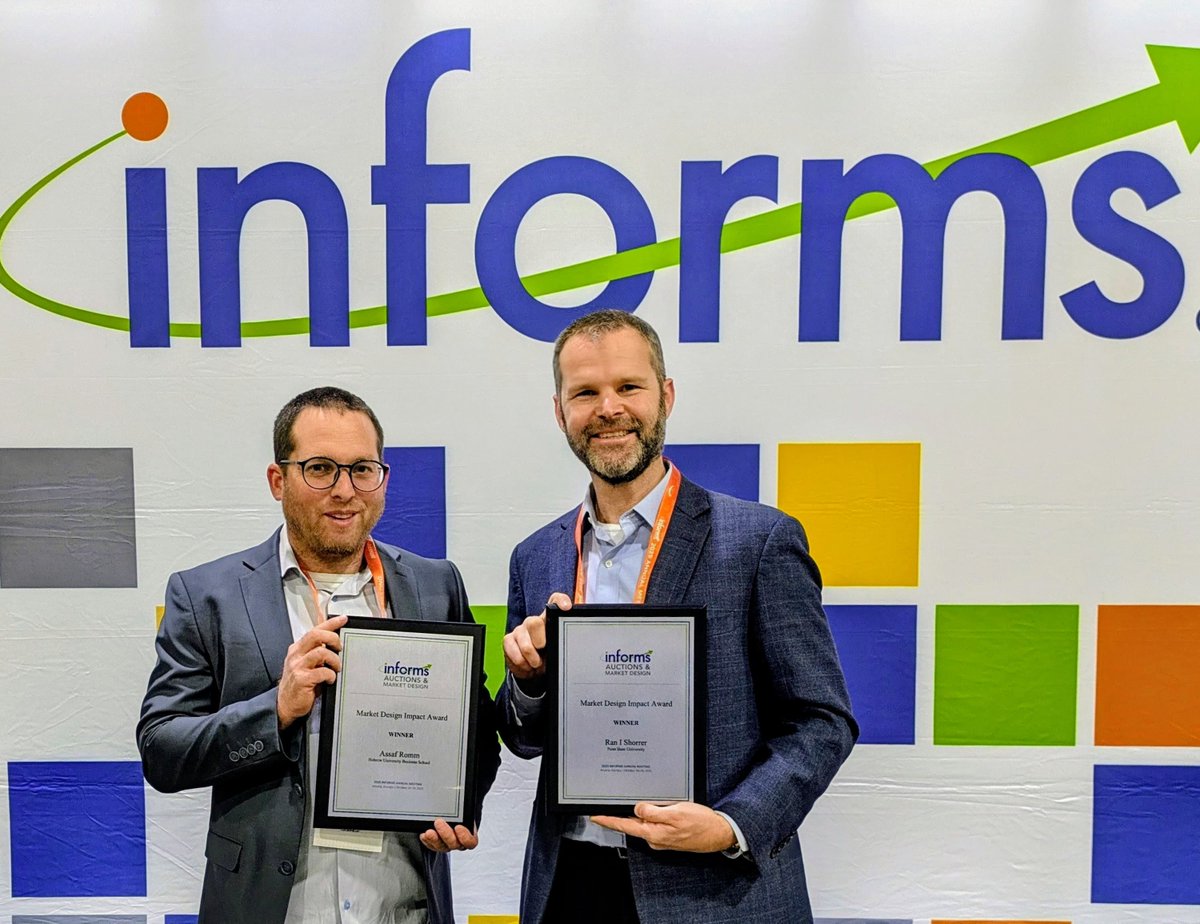
Market Design Impact Award to Hassidim, Romm, and Shorrer

 The Hebrew University breaks the news with this congratulatory message:

"Congratulations to our very own Assaf Romm  and coauthors! 🎉Assaf, along with Avinatan Hassidim and Ran Shorrer , has been awarded the inaugural INFORMS Auctions and Market Design (AMD) Market Design Impact Award- recognizing major contributions in market design over the past 15 years.
Their groundbreaking work has transformed both theory and practice, from redesigning Israel’s Psychology Master’s admissions and Pre-Military Academy programs to improving the medical internship match, impacting thousands of lives. Beyond implementation, their research revealed how real-world behavior can differ from theoretical predictions, helping to pioneer the field of behavioral market design.
Through innovative design, rigorous theory, and a deep understanding of human behavior, Assaf and his coauthors have shown how market design can address pressing social needs while advancing the field.
👏 Remarkable achievement! "


Two men in suits stand side by side holding framed award plaques with text reading INFORMS AMD Market Design Impact Award for Ran Shorrer and Assaf Romm in front of a large blue and green INFORMS logo on a gray background with colorful geometric squares 


I expect that a full(er) account will soon be given on the INFORMS  Market Design Impact Award  page 

Wednesday, October 8, 2025

New Fellows of the Econometric Society

 The Econometric Society has announced the results of the 2025 election of new Fellows.

Congratulations to all of them. It's a great list, that includes important market designers and  experimental/behavioral economists.

"The Society is pleased to announce the election of 25 new Fellows of the Econometric Society. The 2025 Fellows of the Econometric Society follow.

Atila Abdulkadiroglu, Duke University
S. Nageeb Ali, Pennsylvania State University
Heather Anderson, Monash University
Debopam Bhattacharya, University of Cambridge
Francis Bloch, Universite Paris 1 and Paris School of Economics
Eric Budish, University of Chicago Booth School of Business
Yi-Chun Chen, National University of Singapore
Xavier D’Haultfoeuille, CREST-ENSAE
Cecile Gaubert, University of California, Berkeley
Bryan Graham, University of California, Berkeley
Nathaniel Hendren, MIT
Oscar Jorda, Federal Reserve Bank of San Francisco/University of California, Davis
Anil K Kashyap, University of Chicago Booth School of Business
Jinwoo Kim, The Hong Kong University of Science and Technology
Frank Kleibergen, University of Amsterdam
Ivana Komunjer, Georgetown University
Leslie Marx, Duke University
Edward Miguel, University of California, Berkeley
Debasis Mishra, Indian Statistical Institute, Delhi
Tymofiy Mylovanov, Kyiv School of Economics and University of Pittsburgh
Fabrizio Perri, Federal Reserve Bank of Minneapolis
David Romer, University of California, Berkeley
Roland Strausz, Humboldt University of Berlin
Francesco Trebbi, University of California, Berkeley
Eyal Winter, Lancaster University and the Hebrew University"

######## 

In each of the years 2020-2024 the lists of new Fellows have been somewhat longer, and my sense is that we should keep trying to have longer lists, because we're  we're systematically missing many who would be jolly good Fellows.

Sunday, September 21, 2025

The 2025 Golden Goose awards

 In these difficult times for science funding, the Golden Goose Award is a reminder of its benefits.

 Here's it's backstory

Here are the 2025 winners

“Nature has all the answers”

How a knack for nature’s oddities improved disease diagnostics & inspired scores of scientists

AWARDEE: Joseph G. Gall 

FEDERAL FUNDING AGENCIES: National Institutes of Health, National Science Foundation 

 and

Cisplatin Breakthrough Redefines Testicular Cancer Treatment 

 AWARDEES: Barnett Rosenberg, Loretta VanCamp, Thomas Krigas 

FEDERAL FUNDING AGENCIES: National Institutes of Health, National Science Foundation 

 ######### 

 Here are all my posts on the Golden Goose.  (Two of the early awards were for market design:)

Thursday, July 24, 2025

INFORMS celebrates Yash Kanoria

Last month, INFORMS' Division of Manufacturing and Service Operations Management awarded Yash Kanoria  the 2025  MSOM Young Scholar Prize.

Here's a slide from the prize announcement (shared with me by Omar Besbes).


Here are two papers of his that I admire:

Ashlagi, Itai, Yashodhan Kanoria, and Jacob D. Leshno, (2017). “Unbalanced Random Matching Markets: The Stark Effect of Competition”,  Journal of Political Economy 125, 1: 69-98. https://www.journals.uchicago.edu/doi/full/10.1086/689869 

  Ashlagi, Itai, Mark Braverman, Yash Kanoria, and Peng Shi, (2020). Clearing matching markets efficiently: informative signals and match recommendations. Management Science66(5), 2163-2193 https://pubsonline.informs.org/doi/abs/10.1287/mnsc.2018.3265


Wednesday, June 4, 2025

INFORMS Market Design Impact Award: call for nominations

 Here's the call for nominations for a new prize to recognize practical market design.

 Call for Submissions: Market Design Impact Award

The INFORMS Auctions and Market Design (AMD) is happy to announce the Market Design Impact Award. The prize is awarded annually and is intended to recognize major contributions in market design. It may be awarded to one individual or a small team when the research is joint. The award may be given for original research from the last 15 years that has made a lasting impact (directly or indirectly) on the field and/or the practice of market design.

Nomination Procedure

Anyone in the market design community may nominate a candidate. The committee is seeking nominations, which include a nomination letter and two letters of recommendation, highlighting the nominee's accomplishments with emphasis on the criteria for the award. Please send nominations to amdimpactaward@gmail.com by July 30 with the subject "Market Design Submission"

A nomination letter of no more than 1000 words describing the content of the contributions.
Bibliographic data (and links or the papers) as needed.
One-two sentences that describe the contribution.
At least two (and most three)  endorsement letters that describe in at most 500 words the lasting contribution, significance, and impact of the paper(s) and work. The letters should specify the relationship of the endorser to the nominees. The nominator should solicit these letters.
The Award Committee welcomes questions from anyone considering or intending to submit a nomination. The committee may be contacted by email at amdimpactaward@gmail.com.

Committee 2025

Jose Correa, University of Chile

Alvin Roth, Stanford University

David Shmoys, Cornell University

The winner(s) will be recognized at the AMD business meeting of the 2025 INFORMS Annual Meeting. Information on this prize can also be found at the AMD webpage.


Tuesday, April 29, 2025

National Academy of Sciences Elects Members and International Members (4 economists: Steve Berry, Parag Pathak, Ed Leamer, and Sergiu Hart)

 Congratulations to all the new members, and to the four newly elected economists.

Of note: One of the economists is unusually young for this distinction, and one, who was not, passed away between the beginning and end of this year's election process.

National Academy of Sciences Elects Members and International Members

"The National Academy of Sciences announced today the election of 120 members and 30 international members in recognition of their distinguished and continuing achievements in original research.

 ...

Berry, Steven T.; David Swensen Professor, Department of Economics, Yale University, New Haven, Conn.

...

Pathak, Parag A.; Class of 1922 Professor of Economics, Department of Economics, Massachusetts Institute of Technology, Cambridge

...

Elected posthumously to the Academy:

Leamer, Edward E.; professor in economics and statistics, Department of Economics, University of California, Los Angeles

...

Newly elected international member

Hart, Sergiu; professor emeritus of mathematics and economics, Hebrew University of Jerusalem (Israel)

Thursday, March 20, 2025

Lise Vesterlund is celebrated at the Copenhagen Business School

 Here's the announcemnt; the ceremony is tomorrow.

They reveal hidden structures in the economy and job market: Lise Vesterlund and Mariana Mazzucato appointed honorary doctors at CBS.

"On Friday 21 March, two of the world’s most influential economists and research pioneers will be appointed honorary doctors at CBS. Join us for open lectures where they share their insights into gender equality, economic value creation and the invisible structures shaping the job market."


 "How can we create a fairer workplace where top talent is promoted, and women’s careers are not held back by invisible burdens? This is the question that Professor Lise Vesterlund, co-author of the critically acclaimed book The No Club: Putting a Stop to Women’s Dead-End Work, has dedicated her research to. She is now being appointed honorary doctor at Copenhagen Business School, and in her open lecture she will explore the invisible structures at play and the issue of gender equality in the workplace."

#############

Bonus picture, from (I think) an early workshop for The Handbook  Experimental Economics vol. 2:


Friday, March 7, 2025

Toledo celebrates Mike Rees

 Here's the announcement from the University of Toledo:

University Recognizes Faculty Members with Distinguished Honor 

"Rees joined the faculty of the then Medical College of Ohio as an assistant professor in the Department of Urology in 1999 and was promoted to associate professor in 2007 and to professor in 2008.

"His research interests include kidney-paired donation, transplant immunology, immunosuppression, xenotransplantation and value-based healthcare
, and he has received numerous grants totaling millions of dollars including grants from the Echoes of Lasting Peace Foundation, the NIH, the Agency for Healthcare Research and Quality (AHRQ), the Stanford Impact Lab, Wyeth Pharmaceutical Corporation, Novartis, the Ohio Department of Development and the Ohio Center for Innovative Immunosuppressive Therapeutics.

Rees mentored three Ph.D. students in xenotransplantation immunology, all of whom have gone on to successful careers in the health sciences and he has trained more than 50 urologists. He has obtained four patents related to his work in transplantation methods, one of which has led to a 30% increase in the supply of deceased donor livers in Europe, and he has written more than 100 publications and book chapters. These publications include: “Nonsimultaneous Extended Altruistic Donors” an idea that has lead to an additional 20,000 living donor kidney transplants around the world, “Delayed Renal Transplant Function,” “Immunological Effects of Hepatic Xenoperfusion” and “Strategies to Increase the Donor Pool.”

His numerous awards and commendations include attending the 2012 Nobel Prize ceremony at the invitation of his mentor for his UToledo-sponsored 2016-2017 sabbatical, Nobel Laureate in Economics, Alvin Roth, the Medal of Excellence from the American Association of Kidney Patients, the Governor’s Award from the National Kidney Foundation, and he was named an American Society of Transplantation’s New Key Opinion Leader.

Rees has given lectures and seminars in France, the United Kingdom, Canada, Belgium, South Korea, Switzerland, Japan, Saudi Arabia, Germany, Hungary, the Netherlands, Italy, India and the Philippines, and he served a three-year fellowship at Cambridge University, where he trained as a multi-organ transplant surgeon under world-renowned surgeon and transplant pioneer, Professor Sir Roy Calne, as well as completing a Ph.D. in xenotransplantation immunology.

“I have been fortunate to be supported by The University of Toledo since 1996 when the Medical College of Ohio made it possible for me to obtain a Ph.D. in immunology and a fellowship in transplant surgery at Cambridge University prior to my arrival in Toledo in 1999,” Rees said. “Transplantation is the great team sport. I am honored to have been chosen for this award, and I am grateful to all those who have trained me, the University of Toledo and Medical Center, the teams that have supported me, and the grant agencies and philanthropists who have supported my dreams over the course of my career.”


Tuesday, February 18, 2025

Philipp Strack, 2024 Clark Medalist by Drew Fudenberg, in the JEP

 Here's a celebration of Philipp Strack, the Yale economist who won the 2024 Clark Medal of the American Economic Association.

Philipp Strack, 2024 Clark Medalist  by Drew Fudenberg,  Journal of Economic Perspectives, vol. 39, no. 1, Winter 2025, (pp. 225–46)

Here are the first and last paragraphs:

"Philipp Strack is creative, insightful, and skillful, which has allowed him to make major contributions to many areas of microeconomic theory, including behavioral economics, information acquisition and learning, and mechanism design. Some of these papers provide a new understanding of important economics phenomena, others introduce results and techniques that will be used for years to come, and some of the papers do both. Together they have helped spark what his Clark Medal citation called a “new wave of information economics.”

 ...

"Philipp is one of the most cheerful and friendly people I know. I have greatly enjoyed working with and learning from him. He is also extraordinarily productive: as of June 2024, he had published 37 papers in the eleven years since the completion of his dissertation, with several others forthcoming. Of this output, my review has only covered some of the highlights. In addition to the work discussed here, Philipp has made contributions to the study of market design (in [11], with Jacob Leshno and [23], with Afshin Nikzad), on contests (in [15], with Dawei Fang and Thomas Noe and [1], with Christian Seel), on present bias (in [10], with Paul Heidhues), and on epidemics (in [12], with Thomas Kruse). Some of Philipp’s papers provide a new understanding of important economics phenomena, others introduce results and techniques that will be used for years to come, and many do both. All of his work is clear and insightful, and its influence seems sure to expand. "

Thursday, January 16, 2025

Stanford celebrates Daron Acemoglu with the 2025 Sage-CASBS Award

 Stanford's Center for Advanced Studies in the Behavioral Sciences announces:

Daron Acemoglu Wins 2025 Sage-CASBS Award

"Sage and the Center for Advanced Study in the Behavioral Sciences (CASBS) at Stanford University are pleased to announce Daron Acemoglu as winner of the 2025 Sage-CASBS Award. 

He will deliver a public award lecture at the Center for Advanced Study in the Behavioral Sciences on April 24, 2025.

...

"Established in 2013, the Sage-CASBS Award recognizes outstanding achievement in the behavioral and social sciences that advances our understanding of pressing social issues. The award underscores the role of the social and behavioral sciences in enriching and enhancing public discourse and good governance. Past winners of the award include Daniel Kahneman, psychologist and Nobel laureate in economics; Pedro Noguera, Distinguished Professor of Education at the University of Southern California; Kenneth Prewitt, former director of the U.S. Census Bureau and the Carnegie Professor of Public Affairs, Emeritus at Columbia University; William Julius Wilson, the Lewis P. and Linda L. Geyser University Professor, Emeritus at Harvard University; Carol Dweck, the Lewis and Virginia Eaton Professor of Psychology at Stanford University; Jennifer Richeson, the Philip R. Allen Professor of Psychology at Yale University; Elizabeth Anderson, the John Dewey Distinguished University Professor of Philosophy and Women’s & Gender Studies at the University of Michigan; and Alondra Nelson, former acting director of the White House Office of Science and Technology Policy and the Harold F. Linder Chair and Professor of Social Science at the Institute for Advanced Study.

Tuesday, January 7, 2025

National Medals of Science and Technology (including Cynthia Dwork for differential privacy)

 In one of the final acts of his administration, President Biden celebrates 25 distinguished scientists and engineers. (I'm particularly glad to see Cynthia Dwork recognized for her work on differential privacy.)

 Forbes has the story:

Biden Names 25 Recipients Of National Medals Of Science, Technology, by Michael T. Nietzel

In a statement from the White House, Biden said, “those who earn these awards embody the promise of America by pushing the boundaries of what is possible. These trailblazers have harnessed the power of science and technology to tackle challenging problems and deliver innovative solutions for Americans and for communities around the world.”

...


"The 14 recipients of the National Medal of Science are:

    Richard B. Alley, the Evan Pugh University Professor of Geosciences at Pennsylvania State University. Alley researches the great ice sheets to help predict future changes in climate and sea levels.
    Larry Martin Bartels, University Distinguished Professor of Political Science and Law and the May Werthan Shayne Chair of Public Policy and Social Science at Vanderbilt University. His scholarship focuses on public opinion, public policy, election science, and political economy.
    Bonnie L. Bassler, Squibb Professor in Molecular Biology and chair of the Department of Molecular Biology at Princeton University, for her research on the molecular mechanisms that bacteria use for intercellular communication.
    Angela Marie Belcher, the James Mason Crafts Professor of Biological Engineering and Materials Science and Engineering at MIT and a member of the Koch Institute for Integrative Cancer Research. She was honored for designing materials for applications in solar cells, batteries, and medical imaging.
    Helen M. Blau, Donald E. and Delia B. Baxter Foundation Professor and the Director of the Baxter Laboratory for Stem Cell Biology at Stanford University for her research on muscle diseases, regeneration and aging, including the use of stem cells for tissue repair.
    Emery Neal Brown, the Edward Hood Taplin Professor of Medical Engineering and Computational Neuroscience at MIT, was recognized for his work revealing how anesthesia affects the brain.
    John O. Dabiri, Centennial Chair Professor at the California Institute of Technology, in the Graduate Aerospace Laboratories and Mechanical Engineering. His research focuses on fluid mechanics and flow physics, with an emphasis on topics relevant to biology, energy, and the environment.
    Ingrid Daubechies, the James B. Duke Distinguished Professor Emerita of Mathematics at Duke University, was honored for her pioneering work on signal processing.
    Cynthia Dwork, Gordon McKay Professor of Computer Science at Harvard University, was recognized for research that has transformed the way data privacy is handled in the age of big data and AI.
    R. Lawrence Edwards, Regents and Distinguished McKnight University Professor, Department of Earth and Environmental Sciences at the University of Minnesota. Edwards is known for his refinement of radiocarbon dating techniques to study climate history and ocean chemistry.
    Wendy L. Freedman, the John and Marion Sullivan University Professor in Astronomy and Astrophysics at the University of Chicago, for her observational cosmology research, including pioneering uses of the Hubble Space Telescope.
    Keivan G. Stassun, Stevenson Professor of Physics & Astronomy at Vanderbilt University for his work in astrophysics, including the study of star formation and exoplanets.
    G. David Tilman is Regents Professor and the McKnight Presidential Chair in Ecology, Evolution, and Behavior at the University of Minnesota. He studies biological diversity, the structure and benefits of ecosystems and ways to assure sustainability despite global increases in human consumption and population.
    Teresa Kaye Woodruff is the MSU Research Foundation Professor of Obstetrics, Gynecology and Reproductive Biology and Biomedical Engineering at Michigan State University. She is an internationally recognized expert in ovarian biology and reproductive science.

The nine individual recipients of the National Medal of Technology and Innovation are:

    Martin Cooper for his work in advancing in personal wireless communications for over 50 years. Cited in the Guinness Book of World Records for making the first cellular telephone call, Cooper, known as the “father of the cell phone,” spent much of his career at Motorola.
    Jennifer A. Doudna, a Nobel Laureate in Chemistry and the Li Ka Shing Chancellor’s Chair in Biomedical and Health Sciences at the University of California, Berkeley. She is a pioneer of CRISPR gene editing.
    Eric R. Fossum is the John H. Krehbiel Sr. Professor for Emerging Technologies at Dartmouth College. He invented the CMOS active pixel image sensor used in cell-phone cameras, webcams, and medical imaging.
    Paula T. Hammond, an MIT Institute Professor, vice provost for faculty, and member of the Koch Institute, was honored for developing methods for assembling thin films that can be used for drug delivery, wound healing, and other applications.
    Kristina M. Johnson, former president of The Ohio State University was recognized for research in photonics, nanotechnology, and optoelectronics. Her discoveries have contributed to sustainable energy solutions and advanced manufacturing technologies.
    Victor B. Lawrence spent much of his career at Bell Laboratories, working on new developments in multiple forms of communications. He is a Research Professor and Director of the Center for Intelligent Networked Systems at Stevens Institute of Technology.
    David R. Walt is a faculty member of the Wyss Institute at Harvard University and is the Hansjörg Wyss Professor of Bioinspired Engineering at Harvard Medical School and Professor of Pathology at Harvard Medical School and Brigham and Women’s Hospital. He was honored for co-inventing the DNA microarray, enabling large-scale genetic analysis and better personalized medicine.
    Paul G. Yock is an emeritus faculty member at Stanford University. A physician, Yock is known for inventing, developing and testing new cardiovascular intervention devices, including the stent.
    Feng Zhang, the James and Patricia Poitras Professor of Neuroscience at MIT and a professor of brain and cognitive sciences and biological engineering, was recognized for his work developing molecular tools, including the CRISPR genome-editing system."

#########

Here's my post from ten years ago:

Saturday, February 7, 2015 Differential Privacy: an appreciation of Cynthia Dwork


Friday, November 1, 2024

Lanchester prize to Ashlagi, Kanoria, Leshno, Braverman and Shi (post 2 of 2)

 INFORMS has now announced the details of the Frederick W. Lanchester Prize, which went to two teams, one of which worked on matching and market design.

Here is the matching team, with a little more detail than in my previous post*, about the papers that were recognized by the award.

2024 - Winner(s)

2024 Winner(s)

Winning material: Collection of Papers: “Unbalanced random matching markets: The stark effect of competition” and “Clearing matching markets efficiently: informative signals and match recommendations
 ############
Here's the prize citation (sent to me by Sasa Pekec, the chair of the prize committee):
"The 2024 Lanchester Prize is awarded to Itai Ashlagi, Mark Braverman, Yash Kanoria, Jacob Leshno, and Peng Shi for their papers “Unbalanced random matching markets: The stark effect of competition” and “Clearing matching markets efficiently: Informative signals and match recommendations”.
These papers have advanced the field of market design by providing fundamental insights into the performance of two-sided matching markets. By introducing a novel theoretical approach, they resolve a long-standing empirical puzzle: why the set of stable matchings is small in many practically important matching markets. Moreover, by creatively integrating match recommendations and signaling strategies, they demonstrate how to reduce congestion in these markets. These contributions have profoundly impacted both methodological work and practical applications focused on the conduct and organization of centralized and decentralized markets."

The other members of the prize committee were Francis de Véricourt, Wedad Elmaghraby, Fatma Kilinç-Karzan, Azarakhsh Malekian, and Mengdi Wang
#########
Itai shared with me his brief remarks upon accepting the award on behalf of the team at the recent Seattle meeting:
 
"This is a real honor and it is very special to share the prize with my wonderful coauthors Mark Braverman, Yash Kanoria, Jacob Leshno and Peng Shi who could not attend this event today.  It is a great honor and humbling to share this award with  Anatoli Juditsky and Arkadi Nemirovski as well as the distinguished past recipients of the prize. 34 years ago, Alvin Roth and Marilda Sotomayor were awarded the prize for their remarkable and beautiful book on two-sided matching. The last two decades, matching in two-sided markets has been and still is a very active area in Operations Research and economics, with many successful applications and a rich theory. We are grateful to be able to contribute to this area. Thanks to Sasa and the committee. It is a real honor being part of this community."

 ###########

*Earlier: Wednesday, October 23, 2024 Lanchester Prize (Post 1 of 2)

Wednesday, October 23, 2024

Lanchester Prize (Post 1 of 2)

 The 2024 INFORMS meetings in Seattle this weekend was the occasion of a number of awards, including the Lanchester Prize, the big publication award in operations research and management science.  Congratulations to the two winning publication teams.

One of the teams will be familiar to the readers of this blog: Itai Ashlagi, Yash Kanoria, Jacob Leshno, Mark Braverman and Peng Shi.  They received the award for a series of papers on matching, about which I'll blog in a subsequent post.

The Lanchester Prize is awarded for the best contribution to operations research and the management sciences published in English in the past five years. 

Learn more about the Lanchester Prize and how to be nominated on the INFORMS website.

WINNING TEAM ONE

Université Grenoble-Alpes

Anatoli Juditsky

Université Grenoble-Alpes
Georgia Tech

Arkadi Nemirovski

Georgia Tech

WINNING TEAM TWO

Stanford University

Itai Ashlagi

Stanford University
Columbia University

Yash Kanoria

Columbia University
Chicago University

Jacob Leshno

Chicago University
Princeton University

Mark Braverman

Princeton University
University of Southern California

Peng Shi

University of Southern California

Honorable Mention

The Chinese University of Hong Kong, Shenzhen

Guillermo Gallego

The Chinese University of Hong Kong, Shenzhen
Cornell University

Huseyin Topaloglu

Cornell University


Wednesday, October 16, 2024

New fellows of the Econometric Society

Congratulations to the 42 newly elected Fellows of the Econometric Society. That's up from 29 new Fellows elected in 2023, which is a step towards the goal (about which I blogged last year*) of electing more Fellows.  But elections depend on recognition that isn't equally available to every specialty and geography, so there are still many nominees and others who would be jewels in the crown of the Society.

"The Society is pleased to announce the election of 42 new Fellows of the Econometric Society. The 2024 Fellows of the Econometric Society follow.

Jerome Adda, Bocconi University 

Cristina Arellano, Federal Reserve Bank of Minneapolis (Secondary affiliation: Latin America)

Costas Arkolakis, Yale University

John Asker, University of California, Los Angeles (Secondary affiliation: Australasia)

David Atkin, Massachusetts Institute of Technology

Paul Beaudry, University of British Columbia

Sascha O. Becker, University of Warwick and Monash University

Sandra E. Black, Columbia University

Estelle Cantillon, Universite Libre de Bruxelles

Alessandra Casella, Columbia University

Thomas Chaney, University of Southern California

David Dorn, University of Zurich

Janice Eberly, Northwestern University, Kellogg School of Management

Kfir Eliaz, Tel Aviv University

Erica Field, Duke University

Andrea Galeotti, London Business School

Francisco Gallego, Pontificia Universidad Caatolica de Chile

Maitreesh Ghatak, London School of Economics (Secondary affiliation: Asia)

Olivier Gossner, CNRS - CREST; London School of Economics

Ayşe Ökten İmrohoroğlu, University of Southern California

Henrik Kleven, Princeton University

Kala Krishna, The Pennsylvania State University

Jeanne Lafortune, Pontificia Universidad Catolica de Chile

Francesco Lippi, LUISS University; Einaudi Institute for Economics and Finance

Deborah J. Lucas, Massachusetts Institute of Technology

Annamaria Lusardi, Stanford University

N. Gregory Mankiw, Harvard University

Kalina Manova, University College London

Elena Manresa, New York University

Enrique G. Mendoza, University of Pennsylvania (Secondary affiliation: Latin America)

Ismael Y. Mourifie, Washington University in St Louis (Secondary affiliation: Africa)

Barry Nalebuff, Yale School of Management

Andrew Newman, Boston University

Efe A. Ok, New York University

Guillermo Ordonez, University of Pennsylvania

Maria Petrova, Universitat Pompeu Fabra

Mar Reguant, IAE-CSIC; Northwestern University

Diego Restuccia, University of Toronto

Andrés Rodríguez-Clare, University of California, Berkeley (Secondary affiliation: Latin America)

Andrea Weber, Central European University

Luigi Zingales, University of Chicago Booth School of Business

Gabriel Zucman, Paris School of Economics; University of California, Berkeley

Finally, the Society would like to express its gratitude to the members of the 2024 Fellows Nominating Committee: Jan Eeckhout (chair), Mariacristina De Nardi, Marcela Eslava, Richard Holden, Yuichi Kitamura, Yaw Nyarko, and Nathan Nunn."


As I wrote last year, Congratulations again to the new Fellows, who have received the carefully considered and frugally awarded applause of their peers. 

##########

*Last year:

Tuesday, October 10, 2023

Monday, September 30, 2024

Golden Goose awards for woodpeckers, penguins, and artificial intelligence

 The Golden Goose awards are given each year to "recognize the tremendous human and economic benefits of federally funded research by highlighting examples of seemingly obscure studies that have led to major breakthroughs and resulted in significant societal impact."

This year they recognize three streams of work, that have led to the recovery of an endangered woodpecker species, to the more effective counting of penguins, and to the invention of neural nets on which the current artificial intelligence industry is based.

Here are those stories.

It’s a Family Affair: The Resurgence of the Red-Cockaded Woodpecker  AWARDEE: Jeff Walters

From Poop to Protection: Satellite Discoveries Help Save Antarctic Penguins and Advance Wildlife Monitoring  AWARDEES: Christian Che-Castaldo, Heather Joan Lynch, Mathew Schwaller

How We Think: Brain-Inspired Models of Human Cognition Contribute to the Foundations of Today’s Artificial Intelligence  AWARDEES: Geoffrey Hinton, James L. McClelland, David E. Rumelhart

Here's the first paragraph of the description of this third award (last but not least:)

"Decades before artificial intelligence emerged as the platform for innovation that it is today, David Rumelhart, James McClelland, and Geoffrey Hinton were exploring a new model to explain human cognition. Dissatisfied with the prevailing symbolic theory of cognition, David Rumelhart began to articulate the need for a new approach to modeling cognition in the mid-1970s, teaming up with McClelland with support from the National Science Foundation to create a model of human perception that employed a new set of foundational ideas. At around the same time, Don Norman, an early leader in the field of cognitive science, obtained funding from the Sloan Foundation to bring together an interdisciplinary group of junior scientists, including Hinton, with backgrounds in computer science, physics, and neuroscience. Rumelhart, McClelland, and Hinton led the development of the parallel distributed processing framework, also known as PDP, in the early-1980s, focusing on how networks of simple processing units, inspired by the properties of neurons in the brain, could give rise to human cognitive abilities. While many had dismissed the use of neural networks as a basis for building models of cognition in the 1960s and 1970s, the PDP group revived interest in the approach. Skeptics critiqued the new models too, and had only limited success in enabling effective artificially intelligent systems until the 2010s, when massive increases in the amount of available data and computer power enabled Hinton and others to achieve breakthroughs leading to an explosion of new technological advancements and applications."

############

Prior awards included market design in 2013 and 2014.