Thursday, April 30, 2026

Australia has more unpaid beekeepers than blood donors

 If only there were some way for Australia to become self-sufficient in blood plasma, so it could stop having to buy it from the US...

The Financial Times has the story:

Australia’s drive to get more blood flowing
The country has more recreational beekeepers than regular donors and is forced to rely on imports  by Nic Fildes 

" Australia needs 100,000 new donors every year to meet its need for blood and plasma. But there are more recreational beekeepers in Australia than people who have actively donated their blood three times or more.

"This is not only an Australian challenge. Most countries have a supply gap. One problem is that the legion of older donors that has kept donations flowing for decades is dwindling and younger generations are not donating or do not return after they’ve tried it once. 

...

"The situation is particularly acute for plasma — the yellow-coloured component of blood sometimes called liquid gold — which is a vital ingredient for 18 different life-saving procedures ranging from immune deficiency treatment to heart surgery. 

Australia supplies only 38 per cent of its own plasma and spends about A$600mn a year to import it — more than double what was spent a decade ago. A report published by the state of New South Wales suggests imports needed could rise to 66 per cent of the total by 2030, meaning taxpayers are set to foot an even larger plasma bill.

For now, Australia relies on the US, where people earn up to $70 per donation, which supplies about 70 per cent of the world’s plasma."


Wednesday, April 29, 2026

Stanford celebrates Ran Abramitzky's studies of immigration

 The Stanford Daily interviews Ran Abramitzky, on the occasion of his winning a Guggenheim fellowship:

Guggenheim fellow Ran Abramitzky sees the American Dream as an ‘intergenerational story’  By Angikar Ghosal

"TSD: Your research program combines economic history, big linked microdata and policy relevance. Where do you see the next frontier for this kind of long-run, data-driven immigration research?

RA: A key frontier is linking together large-scale datasets to follow individuals and families over time and across space.

Much of my work relies on linking millions of individuals across U.S. censuses to study mobility across generations. The next step is to connect these data to other sources — such as college records, administrative data, and historical archives — to better understand how specific institutions shape economic outcomes.

For example, we are digitizing and linking records for millions of college students and faculty from over 100 institutions and connecting them to census data to study how socioeconomic background shapes access to higher education and elite professions.

Another frontier is using new tools, including AI and large language models, to systematically analyze large bodies of text — such as congressional speeches — to better understand how policies and public narratives around immigration evolve over time.

TSD: Given the current political moment around immigration policy, what do you most wish the public understood from the historical evidence?

RA: A key lesson from the historical evidence is that immigrant mobility is a long-term, often intergenerational process.

Many immigrants initially work in manual or low-paying jobs and do not move quickly from poverty to prosperity. However, their children often experience substantial upward mobility despite a challenging start.

What I think is often missing in today’s policy debate is this long-term perspective. Discussions tend to focus on newly arrived immigrants and their short-run outcomes. But historically, much of the economic success of immigrant families has occurred in the next generation.

A more long-term view would recognize these patterns and the contributions of immigrants and their children, and could lead to policies that are more supportive of immigrant integration and opportunity." 


Tuesday, April 28, 2026

Moral Economics: a brief review in the Sunday Times ("fascinating and very different":)

 A column (on unemployment) in the Sunday Times by it's economics editor  David Smith, ends with a brief review of Moral Economics, as a postscript:

 PS
"A lot of economics books cross my desk, but a new one, by the Nobel prize-winning economist Alvin Roth, grabbed my attention. Called Moral Economics: What Controversial Transactions Reveal About How Markets Work, to be published soon by Basic Books, it is not a title designed to send it racing off the shelves.

However, it starts in an arresting way with a story I had not heard before of another celebrated Nobel prize-winning behavioural economist, Daniel Kahneman, known to many for his bestselling book Thinking, Fast and Slow. Two years ago, he celebrated his 90th birthday with family in Paris before flying to Zurich and ending his life in an assisted suicide clinic. “Danny,” Roth recalls, “was still in relatively good health, but he wanted to avoid the prospect of a long, disabling decline.”

...

It is a fascinating and very different economics book, from which I may bring you more as I find it."

Monday, April 27, 2026

Thumbs-up pictures in Taiwan, and kidney notes

 Photographers in Taiwan often ask their subjects to raise their thumbs (see all our thumbs below), just as American photographers ask for smiles.  One of the hosts in our recent visit suggested that this custom may have become solidified during Covid, when everyone wore masks, so that smiles couldn't be seen.


 I came away from Taiwan thinking that kidney exchange (which is now legal there) does not seem to be occurring with any regularity. This is a missed opportunity so far, since Taiwan has a very high incidence of kidney failure and dialysis. And (like everywhere else) there's a dire shortage of transplants: around 8500 people are on the waiting list, but the total annual number of transplants is below 500.

 But there's certainly hope for the future: as the I Ching says,* the universe progresses persistently:) 


*"Heaven keeps moving forward vigorously" (天行健, tiān xíng jiàn) is a foundational tenet from the I Ching (Book of Changes), specifically the Daxiang Zhuan (Commentary on the Images) regarding the Qian (Creative) hexagram. It signifies that the universe is robust and unceasing in its operation, urging humans to model this by constantly striving for self-improvement and diligence"


 (A friend, seeing this photo, says "Whoa, super deep life lessons, and yummy snacks in the background...)

Saturday, April 25, 2026

Night markets in Taiwan

Night markets in Taiwan are like open-air food courts in which each seller sells a single food preparation.


This last photo, of a selection of freshly made breads that look like brains, reminded me of the old joke about why economists' brains are so expensive per ounce.
 

Friday, April 24, 2026

Playing dirty on Polymarket--Insider trading on information, and on manipulation

Here are news reports on two kinds of insider trading on prediction markets: predicting what you are (or someone close to you is) going to do, or predicting a measurement you can control.

From the NYT:

Soldier Used Classified Information to Bet on Maduro’s Ouster, U.S. Says
Federal prosecutors say that Sgt. Gannon Ken Van Dyke, who was involved in the operation to oust Nicolás Maduro from power in Venezuela, used the information to place bets on a prediction market. By Benjamin Weiser and Jonah E. Bromwich
 

"A U.S. Army special forces soldier who helped capture Nicolás Maduro of Venezuela has been charged with using classified information to bet on the mission on Polymarket, a prediction marketplace, federal authorities said on Thursday.

"The soldier, Master Sgt. Gannon Ken Van Dyke, who was stationed at Fort Bragg in North Carolina, made more than $400,000 by betting on different outcomes related to Venezuela after learning of the operation, federal prosecutors and the F.B.I. said. "

##########

And from the WSJ: 

Unusual weather bets on Polymarket spur French investigation by Alexander Osipovich, Sam Schechner 

 "France’s national weather service is investigating irregularities at a monitoring station at Paris Charles de Gaulle Airport after it reported anomalous temperature spikes. The spikes led to lucrative payoffs for some traders on Polymarket, the crypto-based betting platform.

...

"Every day, Polymarket lists contracts that allow its users to bet on the maximum temperature in dozens of cities worldwide. Its Paris contract is based on the reading at Charles de Gaulle airport, as reported by Weather Underground, an online weather data provider.

"On April 15, the temperature in Paris had reached 18 degrees Celsius in the afternoon and was cooling down in the evening when the airport gauge showed a brief, unexplained jump, hitting 22 degrees Celsius at 9:30 p.m. local time, Weather Underground data shows. Other nearby weather stations didn’t show a similar spike. 

"Just before the anomaly, xX25Xx placed cheap, long-shot bets on Polymarket that the maximum temperature in Paris that day wouldn’t be 18 degrees Celsius, when other bettors were more than 99% sure that the day’s top temperature would remain at that level.

"The airport weather station also registered a temperature spike around 7 p.m. on April 6. That day, a Polymarket account with username “Hoaqin” made nearly $14,000 in profit by betting that Paris temperatures would peak at 21 degrees Celsius, Polymarket data shows. Temperatures at Charles de Gaulle had been hovering at around 18 degrees in the late afternoon, according to Weather Underground data. 

... 

"In March, an Israeli journalist said he had received death threats from Polymarket bettors demanding that he revise his article about an Iranian missile strike on March 10. The details of his article were used to settle bets on whether Iran had carried out a missile, drone or airstrike that day.

"Soon after the incident, Polymarket explicitly prohibited insider trading and market manipulation on its international platform for the first time. The amended rules state that Polymarket users can’t trade contracts where they can influence the outcome of the underlying event.

"A similar prohibition is in place in regulated prediction markets such as Polymarket’s main competitor, Kalshi, as well as at Polymarket’s new U.S. platform. "

Thursday, April 23, 2026

Organ donation after euthanasia in the Netherlands

In the Netherlands, not only is it legal to receive medical aid in dying (MAID), but  a growing number of MAID patients are able to successfully achieve their desire to become deceased organ donors.

 From the American Journal of Transplantation:

 Wijbenga, N., Gan, C.T., Ruigrok, D., Berg, E.M., Hagenaars, J.A.M., Siregar, S., van der Kaaij, N.P., Mathot, B.J., van Pel, R., Seghers, L. and Manintveld, O.C., 2026. The Increasing Contribution of Organ Donation after Euthanasia to the Lung Transplantation Donor Pool in the Netherlands. American Journal of Transplantation. 

 "Abstract: The number of organ donation after euthanasia (ODE) procedures in the Netherlands has grown substantially, yet their contribution to the lung-donor pool remains unclear. There is no clinical consensus on how these potential ODE lung-donors should be assessed. We aimed to describe the total contribution of ODE to the lung-donor pool in the Netherlands and describe the assessment of potential ODE lung-donors.
We collected data from all ODE procedures performed between 2012-2024 in the Netherlands. We assessed the number of ODE-lungs offered, rejected, accepted, and transplanted, comparing characteristics of discarded and transplanted lungs.
Of 1166 lung-donor, 664(60%) were DCD donors of which 154(23%) were ODE lung-donors. The total proportion of donor lungs from ODE lung-donors acceptable to offer for lung transplantation was 117 of which 104 (89%) were transplanted.
Evaluation prior to donation was highly variable, with medical history and chest CT most affecting acceptance decisions. Short-term outcomes were excellent, with 1-year survival of 84%.
Our findings indicate that ODE lung donors are increasingly important in the Netherlands, with high acceptance rates, despite highly variable evaluation methods. Standardizing the assessment of potential ODE lung donors could further improve acceptance rates and enhance the contribution of ODE to the lung-donor pool."

Moral Economics, on the Passion Struck podcast

In the run up to the May publication date, I've been interviewed on a variety of podcasts about my book Moral Economics: From Prostitution to Organ Sales, What Controversial Transactions Reveal About How Markets Work.  Here's one from the podcast Passion Struck: Nobel Laureate Alvin Roth: How Incentives Shape Your Life | EP 757


 #############

Earlier:

Wednesday, April 22, 2026   Moral Economics, on the Armchair Expert podcast

Below is a one minute bit excerpted from the Armchair Expert interview, on why it's easy to buy drugs, but hard to hire a hitman: 

The Difference Between Hitmen and Dealers


Wednesday, April 22, 2026

Moral Economics, on the Armchair Expert podcast

At the Armchair Expert podcast, Dax Shepard interviewed me in anticipation of the May publication of my book Moral Economics: From Prostitution to Organ Sales, What Controversial Transactions Reveal About How Markets Work  


Here's the video (which was recorded last month at their studio in LA): 

Tuesday, April 21, 2026

Market Design and Kidney Exchange at NTHU: Public Lecture in Taiwan (video)

 Here is a video of a public lecture I gave at National Tsing Hua University (NTHU) in Taiwan.

It begins at around 13:40 (and if I've done it right, the version below should start around there), and the Q&A starts around 1:15:00 


Monday, April 20, 2026

Lund University anticipates EU-wide kidney exchange, and celebrates Tommy Andersson

European kidney exchange is making progress:)

 Kidney Transplants Save Lives, Cut Taxpayer Costs   Lund University
Sweden's kidney exchange programme has been operational since 2018 and will soon be expanded to include the entire EU. The programme has meant that patients' previous waiting times of up to two years have been reduced to just six months.

"Tommy Andersson, Professor of Economics at Lund University School of Economics and Management, never imagined his research would one day lead to this-but his joy, pride, and commitment are unmistakable.

"Thirteen years ago, we began the planning phase in Sweden, and in 2019 we expanded to Denmark, and later to Finland, Iceland, and Norway. The programme is called STEP (Scandiatransplant Exchange Programme). Now, in 2026, there is a consensus on how kidney exchanges should be conducted across the entire EU, and almost all the pieces of the puzzle are in place for us to launch the pilot project during 2026," says Tommy Andersson.

WATCH FILM (in Swedish): "The Economist Saving Lives" -  

Tommy Andersson was involved from the start, developing the algorithms that make the kidney exchange programme in Sweden possible. In cases where a family member can donate a kidney, the transplant can occur directly. However, if the donor's kidney does not match the patient, the exchange programme becomes vital. The programme enables matching across Scandinavia and soon across the entire EU." 

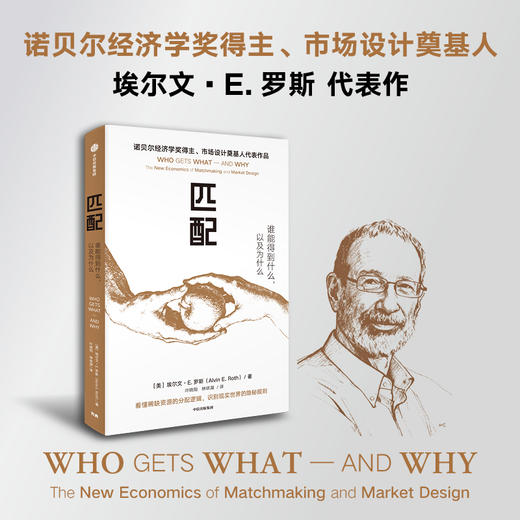
New Chinese edition of Who Gets What and Why

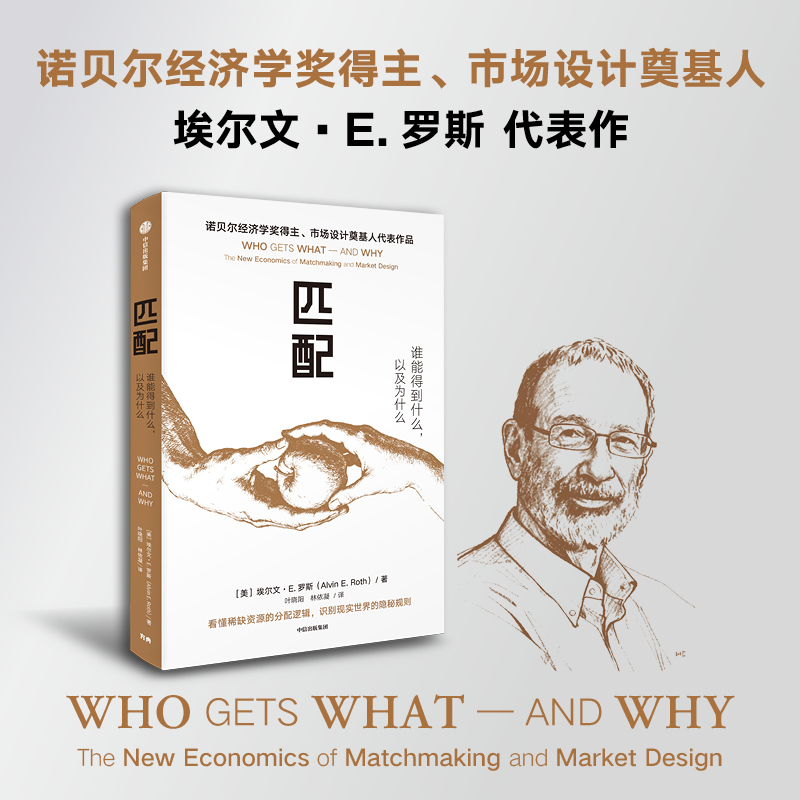
 There's a new (October, 2025) Chinese edition of my 2015 book Who Gets What ― and Why: The New Economics of Matchmaking and Market Design.  It's the same translation as the first edition, with a new (improved) title, closer to the English.  This is the simplified character version, distributed on the mainland.

中信出版 | 匹配:谁能得到什么,以及为什么 诺贝尔经济学奖得主、市场设计奠基人代表作品 商品图0 


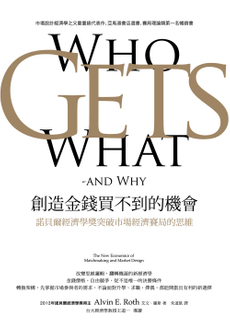
The 2016 traditional character translation is still in use in Taiwan:

《創造金錢買不到的機會》書籍圖片-1 


Sunday, April 19, 2026

Funeral expenses for deceased organ donors in Taiwan

 In Taiwan, the Ministry of Health and Welfare helps pay for the funerals of deceased organ donors.

 From the Taiwan Organ Sharing Registry and Patient Autonomy Promotion Center

(2)  Grants and Assistance for Donors' Families

a.        Funeral Subsidies:
The MOHW provides funeral subsidies to the donor's family, including NT$50,000 for corneal donations and NT$100,000 for multiple organ donations in addition to the cornea.

b.        Farewell Care Service:
In order to express our gratitude to the organ donors and their families, we provided flower baskets and certificates of appreciation at the farewell ceremony of the donors. In addition to affirming the selfless dedication of the organ donors, we also thanked the family members for their decision. 

Saturday, April 18, 2026

The diffusion of space warfare: commercial satellites play a role in (everyone's) battlefield intelligence

There's now a vibrant market for real-time commercial satellite photos.  

Defense One has the story from the Persian Gulf:

US must adjust to Iran’s use of commercial satellite photos, Space Command says CENTCOM’s declaration of “space superiority” hasn’t prevented Tehran from putting space to use.
By Thomas Novelly

COLORADO SPRINGS, Colorado—Iran’s use of commercial space imagery to strike U.S. and allied targets will force the Pentagon to adjust, the head of U.S. Space Command said.

“We have to recognize that the rest of the world can now see the entire planet transparently and almost 24/7 and so we have to be able to operate in that environment successfully,” Gen. Stephen Whiting, the head of U.S. Space Command told reporters Tuesday during the Space Symposium conference here. "

Friday, April 17, 2026

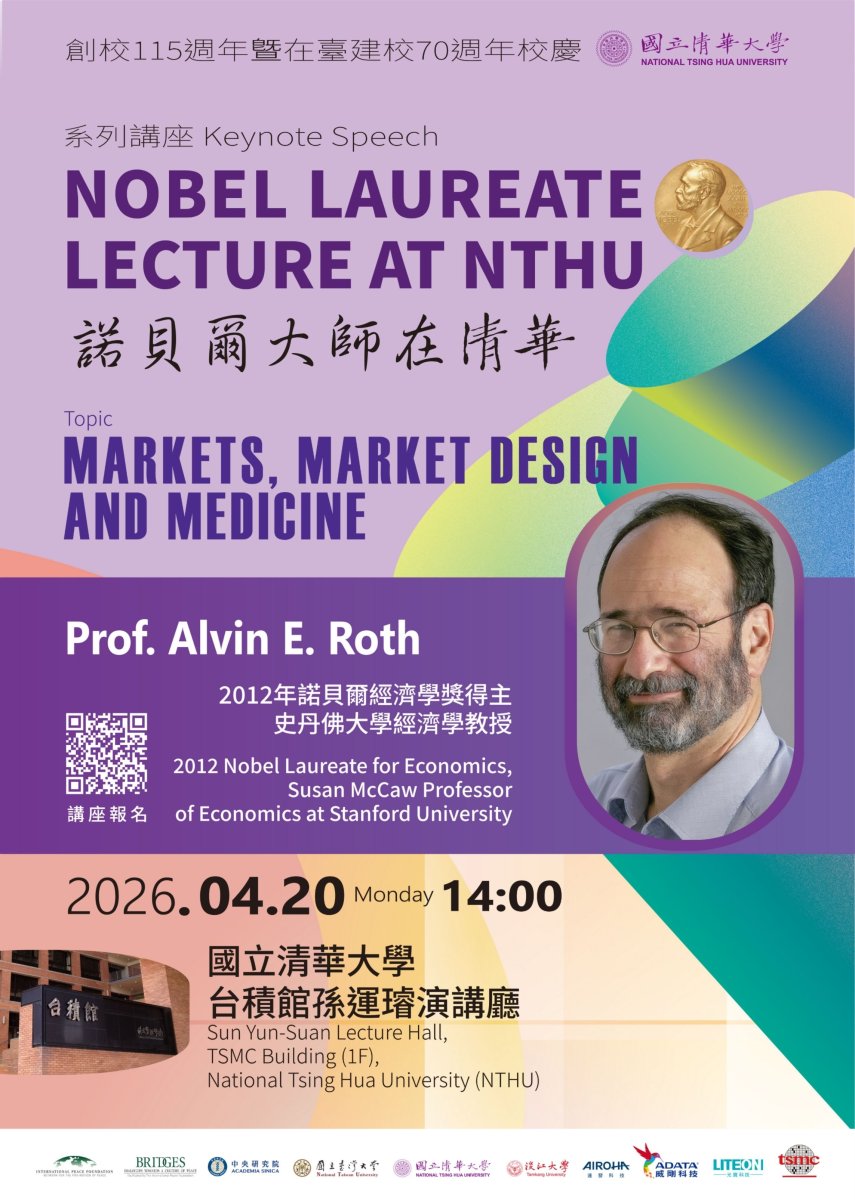
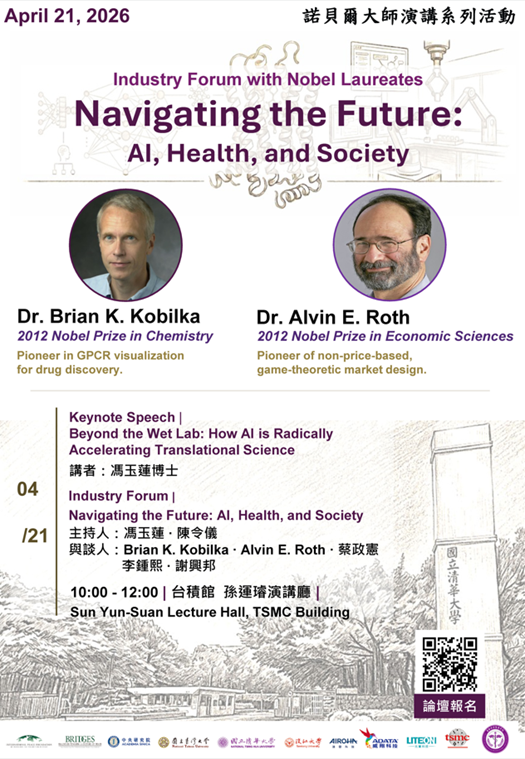
Market Design and Medicine, in Taiwan (public lectures at National Tsing Hua University)

I'll be in Taiwan for some talks on Monday and Tuesday at National Tsing Hua University

NTHU Nobel Laureate Lecture Series: Prof. Alvin E. Roth & Prof. Brian K. Kobilka (April 20–21, 2026)
 

"National Tsing Hua University is honored to host two Nobel Laureates on April 20 (Mon) and April 21 (Tue), 2026. We cordially invite you to join this series of prestigious lectures, forums, and academic exchanges.

Distinguished Speakers:

  • Prof. Alvin E. Roth (Economics, 2012) – Speaker Bio
  • Prof. Brian K. Kobilka (Chemistry, 2012) – Speaker Bio

Event Schedule & Registration

1. Public Lecture by Prof. Alvin E. Roth

  • Topic: Markets, Market Design and Medicine
  • Time: April 20 (Mon), 14:00 – 16:00
  • Venue: Sun Yun-suan Lecture Hall, 1F, TSMC Building
  • Register: Click Here to Register

2. Industry Forum (Prof. Roth & Prof. Kobilka)

  • Topic: Navigating the Future: AI, Health, and Society
  • Time: April 21 (Tue), 10:00 – 12:00
  • Venue: Sun Yun-suan Lecture Hall, 1F, TSMC Building
  • Register: Click Here to Register

3. Discussion Session: Prof. Roth with CTM & TSE Faculty/Students

  • Time: April 21 (Tue), 14:30 – 16:00
  • Venue: Room 901 (AUO Auditorium), 9F, TSMC Building
  • Register: Click Here to Register
 

We look forward to your participation in these insightful academic sessions."


Thursday, April 16, 2026

Frederick Hillier (1936-2026)

 I never took a course from Fred Hillier when I was a PhD student in the Department of Operations Research at Stanford from 1971-73, but as an assistant professor at the University of Illinois from 1974 I taught undergraduate OR from the introductory OR textbook by Hillier and Lieberman.

Here's his Stanford obituary:

Influential textbook author Frederick S. Hillier dies at 89
Hillier’s work shaped operations research theory and practice at Stanford and beyond, with his textbooks introducing the field to generations of learners worldwide.

"Frederick S. Hillier, professor emeritus of operations research in Stanford Engineering’s Department of Management Science and Engineering, passed away on Jan. 9, 2026. He was 89.
...
"Hillier was best known for co-authoring Introduction to Operations Research, first published in 1967. “His textbook played a major role in defining what operations research is,” said Peter W. Glynn, professor of management science and engineering at Stanford. “It helped people in adjacent fields understand what the field is and how it works.” 

...

"When he arrived at Stanford, Hillier was assigned Gerald J. Lieberman as his freshman adviser. Lieberman introduced Hillier to the emerging field of operations research and became Hillier’s undergraduate mentor, doctoral advisor, department chair, and eventually his co-author.

...

"Following Lieberman’s encouragement, Hillier stayed at Stanford for graduate school. He earned an MS in statistics in 1959 and a PhD in operations research in 1961. He joined the Stanford faculty as an assistant professor in the Department of Industrial Engineering that same year.

...

"Hillier retired in 1996 and continued revising his textbooks into his late 80s. The 11th edition of Introduction to Operations Research was published in 2020, and he completed the manuscript for the 12th edition in 2023." 

Wednesday, April 15, 2026

Unraveling in law clerk recruitment, along political lines

 "What's past is prologue:" law clerkships are unraveling yet again, with conservative judges defecting first.

The Harvard Crimson has the story:

Conservative Judges’ Early Hiring Fuels Two-Track Clerkship System at Harvard Law  By Sierra R. Pape and Uy B. Pham

"Federal judges — particularly those aligned with the conservative legal movement — are increasingly recruiting Harvard Law School students during their first year, accelerating a clerkship hiring process that has traditionally taken place much later in law school.

While most judges continue to follow the “on-plan” timeline, where applications open during the summer after students’ second year, a growing number — disproportionately conservative and often affiliated with the conservative Federalist Society for Law and Public Policy Studies — are hiring months earlier through informal networks.

The shift is a sign of a dual system of clerkship hiring at HLS: one track that is formal, application-based, and largely followed by students applying to work with liberal judges, and another that is earlier, network-driven, and dominated by conservative pipelines."

 HT: Martha Gershun

##############

Here's an earlier post on the same divide among judges:

Monday, September 28, 2020

Judicial clerkships in the time of coronavirus--uneven compliance with the pilot hiring plan, and post-clerkship connections

 An article in the UC Davis Law Review Online discusses the hiring of law clerks by U.S. judges, during the current pandemic,  with reference to the  Federal Law Clerk Hiring (Pilot) Plan which is in its second year this year. (The plan calls for judges to delay hiring second year law students until June, and to leave offers open for at least 48 hours.)

The Federal Law Clerk Hiring Pilot and the Coronavirus Pandemic  by Carl Tobias, UC Davis Law Review Online, 2020,54, 1-20.

The article says that compliance with the plan is uneven, but that "numerous jurists who support the nascent pilot are Democratic Presidents' confirmees ... while copious judges who seem to oppose the pilot  in turn are GOP chief executives' appointees..." (p9).


Monday, April 13, 2026

Complex tragedy in a headline: Israeli Court Lets Parents of Gaza Hostage Killed by IDF Fire to Use Son's Sperm for IVF

 Rarely does a headline capture so much of a complicated tragedy.  Read it at least twice.

From Haaretz: 

Israeli Court Lets Parents of Gaza Hostage Killed by IDF Fire to Use Son's Sperm for IVF 

"An Israeli family court has allowed the parents of Yotam Haim, who was mistakenly killed by Israeli troops after escaping Hamas captivity, to use his sperm posthumously for in vitro fertilization, citing his presumed wish to have children even after his death. "

#######

This is a story that also involves the modern technology that can be brought to bear on human reproduction, including not only sperm donation and IVF, but also perhaps egg donation and surrogacy. 

Sunday, April 12, 2026

First box of books

Moral Economics won't be for sale until May 12, but the supply chain is stirring: my publisher sent me a box of finished copies.


Saturday, April 11, 2026

Trust and medicine: Marcella Alsan on Econ to Go

 One of the big lessons of market design is that markets need social support to work well. That applies with particular force to the market for medical care, which (for its sins) isn't universally trusted.  Neale Mahoney interviews my remarkable colleague Marcella Alsan about her work, starting with her QJE paper on the downstream consequences of the infamous Tuskegee experiment:

Alsan, Marcella, and Marianne Wanamaker. "Tuskegee and the health of black men." The quarterly journal of economics 133, no. 1 (2018): 407-455.


And here's the Econ to Go podcast: 


"In this episode of Econ To Go, Neale Mahoney sits down with Stanford physician-economist and MacArthur Fellow Marcella Alsan to explore how trust and representation shape the U.S. health care system. Her research shows that historical events like the Tuskegee Syphilis Study continue to affect healthcare use and health outcomes today, and that trust isn’t abstract, it’s measurable. The conversation also highlights how trust can be built, how under-representation in clinical trials can influence both physician behavior and patient trust, and other key themes, including:

(01:33) The mistrust problem
(06:50) Representation as remedy 
(12:18) Clinical trials and trust in data 
(24:04) Eroding trust across the system"