Showing posts sorted by date for query China AND organ. Sort by relevance Show all posts

Monday, June 5, 2017

More from the Festival of Economics Trento

I'm back home, after two exciting days in Trento (and two long days of travel). There are a bunch of videos, and some press coverage, for those of you who speak Italian or like to use Google Translate.

You can hear the videos in English if you click on the URL, then start the video by clicking on the arrow in the middle of the screen, and then clicking on the gear icon in the lower right hand corner to select English. (It isn't enough to just click on the English symbol in the upper right...)

Here's a 1 minute video in English, a sort of trailer for my talk on global kidney exchange:

*********

Here's a link to the full video of my first talk, on global kidney exchange.
Mercato e disuguaglianze nella salute

The questions and answer period begins at minute 44, with a question by the eminent transplant nephrologist Giuseppe Remuzzi about his concern (which he mentions is also Frank Delmonico's) that the Philippines and Mexico, where Global Kidney Exchange has begun, are places where there is not only transplant infrastructure, but also illegal, black market organ trafficking.  He ends by saying that he remains to be (but hopes to be) convinced that GKE is a good idea.
My answer begins at minute 46:40.
I replied in part "One reason people get kidneys in illegal black markets is that they don't have better opportunities.  We would like to provide them with a better opportunity..."


Here's a video of the panel on my book: Matchmaking. La scienza economica del dare a ciascuno il suo  Play Video  It begins with a talk about the book, by Professor Dino Gerardi.  Afterwards I spoke in reply to questions from the moderator and the audience, and you can hear me in Italian translation.


And here's the panel on markets for organs "exploitation or opportunity?" also in Italian:
Mercati per il corpo umano: sfruttamento o opportunità?
I very much enjoyed meeting Ignazio Marino, the transplant surgeon who was for a time Mayor of Rome.

Below are some news reports on these sessions
*********
Here's a news story right after my talk on global kidney exchange, which was introduced by Tito Boeri:
"Il sistema delle catene" per donare gli organi
Al Teatro Sociale il Nobel Roth descrive il suo progetto per incrociare pazienti e donatori di Paesi ricchi e poveri
G-translate: "The Chain" system for organ donation
Al Teatro Sociale Nobel Roth describes his project to meet patients and donors of rich and poor countries

and here:
Dai modelli matematici si possono salvare molte vite umane. Il Premio Nobel Alvin Roth a Trento
"From the mathematical models you can save lives. The Nobel Prize Alvin Roth in Trento
We die because we can not afford a transplant. Roth: "Our program intends to solve the problem by crossing supply and demand"
**************
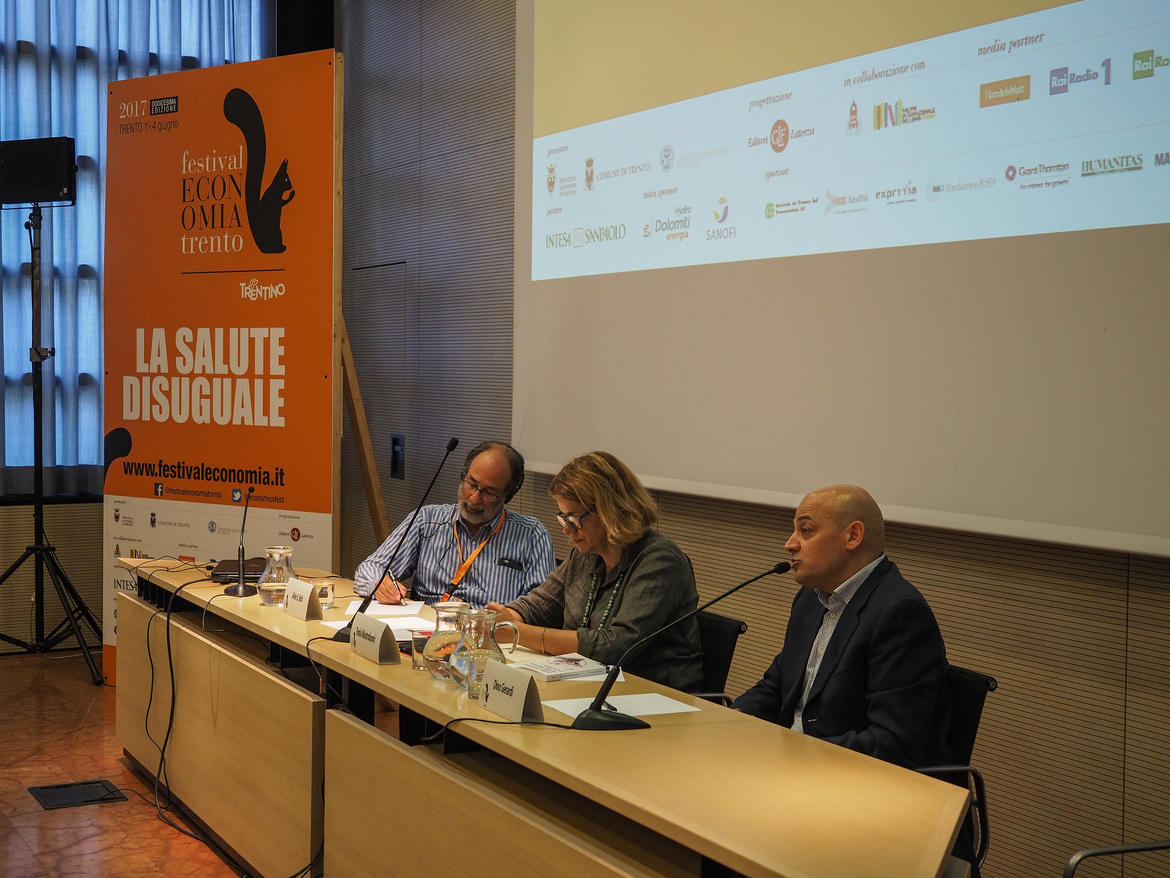
Here's a story covering my "book talk," in which Prof Dino Gerardi talked about the Italian translation of Who Gets What and Why, and I answered questions:
Matchmaking. La scienza economica del dare a ciascuno il suo

*************
Here's a story about the panel discussion on markets for body parts, moderated by Mario Macis, with Nico Lacetera, me, and Ignazio Marino, the transplant surgeon who was  mayor of Rome:
Mercati per il corpo umano: sfruttamenti o opportunità
Il premio Nobel Roth ha dialogato con l'ex sindaco di Roma (e chirurgo) Marino su trapianti e denaro

************
Here's a pre-festival story:
Oggi alle 16 l'inaugurazione al Palazzo della Provincia. Alle 18 al teatro Sociale l'apertura è affidata al Nobel Alvin Roth. Da domani anche la nostra emittente sarà in piazza S.Maria Maggiore 
Festival dell'economia, su il sipario


And here are two article from the Italian Jewish press:
Festival Economia – Pagine Ebraiche
Salute diseguale, in cerca di una cura
Pubblicato in Attualità il ‍‍30/05/2017 - 5

Il Nobel Alvin Roth a Pagine Ebraiche
“L’economia può riparare il mondo”

************
Updates:

Business Insider Italia has an interview with Ignazio Marino:
Ignazio Marino: “Il mercato nero dei trapianti si può mettere all’angolo salvando molte vite”
(Google translate doesn't seem to do a good job turning it into English, but the very last sentence is
"Quello che ci ha mostrato Roth è un sistema trasparente e può togliere ossigeno ai trafficanti”.
GT renders that as 'What showed us Roth is a transparent system and can remove oxygen to "traffickers.'


Here's a story with an inflammatory headline but a reasonable account, as near as I can tell from Google Translate:
L'economista che vuole legalizzare il traffico d'organi per salvare ricchi (e poveri) del mondo
"The economist who wants to legalize organ trafficking to save the rich (and poor) in the world
"In the US there are 100 thousand people on the waiting list for a kidney transplant but only 12 thousand a year. In the Philippines you do not pay you dialysis. In China they were using executed prisoners as donors. The organs of the problem is global and the Nobel Alvin Roth has the answer (maybe): scambiamoceli among us"
by Francesco Floris, June 7, 2017 

Friday, February 17, 2017

Vatican statement on organ transplantation

When I posted recently about the Vatican conference on organ trafficking and transplant tourism I focused on the participation of China, and the reaction it drew.

Now I've had a closer second look at the conference statement  (whose title is Statement of the Pontifical Academy of Sciences Summit on Organ Trafficking and Transplant Tourism). (UPDATED LINK HERE: https://www.pas.va/en/events/2017/organ_trafficking/final_statement.html )

It's a very tough statement, which casts quite a broad net when talking about "crimes against humanity." Here's the opening paragraph:

"In accordance with the Resolutions of the United Nations and the World Health Assembly, the 2015 Vatican Summit of Mayors from the major cities of the world, the 2014 Joint Declaration of faith leaders against modern slavery, and the Magisterium of Pope Francis, who in June 2016, at the Judges’ Summit on Human Trafficking and Organized Crime, stated that organ trafficking and human trafficking for the purpose of organ removal are “true crimes against humanity [that] need to be recognized as such by all religious, political and social leaders, and by national and international legislation,” we, the undersigned participants of the Pontifical Academy of Sciences Summit on Organ Trafficking, resolve to combat these crimes against humanity through comprehensive efforts that involve all stakeholders around the world."

Here's the paragraph defining what those crimes against humanity are, which to my eye seems to conflate three very different things. It is number 1 in their list of recommendations.

"That all nations and all cultures recognize human trafficking for the purpose of organ removal and organ trafficking, which include the use of organs from executed prisoners and payments to donors or the next of kin of deceased donors, as crimes that should be condemned worldwide and legally prosecuted at the national and international level."

That is, if I read the full statement correctly (you should read it yourself), they are proposing that 

  1. taking organs from executed prisoners, 
  2. making payments to living donors, and 
  3. making payments to next of kin of deceased donors 

should all be considered crimes against humanity.  

Incidentally, the phrase "crimes against humanity"  is one that I hear most often in the context of genocide, although I recognize that it is also used for other horrific crimes that target populations.

I am not encouraged that this will lead to a sensible discussion about either incentives for donation or (even) removing financial disincentives.

Friday, February 10, 2017

Vatican conference on organ trafficking and transplant tourism

A recent meeting at the Pontifical Academy of Sciences of the Vatican:
Summit on Organ Trafficking and Transplant Tourism resulted in a statement and a number of news stories.  Here are several that caught my eye, with divergent views on the situation in China and how it is changing:

From the NY Times: Debate Flares Over China’s Inclusion at Vatican Organ Trafficking Meeting
"China has admitted that it extracted organs from death row prisoners for decades, in what critics have called a serious violation of the rights of inmates who cannot give genuine consent. Since Jan. 1, 2015, Chinese officials have said they no longer use prisoners’ organs, though doubts persist.

“We urge the summit to consider the plight of incarcerated prisoners in China who are treated as expendable human organ banks,” wrote the 11 signatories, who included Wendy Rogers of Macquarie University in Australia; Arthur Caplan of the New York University Langone Medical Center; David Matas and David Kilgour, both Canadian human rights lawyers; and Enver Tohti, a former surgeon from the western Chinese region of Xinjiang."
*********


From Statnews.com
China moves to stop taking organs from prisoners, WHO says
"The World Health Organization says China has taken steps to end its once-widespread practice of harvesting organs from executed prisoners but that it’s impossible to know what is happening across the entire country.

At a Vatican conference on organ trafficking this week, a former top Chinese official said the country had stopped its unethical program, but critics remain unconvinced.

In an interview Thursday, WHO’s Jose Ramon Nunez Pena said he personally visited about 20 hospitals in China last year and believes the country has reformed. But he acknowledged that it was still possible “there may still be hidden things going on.” China has more than 1 million medical centers, although only 169 are authorized to do transplants.

Nunez Pena said he had seen data including organ transplant registries and was convinced the country was now shifting away from illegally harvesting organs.

“What is clear to me is that they’re changing,” he said. “But in a country as huge as China, we can’t know everything.”
...
"Campbell Fraser, an organ trafficking researcher at Griffith University in Australia, agreed the trends over the past few years have shown a drop in the number of foreigners going to China for transplants and an increase of organ seekers heading to the Middle East.

At a press conference at the Chinese Embassy in Italy following the two-day Vatican organ conference, Fraser said migrants — including Syrians, Somalis and Eritreans — sometimes resort to selling off a kidney to pay traffickers to get them or their families to Europe.

“Egypt is where the biggest problem is at the moment,” he said, adding that it has the best medical facilities in the region and can perform the live donor surgeries.

He estimated as many as 10 such illicit transplants could be happening per week, though he had no statistics and said he based his research largely on anecdotal information from recipients, law enforcement, doctors and even some organ “brokers.”

Fraser said he has access to transplant patient “chat boards” because he himself had a kidney transplant in his native Australia in 2003.

Nunez Pena said it was likely that organ trafficking would find its way to conflict-plagued regions.

“We’re hearing about a lot of problems in Egypt, Pakistan and the Philippines,” he said, predicting that authorities were poised to break up an organ smuggling ring in Egypt in the next few weeks. “Wherever you have vulnerable people, you will see these kinds of problems.”

*****************


From Science:

Study retraction reignites concern over China’s possible use of prisoner organs

A journal has decided to retract a 2016 study because of concerns that its data on the safety of liver transplantation involved organs sourced from executed prisoners in China. The action, taken despite a denial by the study’s authors that such organs were used, comes after clinical ethicist Wendy Rogers of Macquarie University in Sydney, Australia, and colleagues authored a letter to the editor of Liver International on 30 January, calling for the paper’s retraction in the “absence of credible evidence of ethical sourcing of organs.”
For years, Chinese officials have come under fire for allegedly allowing the use of organs from executed prisoners for transplants, including for foreigners coming to the country for so-called medical tourism. In January 2015, it explicitly banned the practice and set up a volunteer donation system, but doubts persist that much has changed.
The disputed study—published online in October 2016—analyzed 563 consecutive liver transplantations performed before the ban (from April 2010 to October 2014) at a medical center in China. Suspicious, Rogers organized the protest letter to the journal. “Publication of data from prisoners is ethically inappropriate given that it [is] not possible to ensure that the prisoners freely agreed either to donate their organs, or to be included [in] a research program,” she tells ScienceInsider.

Friday, October 21, 2016

China, transplants, and executed prisoners: is the situation getting clearer?

A recent meeting in China cautiously suggests that there may be some concrete change in the practice of transplanting organs from executed prisoners:
Doctors hail China’s pledge to stop harvesting inmate organs

"Doctors from the World Health Organization and the Montreal-based Transplantation Society who were invited to the conference by China praised Chinese officials for reforms they have made in the transplant system, including a ban put in place last year on using organs from executed inmates.

"Doubts persist that China is accurately reporting figures or meeting its pledge given its severe shortage of organ donors and China’s long-standing black-market organ trade. By its own figures, China has one of the lowest rates of organ donation in the world, and even the system’s advocates say it needs hundreds of additional hospitals and doctors.

"While China suppresses most discussions about human rights, government officials and state media have publicly talked about their commitment to ending a practice opposed by doctors and human rights groups due to fears that it promotes executions and coercion.
...
"Others offered praise for Chinese officials, but stopped short of saying whether they could confirm China had stopped using executed inmates’ organs.

“It’s not a matter for us to prove to you that it’s zero,” said Dr. Francis Delmonico, a longtime surgeon and a professor at Harvard Medical School. “It’s a matter for the government to fulfill what is the law, just as it is in the other countries of the world that we go to.”

"China is believed to perform more executions than any other country, though the government does not disclose how many.

"The former vice minister of health, Dr. Huang Jiefu, publicly acknowledged in 2005 that China harvested executed inmates’ organs for transplant, and a paper he coauthored six years later reported that as many as 90 percent of Chinese transplant surgeries using organs from dead people came from those put to death.

"Huang has also responded to a report earlier this year that a Canadian patient apparently received a kidney from an executed inmate by announcing that the doctor and the hospital in question were suspended from performing more transplants."


Thursday, August 18, 2016

Transplant surgeons meet in Hong Kong amid questions about China's continued use of organs from executed prisoners

The NY Times has the story: Debate Flares on China’s Use of Prisoners’ Organs as Experts Meet in Hong Kong

It discusses a recent article in the American Journal of Transplantation:
Transplant Medicine in China: Need for Transparency and International Scrutiny Remains by T. Trey, A. Sharif, A. Schwarz, M. Fiatarone Singh, and J. Lavee

Here's the abstract of the article:
"Previous publications have described unethical organ procurement procedures in the People's Republic of China. International awareness and condemnation contributed to the announcement abolishing the procurement of organs from executed prisoners starting from January 2015. Eighteen months after the announcement, and aligned with the upcoming International Congress of the Transplantation Society in Hong Kong, this paper revisits the topic and discusses whether the declared reform has indeed been implemented. It is noticeable that China has neither addressed nor included in the reform a pledge to end the procurement of organs from prisoners of conscience, nor have they initiated any legislative amendments. Recent reports have discussed an implausible discrepancy of officially reported steady annual transplant numbers and a steep expansion of the transplant infrastructure in China. This paper expresses the viewpoint that, in the current context, it is not possible to verify the veracity of the announced changes and it thus remains premature to include China as an ethical partner in the international transplant community. Until we have independent and objective evidence of a complete cessation of unethical organ procurement from prisoners, the medical community has a professional responsibility to maintain the academic embargo on Chinese transplant professionals."
************

The NY Times story includes this:
"In an interview conducted on the messaging app WeChat, Huang Jiefu, a senior Chinese transplant official and a former deputy minister of health, appeared to defend the changes but simultaneously acknowledge they were far from perfect.

“We have finished walking the first step of a long march of 10,000 li, the task is heavy and the road far, but we are walking on a path of light,” he wrote. "

Monday, July 11, 2016

The U.S. House of Representatives expresses concerns about organ transplants in China

The House of Representatives has passed a resolution of concern:

Summary: H.Res.343 — 114th Congress (2015-2016)All Bill Information (Except Text)

Saturday, December 19, 2015

Voluntary deceased organ donation in China

It's always hard to parse the Chinese organ data, and know what is going on in the military hospitals, but here's an encouraging story

Chinese Organ Donation on the Rise
   2015-12-06 21:11:39    Xinhua      Web Editor: Guan Chao

"Chinese organ donation has been on the rise after the country banned the use of prisoners' organs for transplant starting Jan. 1 this year, a top medical expert said Sunday.

As of Nov. 9, China has recorded 5,384 voluntary organ donors, who donated 14,721 various organs, said Huang Jiefu, head of a national human organ donation and transplant committee and former vice health minister.

China is expected to top the world in terms of organ donation in several years, said Huang at a forum in the central city of Changsha.

"As long as the donation system is transparent, most of citizens will be willing to join the program," he said.

The shortage of qualified transplant doctors is a major bottleneck. There are only 169 hospitals across the country eligible for organ transplant, with some 100 doctors able to do the operation, said Huang.

Huang called for speedy training of medical talent and expanding the number of hospitals eligible for organ transplant to 300 and the number of doctors to 400 to meet the public demand.

China began a voluntary organ donation trial in 2010 and promoted the practice across the country in 2013. Now, it tops Asia in the number of organ donations."

Wednesday, July 15, 2015

Taiwan moves to criminalize transplant tourism to China


Taiwan Shuts Down Organ Transplant Tourism, By Jenny Li, Epoch Times |

"Taiwan’s Parliament has made amendments to its organ transplantation law that would have the effect of criminalizing the transplantation of organs from executed prisoners in China, part of a global trend to halt thetrafficking of human organs in China.


In a June 12 session in Taiwan’s Legislative Yuan, a number of important amendments to the Human Organ Transplant Ordinance were read and passed as law.
Under the updated legislation, patients who travel abroad to receive an organ acquired by illegal means can be sentenced up to five years in jail and face fines from $NT300,000 (about $9,700) up to $NT15,000,000 (about $484,000).
The new amendments place some of the responsibility of regulation on doctors and hospitals. Doctors must file a report for any patient who receives a transplant overseas and carries out follow-up treatment in the country. Both doctors and hospitals are subjected to fines of up to $NT150,000 (about $4,840) if they fail to submit reports. Medical institutions and staff will incur criminal charges for filing false reports."

Friday, April 3, 2015

In defense of pilot studies for organ donor incentives

The third in the series of forthcoming AJT papers about incentives/disincentives for donation discusses the basis for pilot studies (see earlier posts 1 and 2)

Between Scylla and Charybdis: Charting an Ethical Course for Research Into Financial Incentives for Living Kidney Donation
J. S. Fisher1, Z. Butt, J. Friedewald, S. Fry-Revere, J. Hanneman, M. L. Henderson, K. Ladin, H. Mysel, L. Preczewski, L. A. Sherman, C. Thiessen andE. J. Gordon*
Article first published online: 31 MAR 2015
DOI: 10.1111/ajt.13234

"The transplant community appears to be in a state of equipoise regarding the ethical soundness of empirically investigating a regulated system of financial incentives for living kidney donation. ...Proponents of financial incentives for nondirected living donors posit that incentives would increase the supply of high quality organs, prolong quantity, improve quality of life of recipients, and offset the societal cost by reducing the patient population receiving dialysis [10, 11]. Opponents argue that financial compensation beyond recovering expenses would: (1) cause undue pressure to donate, (2) exploit at-risk individuals (such as the poor), (3) commodify the human body, (4) exacerbate disparities in access to transplants between different socioeconomic strata, and (5) negatively impact public opinion and potentially lead to decreased organ donation rates [12, 13]. However, the debate over the intended and unintended effects of a federally regulated system of financial incentives in the United States remains unresolved partly due to a lack of empirical data.

Critics commonly turn to national programs outside the United States (e.g. India, China, Philippines, Eastern Europe) where black market incentives are the rule to justify concerns that financial incentives are exploitative of living donors. We do not disagree that paying donors illegally is exploitive. Other countries like Israel, Saudi Arabia, Iran, Singapore, and Ireland, however, have implemented legal compensation policies that assist living kidney donors to varying degrees and with varying success. However, these programs developed organically without extensive transparency or oversight, rather than as part of a prospective study designed with embedded outcome measures. Thus, it is unclear whether the successes of such policies are translatable to the US context given the differences in our governmental, medical, and societal infrastructures. Until rigorous, relevant data are properly collected, there is no way to determine whether concerns are warranted about potentially adverse effects of financial incentives on patient safety, exploitation, autonomy, and public trust as part of a US federally regulated system.

Members from several academic and professional organizations have called for pilot studies to investigate the provision of financial incentives to eligible living kidney donors to increase donation rates [14-17]. Logistical parameters for such studies have been suggested [18, 19]. However, while proposals for pilot studies commonly advance arguments for financial incentives, they have not systematically addressed the ethical concerns raised by opponents of a pilot study. This paper provides an ethical justification for conducting a pilot trial to study the feasibility and impact of a federally regulated system utilizing financial incentives on living kidney donation rates.''
...
in conclusion...
"the first step to resolve equipoise will require one or more carefully designed pilot studies to assess individual perceptions to determine if a course can be charted between exploitation and undue influence. Only such pilot studies can inform the transplant community as to whether larger, randomized controlled trials may be ethically undertaken to determine if ultimately, a federally regulated financial incentives program could feasibly and effectively increase living kidney donation rates without living donors incurring perceptions of negative psychological experience or generating negative public reaction.

Thursday, January 29, 2015

New reports that China to stop harvesting executed prisoners' organs

But no word on how they propose to manage the transition from executed prisoners to developing a voluntary source of donated organs for transplant.

Here's a BBC story: China to stop harvesting executed prisoners' organs

China has promised to stop harvesting organs from executed prisoners by 1 January, state media report.
It has said for many years that it will end the controversial practice. It previously promised to do so by November last year.
Death row inmates have long served as a key source for transplants.
China has been criticised for taking their organs without consent, but has struggled to encourage voluntary donations due to cultural concerns.
Prisoners used to account for two-thirds of transplant organs, based on previous estimates from state media.
For years, China denied that it used organs from executed prisoners and only admitted to the practice a few years ago.
The Chinese authorities put more prisoners to death every year than the rest of the world combined - an estimated 2,400 people in 2013 - according to the San Francisco-based prisoners' rights organisation, Dui Hua.
'Fair, just and transparent'
State media reported on Thursday that the head of the country's organ donation committee Huang Jiefu said that by 1 January 2015, only voluntarily donated organs from civilians can be used in transplants.
So far 38 organ transplant centres around the country, including those in Beijing, Guangdong and Zhejiang, have already stopped using prisoners' organs, according to reports.
Dr Huang, who was addressing a seminar, said that every year about 300,000 people in China need transplanted organs, but only 10,000 operations are carried out.
Grey line
Analysis: Celia Hatton, BBC News, Beijing
It's taken years for the Chinese authorities to end their own practice of harvesting organs from executed prisoners.
In 2006, Dr Huang admitted China must reduce its reliance on prisoners' organs. He repeated that again in 2009, when announcing the establishment of a national organ donation network. And finally, in 2012, Dr Huang surfaced in Chinese state media once more with a promise to end all prisoners' donations within a few years.
Why did it take so long? Thousands of people are on China's transplant waiting list in desperate need of organs, with no clear solution in sight. Attempts to address the need, by encouraging public organ donations, have faltered.
But many in China believe that bodies should remain intact after death. China's also home to a thriving illegal trade in body parts, making would-be donors nervous they will contribute to a wider problem.
A 2012 poll conducted in the southern city of Guangzhou revealed that 79% of respondents believed organ donation was "noble". However, 81% were concerned the donations "inevitably feed the organ trade."
Clearly, Chinese health officials have a lot of work to do to change public perceptions.
Grey line
With a donation rate of only 0.6 per 1 million people, China has one of the world's lowest levels of organ donation. Dr Huang compared it to Spain, which has a rate of 37 per 1 million.
"Besides traditional beliefs, one of the major roadblocks to the development of our organ donation industry is that people are concerned that organ donation will be fair, just and transparent," he was quoted as saying.
Dr Huang, who used to be the vice minister for health, had last year pledged to phase out prisoner organ transplants by the end of 2013.
Amnesty International's William Nee told the BBC that halting prisoner organ transplants would be "a positive step forward in China's human rights record", although some challenges remain.
"It will be worth seeing not only how effective a new voluntary organ donation system is, but it will also be crucial that the government becomes fully transparent about the number of people sentenced to death, the number of executions per year, and how the executions are carried out," he said.

More on This Story

Related Stories

Tuesday, August 19, 2014

Kidney brokers

Costa Rica cracks down on commercial sales of kidneys, some involving patients and brokers from Israel: The New York Times has the story.
Transplant Brokers in Israel Lure Desperate Kidney Patients to Costa Rica
By KEVIN SACK  AUG. 17, 2014

"Some physicians and ethicists question the relative morality of allowing thousands to die just because the means of saving them is considered repugnant. A regulated marketplace, they say, could all but eliminate the shortage. It is no accident, they argue, that the only country that allows compensation for donors — Iran — effectively has no waiting list.
Experts list China, Egypt, India, Pakistan, Sri Lanka, Turkey, Eastern Europe and the former Soviet republics as hot spots for organ trafficking. But illicit transplants usually go undetected unless there is a surgical mistake or a payment dispute. Prosecutions are thwarted by false affidavits, toothless laws and lack of international cooperation, particularly regarding extradition.
Over the last decade, the authorities have pursued only a handful of cases worldwide. Few have sidelined the brokers, who seem bolder than ever. Some, like Mr. Volfman, who leases office space atop a mirrored skyscraper in Ramat Gan, have moved out of the shadows. They brazenly ply their trade even while under police scrutiny, posting Facebook photos of the luxury cars and five-star hotel rooms they rent on the road.
The Times found that brokers in recent years typically have charged clients $100,000 to $200,000 to cover expenses associated with a transplant. As with other scarce luxuries, pricing can be elastic."

Sunday, June 1, 2014

Black markets for kidney transplants

miscellaneous black market links I've been collecting, of different vintages:

Nancy Scheper-Hughes in the New Internationalist magazine, May 2014: Human traffic: exposing the brutal organ trade

Arabianbusiness.com reports, April 2014: 410 Saudis said to buy organs on black market
"As many as 410 Saudis have bought organs – mainly kidneys – from the black market for illegal transplantations over the past two years, Makkah daily reported.
Dr Faisal Shaheen, director of the Saudi Center for Organ Transplants, was quoted as saying: “A total of 220 Saudis bought organs for transplants from markets in Pakistan, China and Egypt in 2013 and 190 did the same in 2012 at their own personal expense.”

CNN, March 2014: Lebanese mayor arrested in Spain, accused of attempted organ trafficking
"A wealthy mayor from Lebanon has been arrested in Spain for allegedly offering to pay $55,000 to poor people to obtain liver tissue for his liver transplant, police and a government official announced Wednesday.
...
"The mayor's alleged accomplices recruited and later paid for nine poor people -- eight immigrants and a Spaniard -- to have specialized liver compatibility tests at a clinic in Valencia last summer, police say. The combined tests cost $16,000, which the mayor's aides allegedly paid. Some of the nine people also received small sums of money for taking part, police said.
Just one man, a Romanian immigrant, met the medical criteria for the liver tissue removal and, posing as a legitimate donor, he accompanied the Lebanese mayor last summer to a Barcelona clinic that specializes in liver transplants. But medical workers there, following strict protocols against human organ trafficking, prevented it."
(same story here from another source: http://www.thelocal.es/20140312/police-thwart-first-illegal-organ-sale-in-spain )


Frank Delmonico's 2011 slides: WHO Perspective on Self-sufficiency--Accountability on the National Level calling for countries to develop organ donation sufficient to cover their national needs for transplantation.

The Guardian, in Dec 2010 (with various Eastern Europe mentions): The doctor at the heart of Kosovo's organ scandal As Kosovo's prime minister denies links to organ trafficking, 'Doctor Vampire' is the subject of an international manhunt
"Azerbaijan's prosecutor-general's office said last month that an investigation prompted by information from Ukranian police found "citizens of various countries" had been brought into the country for illegal kidney transplants. Four Ukrainian doctors have been arrested in connection with the alleged racket. Azerbaijani press reported that Sonmez was "involved" in the ring, which also did operations in Ecuador. "

AzeriReport.com reports, August 2010, on Illegal Organ Transplant Mafia Exposed
"The group has been disclosed by the Trafficking Prevention Department of the Ukrainian Ministry of Internal Affairs. The trans-national criminal group was involved in illegal transplantation of kidney and it included 12 members. Yurii Kucher, representative of the Ukrainian Ministry of Internal Affairs, said over three years the group has recruited online and transported Ukrainian, Russia, Moldavian, Belarus and Uzbek citizens to Azerbaijan and Ecuador.
...
The Azerbaijan law enforcement agencies are unavailable for comments. It has been established that the operations were performed in a private clinic inBaku. The lawyers claim if the donors sold their kidney voluntarily, this is not a crime and any accusations are groundless. Many people are ready to sell their internal organs to make money.  A few days prior to the arrests in Ukraine, Yeni Musavat, an Azeri newspaper, sent a journalist to an area in downtown Baku where the illegal organ donor recruiters gathered and formed a market. The Yeni Musavat journalist was offered to go to a hospital to negotiate terms for the kidney removal.  In the clinic, the journalist was asked to consider selling part of his liver."


Yosuke Shimazono, "The state of the international organ trade: a provisional picture based on integration of available information, Bulletin of the World Health Organization Volume 85, Number 12, December 2007, 901-980


HT: various correspondents

Wednesday, March 26, 2014

Tuesday, March 25, 2014

Organ transplants and executed prisoners in China

It appears that China's reliance on executed prisoners for transplantable organs is unlikely to end soon, but will be incorporated into what Chinese officials hope will be a more transparent system:

Govt seeks fairness in organ donor system for inmates

Updated: 2014-03-07 07:20

By Shan Juan (China Daily USA)


"China is set to further strengthen the regulation of organ donations from executed prisoners and integrate it into the existing public voluntary organ donation and allocation system, according to a political adviser close to the situation.
Huang Jiefu, director of the China Organ Donation Committee and former vice-minister of health, made the remarks on Tuesday on the sidelines of the ongoing two sessions.
"By doing that, organs from death-row inmates used for life-saving operations are secured in a fair, transparent, and corruption-free manner," he said.
Previously, organ donations from executed prisoners were handled inappropriately by "some doctors and law enforcement officers", which might lead to malpractice and corruption, he said.
To end that, "we will regulate the issue by including voluntary organ donations by executed prisoners in the nation's public organ donation system to help ensure an open and fair practice", he said.
China launched the system in 2010 to make it easier for the public to donate organs and ensure the organs are given based on need rather than the "highest bidders".
As of Sunday, 1,570 organ donations had been facilitated via the system, according to Huang.
Donations from executed prisoners were initially not covered by the system. Zhu Jiye, director of the liver and gallbladder surgical department of Peking University People's Hospital, called for changes to the system, to ensure that death-row inmates are not coerced into donating organs.
"We respect their right to donate, but it must be voluntary and their donated organs should be used fairly," he said.
According to Zhu, transplant surgery using organ donations from death-row inmates has declined in recent years, and there were only two such operations at his hospital last year.
Huang added: "China is gradually moving away from a long-term reliance on executed prisoners as a major source for organ donations."
In November, 38 out of the 165 transplant centers in China signed a declaration vowing to stop using donated organs from executed prisoners, according to Huang.
He expects that procedures that include the procurement and allocation of organs from inmates who have been executed will be integrated into the national system soon.
"We've reached consensus with the legal and law enforcement departments on that," he said.
To ensure that donations are voluntary, written consent from the inmate and the family is required, he said.
Another source who didn't want to be named but is close to the situation said written consent from the executed prisoner's lawyer will be added as well.
Also, only designated organ procurement organizations will be allowed to approach law enforcement departments regarding the issue, Huang said.
Most importantly, "donated organs from executed prisoners will be put into a computerized system to ensure fair allocation", he said.
"Any organ donations, including those by executed prisoners, have to go through the system and the computerized allocation process," he added.
Statistics from the National Health and Family Planning Commission show that about 300,000 Chinese people need organ transplants every year.
However, only around 10,000 eventually receive one.
shanjuan@chinadaily.com.cn"
**************************
HT: Jay Lavee

Here are some earlier posts on organ donation in China.

Saturday, February 1, 2014

Counterproductive incentives in transplantation

Which would be better, to have a transplant center transplant 200 patients and have 150 do well, or to have the center transplant 100 patients and have all of them do well? How about if the 100 patients who didn't receive a transplant in the second scenario would all have died?

In Oregon, The Bend Bulletin has a three part series (pointed out to me by Ben Hippen) on the difficulties of regulating transplant centers, and the sometimes counterproductive incentives that are introduced (in an effort to counteract other bad incentives that hospitals may have).

UPMC, the University of Pittsburgh Medical Center, comes out looking very good, incidentally.


Patients denied transplants as donor organs are discarded
PART 1: Centers forced to focus on benchmarks rather than patients
By Markian Hawryluk

"Patients who need organ transplants are dying even while viable organs are being thrown out, as government regulations have forced transplant centers to focus on overall survival rates instead of the well-being of individual patients.

"The rules implemented by the Medicare program, which pays for the vast majority of organ transplants in the U.S., evaluate transplant centers based on the one-year patient and organ survival rates after transplant. Centers that fall below benchmarks could be shut down or forced into a lengthy and expensive remedial process.

That has prompted many centers to choose healthier patients and higher quality organs to transplant. High-risk patients that could pull down a center’s overall survival rate are often unable to get on the transplant list, or end up dying on the waiting list as centers pass on marginal but still usable kidneys, livers and lungs. And the decades-long growth in the number of transplants performed in the U.S. has plateaued since the regulations were implemented.

“The side effect has been to turn people risk averse,” said Dr. Dorry Segev, a transplant surgeon at Johns Hopkins Medical Center, “to the point where patients who would benefit from transplant are being denied transplants, and to the point where organs that are beneficial to patients are discarded.”

The regulations have caused centers to take a hard look at their quality-improvement mechanisms and how they evaluate patients and organs for transplant.

Programs became acutely aware of their survival rates, which began to climb after the rules went in effect in 2007.

The percentage of hearts still beating one year after transplant hit an all-time high of 91 percent in 2010, up from 88 percent in 2003; 85 percent of transplant lungs were still breathing, up from 80 percent in 2003. Deceased donor kidney transplants have achieved an astonishing 93 percent success rate.

"Transplant surgeons routinely credit the regulations with strengthening the transplant system and for the most part, improving the quality of care for transplant patients.

“There is no question we have a healthier system and a more monitored system than we did before these regs came out,” said Dr. Michael Abecassis, director of the transplant center at Northwestern University in Chicago.

The unintended consequence, he said, is that centers are “cherry-picking” their patients.

“Patients might die and not get transplanted even though they may have an 80 percent chance of survival,” Abecassis said. “If the target is 90 percent, or you’re going to get flagged, you may look at 80 and say, ‘I’m not going to do that.’ Well, if you’re the patient, it’s 80 versus zero. Then 80 is pretty good.”

 ...
"Before the regulations went into effect, the number of transplants in the U.S. had grown each year. But in 2007, the first year centers were being held to the survival benchmarks, the number of transplants dropped and has remained flat ever since."
****************

Transplant centers pull back to avoid sanctions
PART 2: High-risk patients can put programs in jeopardy

"The new regulations, known as the Medicare Conditions of Participation, or COPs, were finalized in 2005 after a series of highly public transplant scandals. Reports of wait-list irregularities, diversions of organs and major medical errors spurred CMS officials to step in and establish regulations for what primarily had been a self-regulated field.

"CMS, the largest purchaser of transplants in the world (with the possible exception of China), adopted metrics originally developed by the transplant industry itself. Years earlier, the United Network for Organ Sharing’s Organ Procurement and Transplant Network had set up a flagging system to help identify and improve programs with subpar results.

But while that flagging system relied on peer review and public disclosure, the CMS regulations threaten to shut down centers that don’t improve.

Centers whose number of patient deaths or organ failures exceed 150 percent of what would be expected for their mix of patients are flagged. Multiple flags within a 21⁄2-year period trigger CMS action.

Centers then have 210 days in which to explain the mitigating factors that led to their low survival rates. If programs can improve by the end of that period, they are allowed to continue operating as usual. In other cases, CMS will acknowledge the mitigating circumstances and grant exceptions.

The centers that can’t improve quickly or convince CMS to grant an exception are given three options: shut down voluntarily, shut down involuntarily, or enter into a systems improvement agreement, or SIA. Through August 2012, 127 of the nation’s 330 transplant centers were flagged twice and investigated by CMS, including the programs at Hopkins.

*****************

Transplantable organs go to waste
PART 3: Centers feel regulatory pressure to avoid non-ideal organs

"Transplant programs may have to make do with more marginal organs going forward. Ideal organs generally come from young, healthy individuals who incur a traumatic death. Those types of donors are becoming less common, due to gains in highway safety and medical advances that can save accident victims from brain death. A Canadian study released in October found that the percentage of patients with brain injuries who eventually were declared brain dead fell from a high of 9.6 percent in 2004, to 2.2 percent in 2010.

"Donations after brain death accounts for half of kidney transplants, three-quarters of liver transplants, 90 percent of lungs, and all hearts. But that is changing.

"An increasing proportion of organs are coming from patients whose hearts stopped beating before the other organs could be recovered, or from older, sicker donors. Both categories of organs have a lower chance of surviving one year after transplant.

“We are seeing more and more organs sitting in that category of marginal organs,” Alexander said.

"Expanded-criteria donor kidneys (ECD), for example, have an 82 percent one-year survival rate, compared with 90 percent for a standard-criteria kidney. A kidney procured from a brain-dead donor has a 91 percent one-year survival rate, while those recovered from donors after cardiac death (DCD) have an 89 percent rate.

"When patients are listed for transplant, they are usually presented with a menu of organ types, each with different risk profiles, and asked to choose what types of organs they would accept. When organs become available, doctors and transplant coordinators decide whether they are willing to transplant that organ into that patient and whether to pass on that offer to the patient.

"Studies show that in aggregate, transplant candidates who accept ECD kidneys do better over the long run than patients who wait on dialysis for a more ideal kidney. While standard kidneys last an average of 10 years post-transplant, ECD kidneys average five.
...
"Yet marginal and high-risk organs are routinely turned down. An analysis of organ sharing data by surgeons at the University of California, San Francisco, found that 84 percent of patients who died waiting for a liver had received at least one organ offer and an average of six offers. Most were declined by the surgeons due to donor age or quality of organ.

“Wait-list deaths are not simply due to lack of donor organs as many of us assume,” lead author Dr. John Roberts said, citing the stigma of non-ideal livers.

"When surgeons become more selective about marginal organs, it can quickly result in a snowball effect. When an organ becomes available it is offered electronically to centers in the region and across the country. The more centers decline an organ, the more surgeons with patients lower down the list begin to wonder why the organ has been passed on so many times. And with each refusal, the time the organ sits on ice and degrades in quality increases. Kidneys can still be transplanted up to 48 hours after being put on ice, livers less than a day. If no center is willing to take a chance, eventually the organ is simply thrown out.

“Our system is pretty slow,” Roberts said. “It works well for good organs. It doesn’t work that well to get not-so-good organs broadly distributed.”

Monday, November 18, 2013

Ohio execution stay for Ronald Phillips for possible organ donations

This will complicate my discussions in China...

Ohio execution stay for Ronald Phillips for possible organ donations

Ohio's governor delayed the execution of a condemned child killer to consider the inmate's unprecedented organ donation request, acknowledging that it's ''uncharted territory'' but expressing hope that the man might help save a life before losing his own.
Ronald Phillips, 40, was scheduled to be put to death Thursday with a lethal injection of a two-drug combination not yet tried in the U.S., but Gov. John Kasich issued a stay of execution Wednesday. The execution date has been reset for July 2.
"I realize this is a bit of uncharted territory for Ohio, but if another life can be saved by his willingness to donate his organs and tissues then we should allow for that to happen," Kasich said in a statement. He said he wanted to allow time for medical experts to study whether Phillips could donate non-vital organs, such as a kidney, before being executed.
Phillips, who was sentenced for raping and killing a 3-year-old girl in Akron in 1993, asked this week to donate a kidney to his mother and his heart to his sister. His attorney said it was an attempt to do good, not a delay tactic.
Ohio's prison medical policy accommodates organ donations, but prison officials rejected the request, saying it came too late to work out logistics and security concerns.
Kasich said Phillips' crime was heinous but his willingness to donate organs and tissue could save another life and the state should try to accommodate that.
Some 3,500 people in Ohio and more than 120,000 nationally are awaiting organ donations, said Marilyn Pongonis, a spokeswoman for the Lifeline of Ohio organ donation program.
If Phillips is a viable donor for his mother, who has kidney disease and is on dialysis, or for others awaiting live transplants of non-vital organs, the stay would allow time for those procedures to be performed, Kasich said.
Phillips' sister suffers from a heart ailment and he also wants to donate his heart to her.
Richard Dieter, executive director of the Death Penalty Information Center, said a Delaware death row inmate was permitted in 1995 to donate a kidney to his mother while in prison, though he was not facing imminent execution like Phillips.
"This step by the governor puts it into a more normal discussion of (how) an inmate, without any security problems, can help save another person and is that the right thing to do," he said. "With 24 hours to go before an operation had to be carried out, it definitely gets in the way of that process."
Vital organ donations raise larger ethical issues and have not been allowed during U.S. executions but have occurred in China, Deiter said.
Dieter, whose group opposes the death penalty, added: "If the whole idea is to save a life, there's one life to be saved simply by not executing the person at all."
Phillips made his request after the governor denied him mercy and Phillips had exhausted his other legal options. The state had left it up to Phillips' family whether the organs would be harvested after his death.


HT: Bernadette Keller